THE PEOPLE DO NOT YEARN FOR AUTOMATION | Decoder
Decoder with Nilay Patel@DecoderPodTHE PEOPLE DO NOT YEARN FOR AUTOMATION | Decoder
Nilay Patel discusses the software brain mindset that attempts to turn every human experience into a database or algorithm. He explains the growing disconnect between tech leaders excitement for AI and the public's increasing dislike for automation.

- Views
- 88.1K
- Likes
- 4.4K
- Comments
- 404
- Topics
Analysis
Nilay Patel discusses the software brain mindset that attempts to turn every human experience into a database or algorithm. He explains the growing disconnect between tech leaders excitement for AI and the public's increasing dislike for automation.
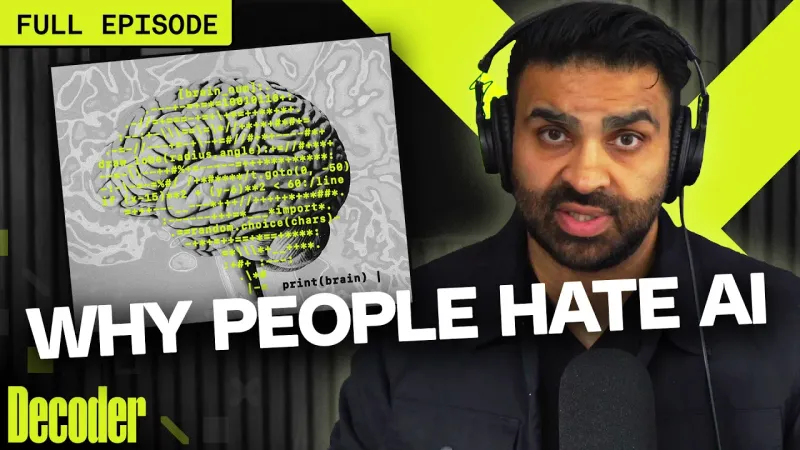
A man with a serious expression and headphones looks directly at the camera next to a brain graphic filled with computer code. The background features a bright yellow 'X' and dark studio walls. Large white text at the bottom reads 'WHY PEOPLE HATE AI'.
Today, I want to lay out an idea that's been banging around my head for weeks been banging around my head for weeks now as we've been reporting on AI I've been calling it software brain and I've been calling it software brain and it's a particular way of seeing the it's a particular way of seeing the world that fits everything into world that fits everything into algorithms and databases and loops. Lately, software thinking has been turbocharged by AI in a way that I think helps explain the enormous gap between how excited the tech industry is about the technology and how much regular people are growing to dislike it. While more than 80% of people were either very concerned or somewhat concerned about the technology, only 35% of people were excited about it.
- 01The Obsession
Start with a personal idea or observation that has been bothering you lately.
OriginalToday, I want to lay out an idea that's been banging around my head for weeks been banging around my head for weeks now as we've been reporting on AI
- 02The Rebrand
Give your observation a catchy, unique name and a brief definition.
OriginalI've been calling it software brain and I've been calling it software brain and it's a particular way of seeing the it's a particular way of seeing the world that fits everything into world that fits everything into algorithms and databases and loops.
- 03The Conflict
Introduce a major trend that is creating a gap between two groups of people.
OriginalLately, software thinking has been turbocharged by AI in a way that I think helps explain the enormous gap between how excited the tech industry is about the technology and how much regular people are growing to dislike it.
- 04The Data Proof
Cite specific, shocking statistics to prove that this conflict is real and significant.
OriginalWhile more than 80% of people were either very concerned or somewhat concerned about the technology, only 35% of people were excited about it.