
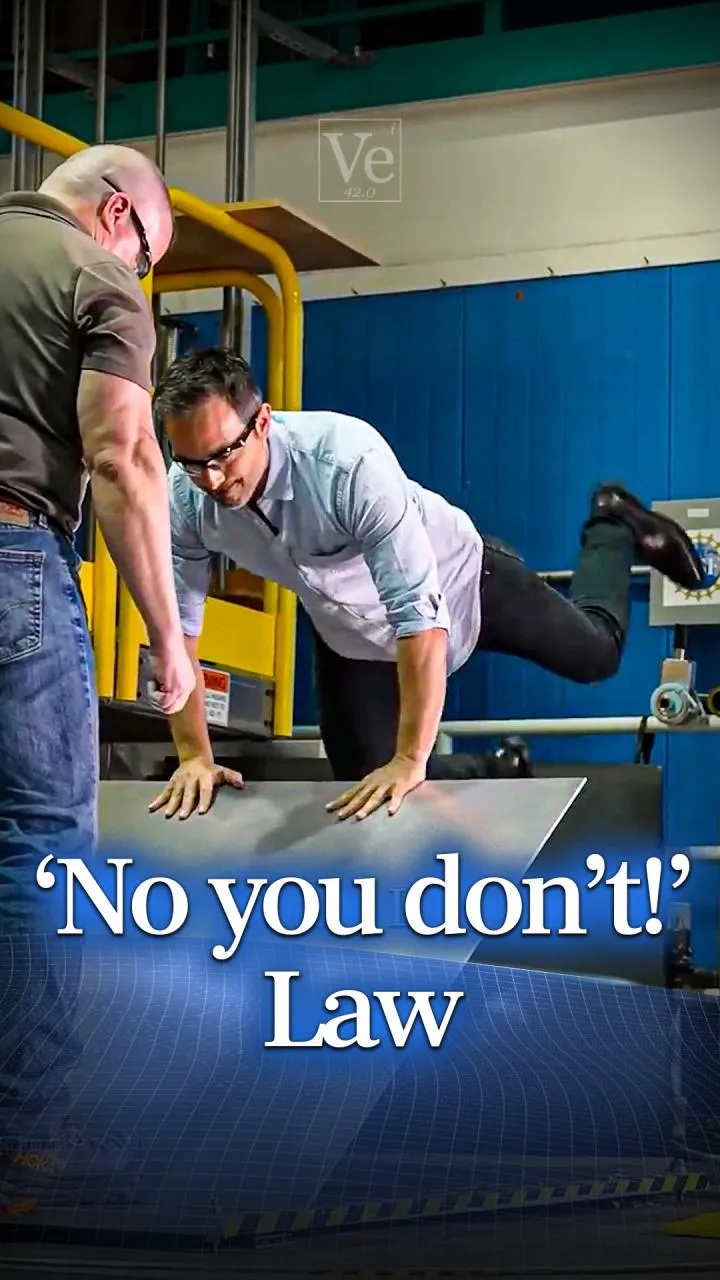
Whatever you try to do, Lenz's law opposes you... #veritasium #science #physics #magnetism
Whatever you try to do, Lenz's law opposes you...
- Views
- 4.8M
- Likes
- 216.1K
- Comments
- 494
- Topics
Analysis
Verbal hook
I like to think of Lenz's law as the no, you don't law, because whatever you try to do, nature acts to oppose you.
Visual hook
Physical Struggle- 01The Memorable Hook
Give a technical idea a simple, human-sounding nickname or rule. State the broad principle in a way that makes viewers want to see it demonstrated.
- 02The First Demonstration
Show the first clear example of the rule in action. Explain the immediate cause in simple terms so the visual has a scientific foundation.
- 03The Reversal Test
Reverse the action. This proves the rule is not limited to one direction and creates a second visual payoff.
- 04The Human Reaction
Insert an honest, funny reaction to the unexpected difficulty. This makes the experiment feel personal and gives the audience a brief emotional reset before the deeper explanation.
- 05The Escalating Explanation
Describe a stronger attempt and explain why pushing harder makes the resistance stronger. Link the physical result to a cause-and-effect chain.
- 06The Escalation Tests
Test several related objects or situations. Preserve the same setup while changing the object or action, so viewers watch for whether the rule still holds.
- 07The Broad Final Test and Payoff
Use one final, unexpected object to show that the principle is broader than the first example. End by stating the single mechanism that explains every test.