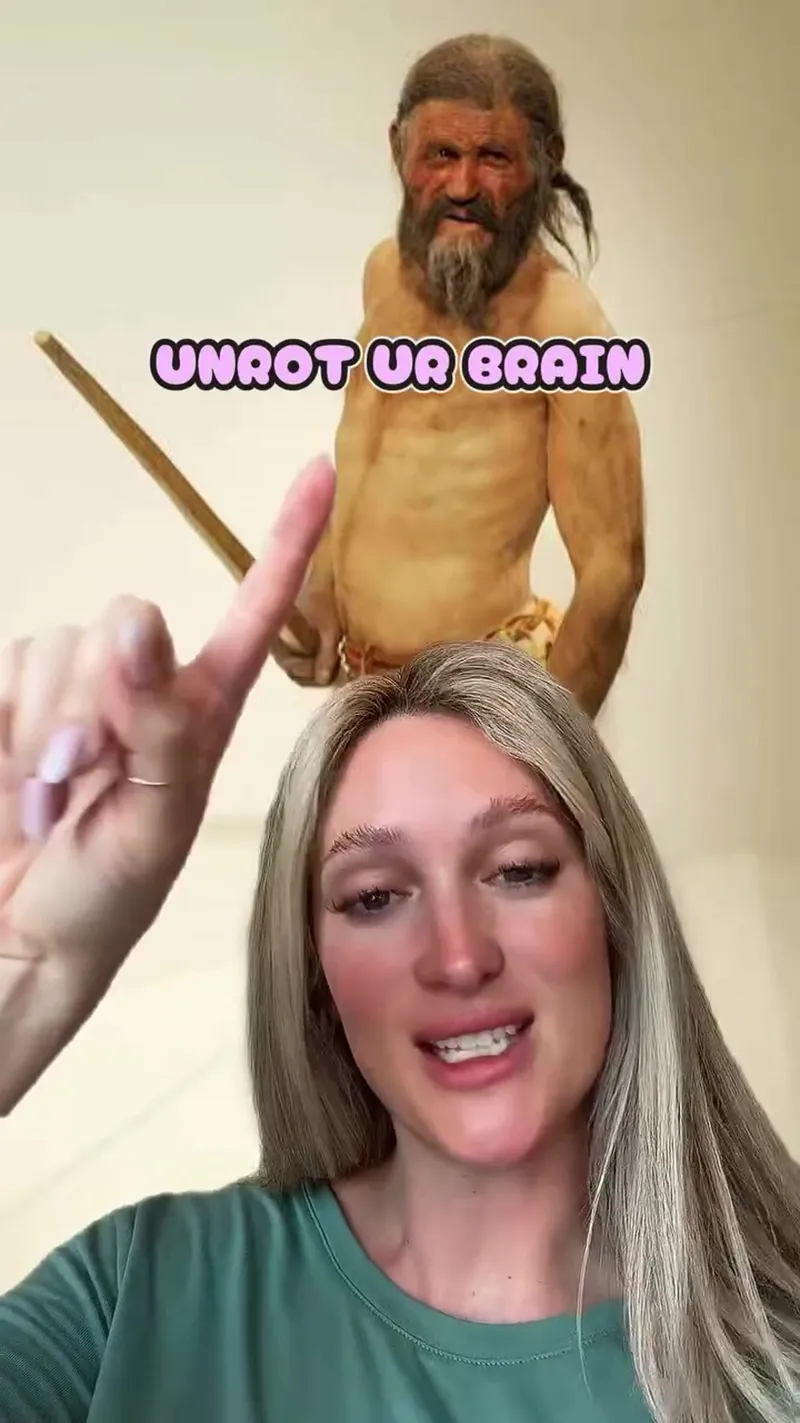
Katie shares a fascinating story about scientists who extracted 5,300-year-old yeast from the stomach of Ötzi the Iceman to bake sourdough bread. She explores the mummy's discovery in the Swiss Alps and explains how this ancient yeast might help break down toxic chemicals in the environment today.
Baking Sourdough with 5,300-Year-Old Mummy Yeast
Katie shares a fascinating story about scientists who extracted 5,300-year-old yeast from the stomach of Ötzi the Iceman to bake sourdough bread. She explores the mummy's discovery in the Swiss Alps and explains how this ancient yeast might help break down toxic chemicals in the environment today.
- Views
- 366.6K
- Likes
- 26.1K
- Comments
- 318
- Topics
Analysis
Recently, scientists took yeast out of this mummy's stomach and they made sourdough bread.
Recently, scientists took yeast out of this mummy's stomach and they made sourdough bread. This is utsi, I believe that's how you pronounce it. And he is a soft or a wet mummy. So I'm going to explain how we took yeast out of his stomach and we made sourdough bread. But if you don't know who I am, my name is Katie. I do a series called on rot your brain where I deep dive a subject that I know nothing about every single week and I bring it to you and I give you some, like, podcasts or things to read if you're interested in it at all. Okay, let's get into it. So in 1991, these two hikers are hiking the Swiss Alps and they discover a body frozen in ice. They're like, hey, let's call the authorities. Somebody's probably looking for this guy. And they call, they call the cops and the cops come and they're like, I think this is maybe like outside of our purview. Of course, not before they like royally fucked up the preservation site. But that's neither here nor there. So they get this guy out of the ice and they bring him to a facility where they can study him more essentially. And while they're bringing him there, and while he's there, he starts to melt. So as the scientists are like studying him, they're like, oh my God, like, this guy's so old. He didn't just like die a couple hundred years ago. He died 5300 years ago. They named him Utsi Otzi. I don't really know how to say it. Point is, let me tell you a little bit about this guy. Your best guess is he's around 45 years old. When he died, he was 5 foot 2 in his stomach microbiome, he had grains and goat meat. He died because an arrow was shot into his shoulder and it hit an artery. He had 61 tattoos, some of the oldest known examples of tattoos that we have. And they're essentially like lines and crosses. And the best guess is that they would use charcoal and soot. A lot of scientists believe that these tattoos were actually like therapeutic, placed near pain points and joints, kind of like early acupuncture. Okay. So they bring this guy in and now he's in like a temperature controlled place, obviously. But the melting that had happened, they took four types of yeast and like they sampled obviously everything or like testing everything. They took four types of yeast out of his body. This is not normal yeast, right? This is yeast that survive a freezing for 5,300 years. And we can tell that it's old yeast and not new yeast because it, like, started to deteriorate. I guess you can, like, test the strains of it or, like, what the. What it's like, comprised of, and you could tell that it's old yeast. So they were like, let's go make some sourdough starter. I don't know why, to be honest with you. They're also going to try beer, but they tried to make sourdough starter with flour, and it would not react to the flour in the way that normal yeast does. After months of tweaking, they finally made the sourdough. Whatever. That's weird. But the interesting part is, as they were making this sourdough, they actually discovered that the yeast would eat the phenol. Phenol is a very harsh chemical that we use to, like, preserve stuff. So we were using it to preserve his body and the yeast was breaking it down. Obviously not ideal in this situation, but we have a very hard time breaking down phenol, and it's a very toxic chemical to the earth. So now we're like, oh, my God, can we use this yeast to help clean up the earth a little bit? Anyway, absolutely fascinating, fun little story for the day.
- 01The Bizarre Discovery Hook
State a shocking fact involving an ancient source and a modern result.
- 02The Series Branding
Introduce yourself and the 'concept' of your content style.
- 03The Origin Story
Narrate the moment the subject was discovered and an early mistake.
- 04The Magnitude Shift
Reveal the true, shocking scale or age of the subject.
- 05The Humanizing Details
Provide specific, relatable details about the subject's life/stats.
- 06The Unique Feature Deep-Dive
Focus on one fascinating physical or technical attribute.
- 07The Scientific Core
Explain the technical part of the experiment and why it was unusual.
- 08The Trial and Error
Describe the struggle to achieve the goal mentioned in the hook.
- 09The Accidental Discovery
Reveal the unexpected secondary benefit found during the process.
- 10The Future Implication
Connect the discovery to a modern global problem and sign off.