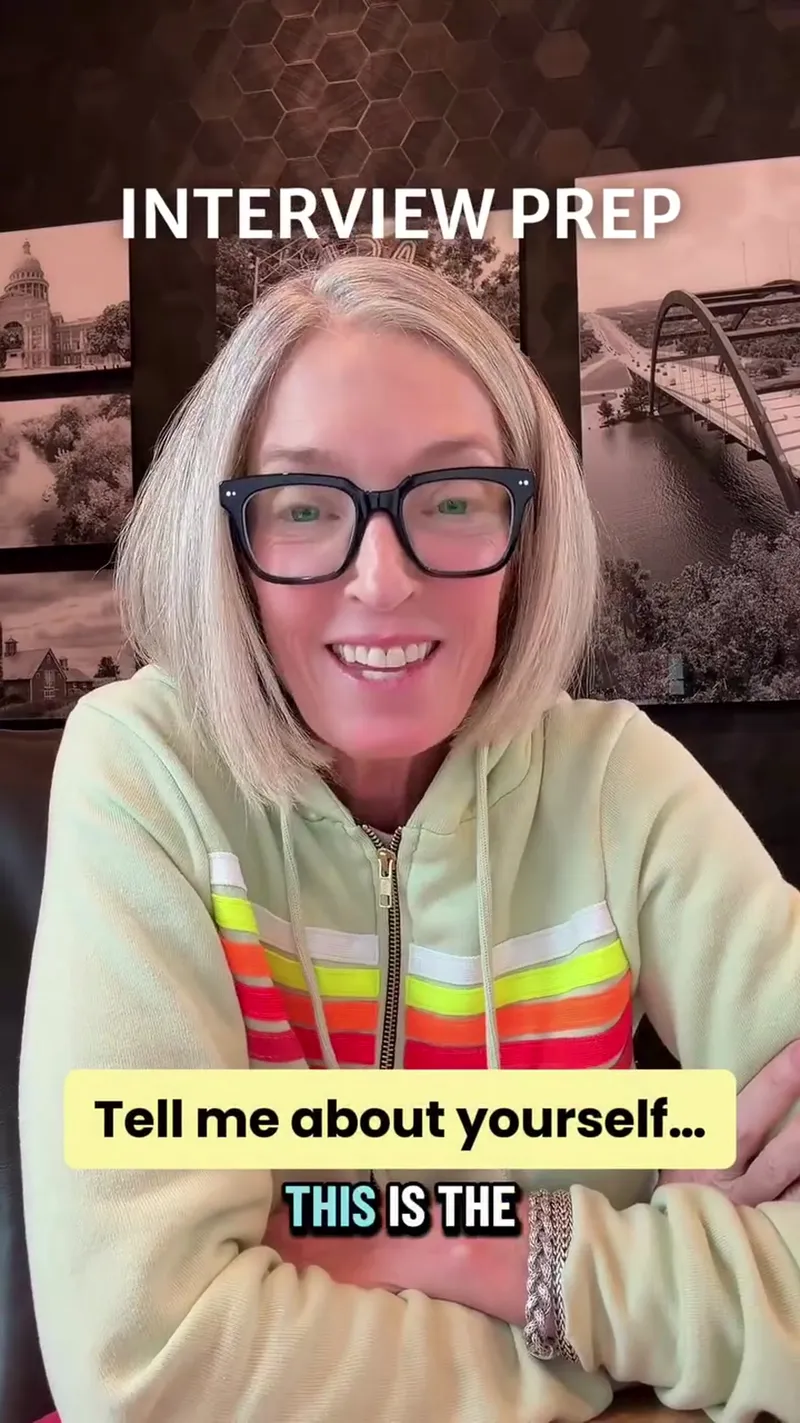
An experienced recruiter provides a structured framework for answering the "Tell me about yourself" interview question. She explains why the question is difficult and offers a specific formula focused on recent experience and relevant projects to help candidates make a strong first impression.
How to Ace the "Tell Me About Yourself" Interview Question
An experienced recruiter provides a structured framework for answering the "Tell me about yourself" interview question. She explains why the question is difficult and offers a specific formula focused on recent experience and relevant projects to help candidates make a strong first impression.
- Views
- 185.2K
- Likes
- 5.3K
- Comments
- 60
- Topics
Analysis
Tell me about yourself. This is the hardest interview question I think for a whole lot of people.
Tell me about yourself. This is the hardest interview question I think for a whole lot of people. I've been, I'm a recruiter, I've been doing this for 20 plus years. I've got a business helping people craft their tell me about yourself stories. And here's why I think this really freaks people out. It is a question that you're going to have to talk about yourself. It is an open ended question. You, you don't really know how far back into your career people are looking for you to go. So you start at the beginning, which for some of us can be a very long time ago. It feels a little bit like it's a test, like what are you expecting me to say? Is this personal? Is this professional? And people just don't really know how to handle it. And so in the moment that it happens, if you have not really prepared for this, your brain freezes. And, and like I said, you start back at the beginning, like, hey, I graduated from college when. And I'm like, oh my God, are they seriously going to talk about college? And this is where we are making our first impression with each other. So what I want to say to those of you that really struggle with this, there is a very clear framework to think about it. Most interviewers really only care about the last five years of your experience. That's where you've done the work that is of most interest to me in the job that you are applying to. So you frame your tell me about yourself with two to three very broad sentences about your background, the industries you've worked for, the sizes of companies you've worked for, et cetera. And then you share with me a project, a initiative, a sales goal, whatever it is that you're really proud of that aligns directly with the role that you are interviewing for. And then you close the conversation with why the company and why the role. And all of that should take place in roughly under 2 minutes, minutes time. So I hope that that's helpful. Drop into the comments, any questions that you have and good luck out there. Practice.
- 01The Pain Point Hook
Identify a specific, difficult task and label it as the hardest part of the process.
- 02Authority and Business Proof
State your credentials and what you do to help people with this specific problem.
- 03The Psychological Breakdown
Explain why this task triggers anxiety or failure in the average person.
- 04The Failure Path
Describe the common mistake people make when they are unprepared.
- 05The Consequence
Show the immediate negative result of that mistake, including the other person's perspective.
- 06The Reassurance & Reveal
Validate the viewer's struggle and promise a clear structure.
- 07The Insider Secret
Reveal a specific rule or preference that most people don't know.
- 08The Framework: Phase 1
The first step of the tactical solution.
- 09The Framework: Phase 2
The second step of the tactical solution focusing on a specific win.
- 10The Framework: Phase 3
The final step of the tactical solution to close the loop.
- 11The Efficiency Rule
Give a specific time or quantity constraint to keep the viewer focused.
- 12CTA and Sign-off
Offer help and encourage the viewer to take action.