
I swear some people talk about parents like they are small children who are incapable of doing anything different. We're constantly talking about how they tried their best, they didn't know better, they can't give something they didn't get, and it's their first time on this earth. Can this all be true? Sure. But is this really how we want our children to feel about us? You are capable. You can learn new things. You can give more than you were given. Patterns can end with you. We will help you do it @callinghome.co
I swear some people talk about parents like they are small children who are incapable of doing anything different.
This text-led carousel argues that parents should not be treated as incapable of growth simply because they lacked support or good examples. It contrasts pity-based excuses with accountability, learning, apology, and the ability to create healthier family patterns.
- Likes
- 15K
- Comments
- 290
- Slides
- 4
- Topics
Analysis
This text-led carousel argues that parents should not be treated as incapable of growth simply because they lacked support or good examples. It contrasts pity-based excuses with accountability, learning, apology, and the ability to create healthier family patterns.
Sign in to see the full analysis.
Sign inSlide 1
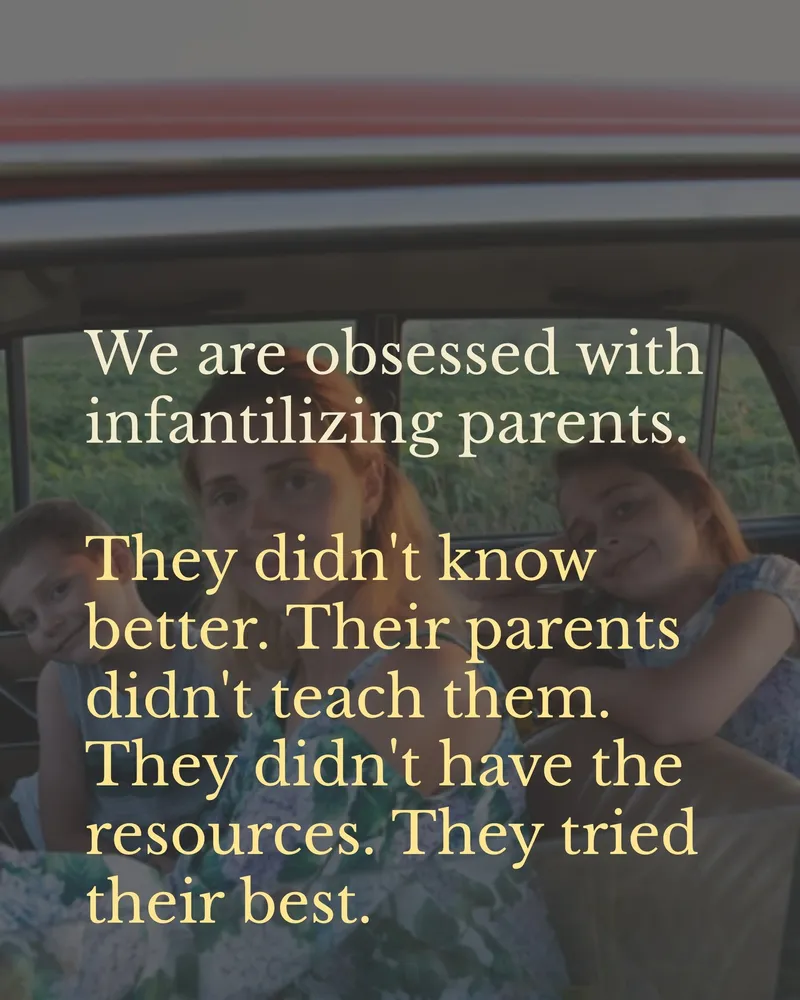
We are obsessed with infantilizing parents. They didn’t know better. Their parents didn’t teach them. They didn’t have the resources. They tried their best.
The unusual phrase “infantilizing parents” stops the scroll because it challenges a familiar belief. The family image makes the topic personal, while the repeated excuses create recognition. The unresolved question—whether compassion has gone too far—pulls viewers into the next slide.
The slide establishes that a familiar, sympathetic explanation may be causing harm, but it does not explain why or what the better interpretation is. The viewer swipes to learn what is wrong with this common framing and what should replace it.
Large cream headline: “We are obsessed with infantilizing parents.”
Muted, darkened photography creates a serious and reflective mood. Warm cream text feels intimate and readable, while the low contrast in the photo pushes the eye toward the bold headline.
Family photo inside a car, with several faces visible behind the text. Follow-up excuses: “They didn’t know better,” “Their parents didn’t teach them,” and “They didn’t have the resources.” Dimmed photo background keeps attention on the message. The final line, “They tried their best,” adds emotional familiarity.
The carousel uses a provocative reframe: familiar compassion toward parents can become infantilizing. That tension challenges the viewer’s assumptions, while the promise of a more capable and accountable model encourages completion.
Slide 1
Controversial ClaimWe are obsessed with infantilizing parents. They didn’t know better. Their parents didn’t teach them. They didn’t have the resources. They tried their best.
Slide 2
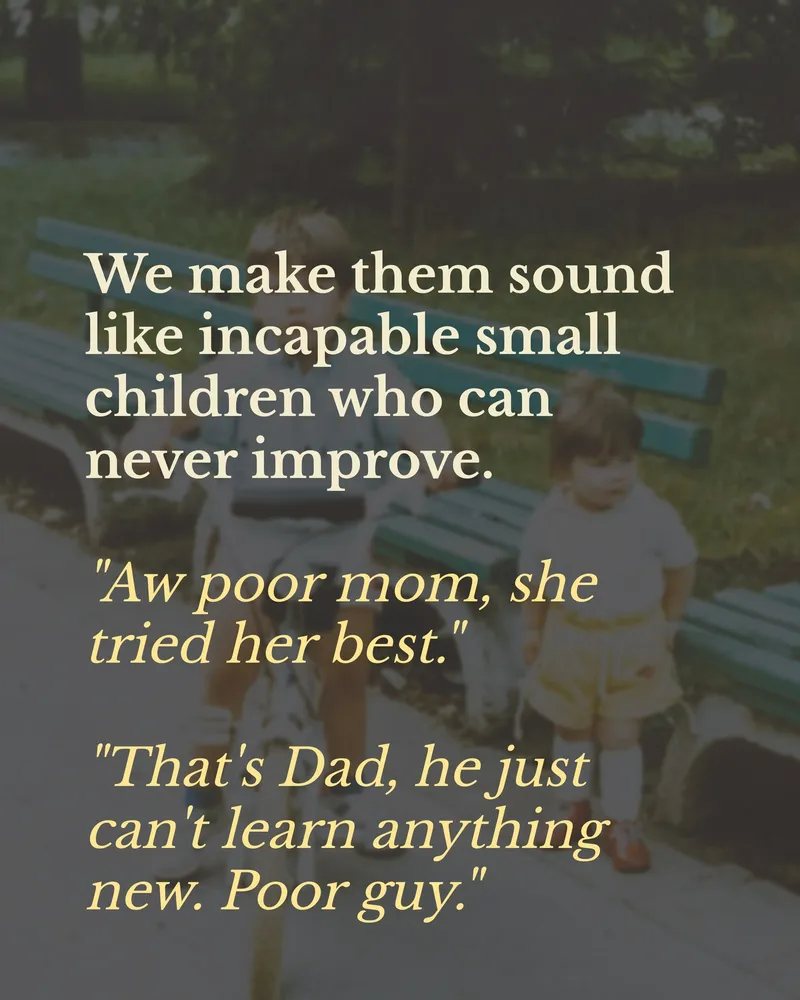
Pattern ExposeWe make them sound like incapable small children who can never improve. “Aw poor mom, she tried her best.” “That’s Dad, he just can’t learn anything new. Poor guy.”
- 01The Provocative Reframe
Challenge a familiar way of excusing or explaining a problem. List the common reasons people give, but leave the audience wondering why this framing may be harmful.
- 02The Hidden Consequence
Reveal what the familiar excuses imply when repeated too often. Use recognizable examples so viewers can spot the pattern in their own words and feel the problem more sharply.
- 03The Better Standard
Turn the critique into a clear model of what capable, responsible behavior should look like. Move from accusation to a direct invitation to become someone who can learn, adapt, and take responsibility.
- 04The Empowering Close
Make the new standard feel possible by naming small, concrete actions. End with a direct affirmation that the audience can choose a different path and is not trapped by the past.
Slide 1
We are obsessed with infantilizing parents. They didn’t know better. Their parents didn’t teach them. They didn’t have the resources. They tried their best.
The unusual phrase “infantilizing parents” stops the scroll because it challenges a familiar belief. The family image makes the topic personal, while the repeated excuses create recognition. The unresolved question—whether compassion has gone too far—pulls viewers into the next slide.
The slide establishes that a familiar, sympathetic explanation may be causing harm, but it does not explain why or what the better interpretation is. The viewer swipes to learn what is wrong with this common framing and what should replace it.
Large cream headline: “We are obsessed with infantilizing parents.”
Muted, darkened photography creates a serious and reflective mood. Warm cream text feels intimate and readable, while the low contrast in the photo pushes the eye toward the bold headline.
Family photo inside a car, with several faces visible behind the text. Follow-up excuses: “They didn’t know better,” “Their parents didn’t teach them,” and “They didn’t have the resources.” Dimmed photo background keeps attention on the message. The final line, “They tried their best,” adds emotional familiarity.
Slide 2
We make them sound like incapable small children who can never improve. “Aw poor mom, she tried her best.” “That’s Dad, he just can’t learn anything new. Poor guy.”
Slide 2 reinforces slide 1 by translating the abstract idea into blunt, recognizable examples. “Incapable” and “never improve” raise the stakes from wording to identity and possibility. The quotes make viewers test their own language and swipe for the argument’s conclusion.
The slide reveals the consequence hinted at in slide 1: repeated sympathy can make people sound permanently incapable. It hides whether this framing is fair and what the audience should believe or do instead, creating a swipe-worthy need for resolution.
Large cream statement: “We make them sound like incapable small children who can never improve.”
The dark gray overlay and muted outdoor colors create a serious, critical mood. Cream text remains warm but highly visible, while italicized quotes add emotional emphasis and make the examples feel dismissive.
Blurred outdoor family scene with adults and children on a bench. Quoted examples: “Aw poor mom, she tried her best.” Second quote: “That’s Dad, he just can’t learn anything new. Poor guy.” Italic quote styling makes the examples feel like common social commentary. Dark overlay separates the text from the busy background.
Slide 3 · Reframe and solution
It replaces the helpless-parent framing with a clear model of a capable, learning, accountable adult, moving the carousel from critique to hope.
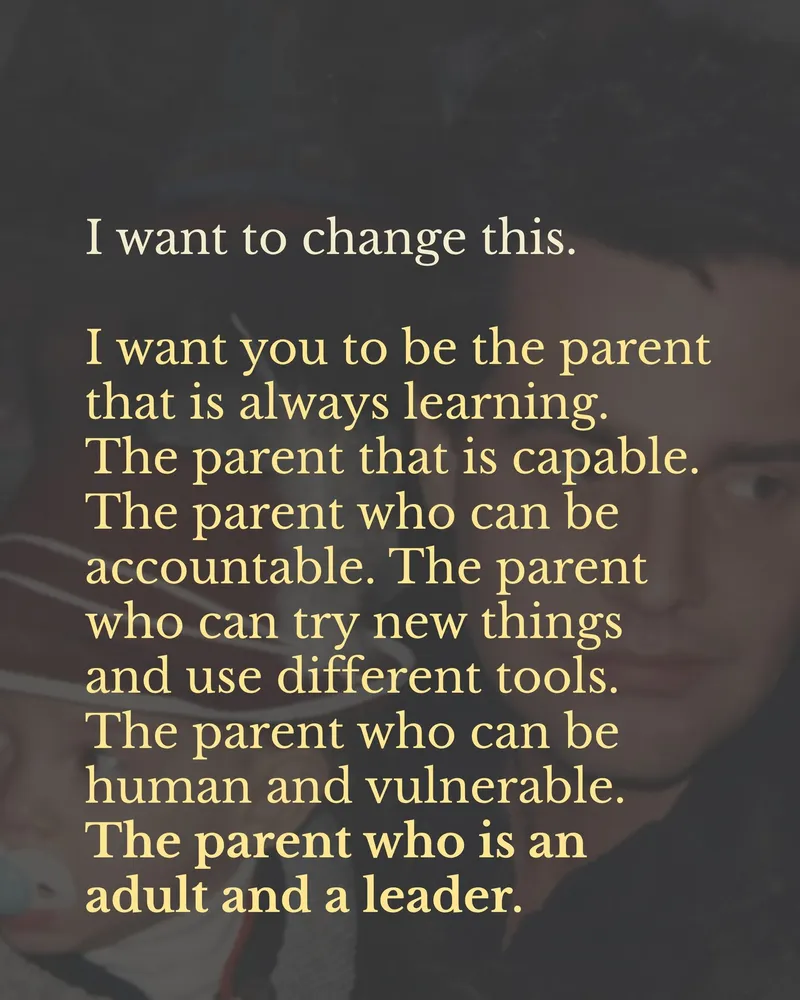
I want to change this. I want you to be the parent that is always learning. The parent that is capable. The parent who can be accountable. The parent who can try new things and use different tools. The parent who can be human and vulnerable. The parent who is an adult and a leader.
It suggests that parents can actively learn, use new tools, and lead differently, setting up a final message about specific forms of change.
It fulfills the hook’s promise to show what should replace the idea that parents are incapable of change. It presents accountability and growth as the better model.
A muted, darkened family photo sits behind large cream serif text. The message shifts from criticizing the old framing to describing a capable, accountable parent.
Slide 4 · Final affirmation
It closes the argument with practical examples and reassurance, leaving the viewer with agency and hope that harmful patterns can be broken.
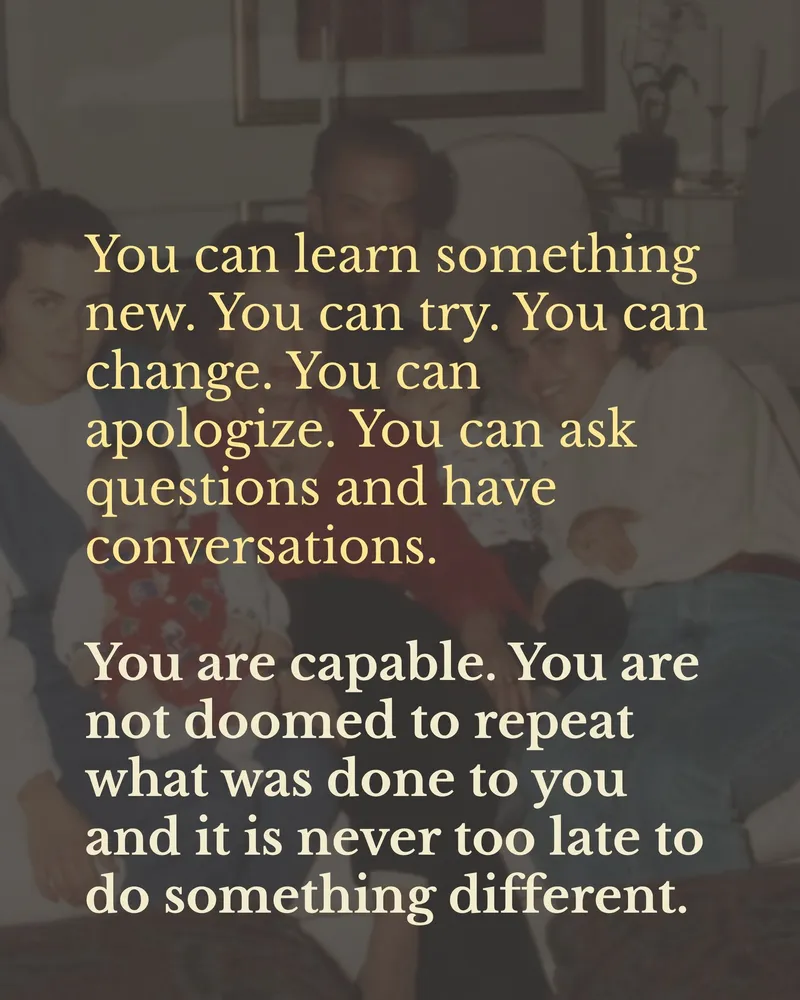
You can learn something new. You can try. You can change. You can apologize. You can ask questions and have conversations. You are capable. You are not doomed to repeat what was done to you and it is never too late to do something different.
It opens no major new loop; it delivers the final promise that people can choose a different path and break inherited patterns.
It fulfills the promise of a more accountable model by showing what change can look like: learning, trying, apologizing, asking questions, and having conversations.
A muted family photo shows adults and children together under a dark overlay. Large cream serif text lists concrete ways to change, then ends with an empowering affirmation.