When was the last time you gave your mind enough space to really think? Depth, agency, and spaciousness are easy to lose when so much of our attention is spent scrolling, reacting, and consuming. But these cognitive luxuries are worth protecting. And you can start reclaiming them through small changes to how you direct your attention each day. I’ve put together 12 tiny experiments to help you think more deeply, freely, and slowly. Save this list so you can always come back to it when you need to, and share it with a friend who might need it right now.
When was the last time you gave your mind enough space to really think?
This educational carousel explains three forms of cognitive luxury: depth, agency, and spaciousness. It follows with four practical experiments for each category, then ends with a promotional CTA for the Ness Labs newsletter and the creator’s account.
- Likes
- 10K
- Comments
- 39
- Slides
- 6
- Topics
Analysis
This educational carousel explains three forms of cognitive luxury: depth, agency, and spaciousness. It follows with four practical experiments for each category, then ends with a promotional CTA for the Ness Labs newsletter and the creator’s account.
Sign in to see the full analysis.
Sign inSlide 1
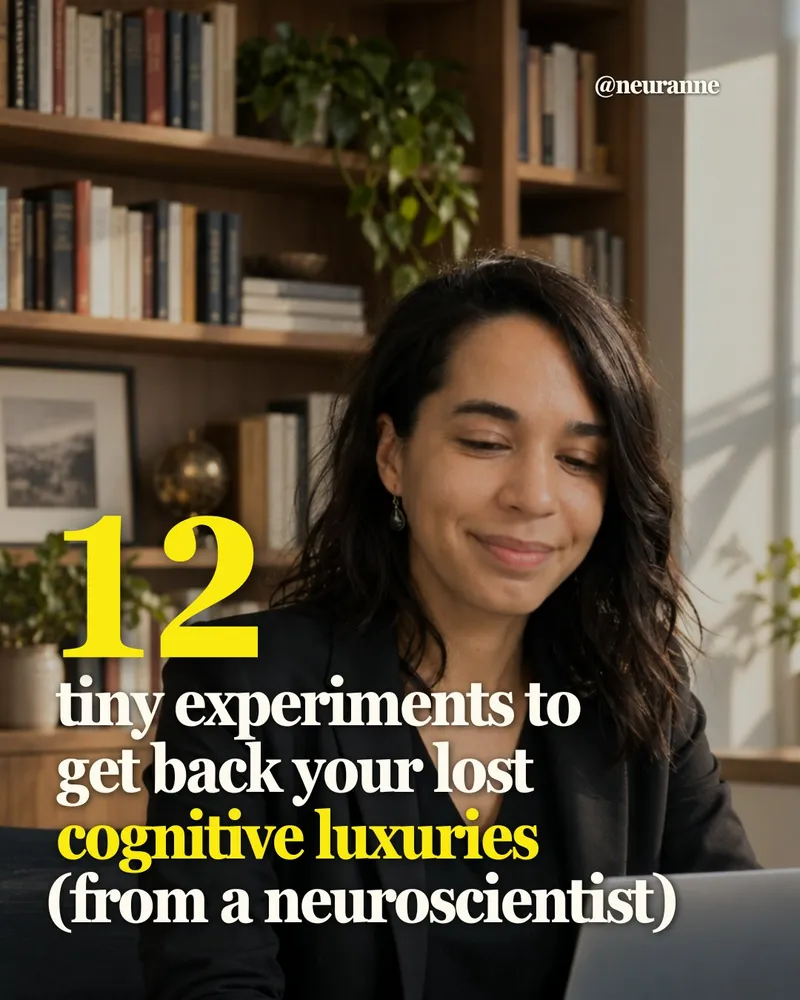
@neuranne 12 tiny experiments to get back your lost cognitive luxuries (from a neuroscientist)
The oversized number stops the scroll, while the unusual phrase “cognitive luxuries” creates intrigue. The portrait makes the promise feel personal and credible. Slide 2 earns the swipe by defining those luxuries, turning a vague benefit into a clear framework.
The slide establishes a specific set of [number] experiments and promises to restore something valuable, but hides what the experiments are and how they work. The viewer swipes to discover the first practical step and see whether the authority claim is credible.
Large yellow “12” followed by the bold headline “tiny experiments to get back your lost cognitive luxuries”
Warm brown and cream tones create a calm, intellectual mood. Bright yellow highlights make “12” and “cognitive luxuries” the first text elements noticed, while white text stays readable over the dark portrait.
Close-up portrait of the creator creates a personal, human connection. Bookshelf and laptop signal learning and thoughtful work. “(from a neuroscientist)” adds authority. @neuranne identifies the creator.
The carousel opens with a relatable problem—losing mental space to scrolling and reacting—and promises 12 small experiments to fix it. The term “cognitive luxuries” creates a curiosity gap, while the three-part structure gives viewers a clear reason to continue through each category.
Slide 1
List Promise@neuranne 12 tiny experiments to get back your lost cognitive luxuries (from a neuroscientist)
Slide 2
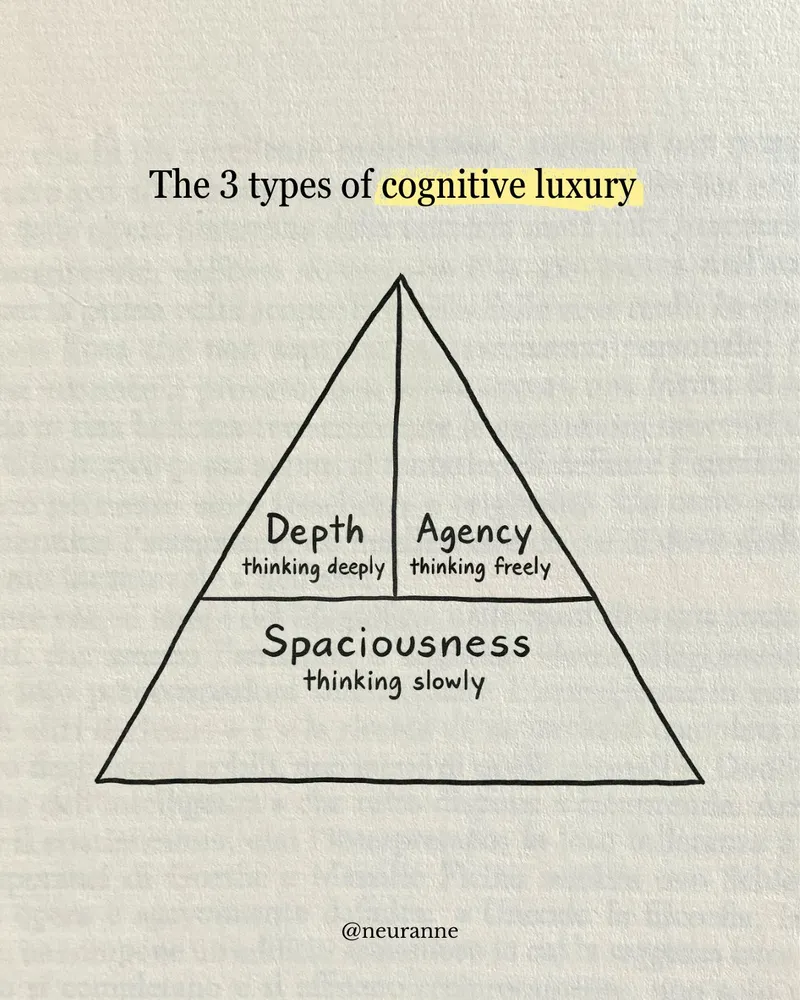
Framework RevealThe 3 types of cognitive luxury Depth thinking deeply Agency thinking freely Spaciousness thinking slowly @neuranne
- 01The Numbered Hook
Open with a relatable problem and promise a specific number of small actions that restore or improve a desirable result. Use credibility to make the promise believable.
- 02The Framework Reveal
Define the unusual idea from the hook through a simple three-part model. Give viewers an early payoff while creating curiosity about the actions inside each category.
- 03First Action Set
Turn the first framework category into four small, time-bound experiments. Use commitment language so abstract advice becomes easy to try and measure.
- 04Second Action Set
Continue the framework with four experiments for the second category. Keep the same visual and writing pattern so viewers can collect the ideas quickly and feel progress toward the promised total.
- 05Final Action Set
Deliver the last four experiments and complete the promised total. This is the main value payoff, so make the actions concrete, low-friction, and easy to test.
- 06The Resource CTA
After the educational promise is complete, offer a deeper resource and a way to keep receiving related content. Connect the CTA to the value just delivered rather than switching topics abruptly.
Slide 1
@neuranne 12 tiny experiments to get back your lost cognitive luxuries (from a neuroscientist)
The oversized number stops the scroll, while the unusual phrase “cognitive luxuries” creates intrigue. The portrait makes the promise feel personal and credible. Slide 2 earns the swipe by defining those luxuries, turning a vague benefit into a clear framework.
The slide establishes a specific set of [number] experiments and promises to restore something valuable, but hides what the experiments are and how they work. The viewer swipes to discover the first practical step and see whether the authority claim is credible.
Large yellow “12” followed by the bold headline “tiny experiments to get back your lost cognitive luxuries”
Warm brown and cream tones create a calm, intellectual mood. Bright yellow highlights make “12” and “cognitive luxuries” the first text elements noticed, while white text stays readable over the dark portrait.
Close-up portrait of the creator creates a personal, human connection. Bookshelf and laptop signal learning and thoughtful work. “(from a neuroscientist)” adds authority. @neuranne identifies the creator.
Slide 2
The 3 types of cognitive luxury Depth thinking deeply Agency thinking freely Spaciousness thinking slowly @neuranne
This slide delivers an immediate payoff by explaining what the unusual phrase means. The simple pyramid is easy to scan and remember. It also creates a new open loop: viewers now want to know how to develop Depth, Agency, and Spaciousness.
The slide reveals the promised concept as three categories, but hides the experiments or methods needed to build each one. That gap makes viewers swipe to learn the first category-specific action and continue the list promised on slide 1.
The pyramid diagram labeled “Depth,” “Agency,” and “Spaciousness”
A soft off-white paper background feels calm and spacious. Black text gives the framework clarity, while the yellow highlight adds a small burst of attention without breaking the reflective mood.
Headline: “The 3 types of cognitive luxury” frames the diagram. “thinking deeply,” “thinking freely,” and “thinking slowly” explain each category. Yellow highlight draws attention to “cognitive luxury.” Hand-drawn lines and paper texture make the framework feel personal and memorable. @neuranne reinforces creator attribution.
Slide 3 · Category 1: Depth Experiments
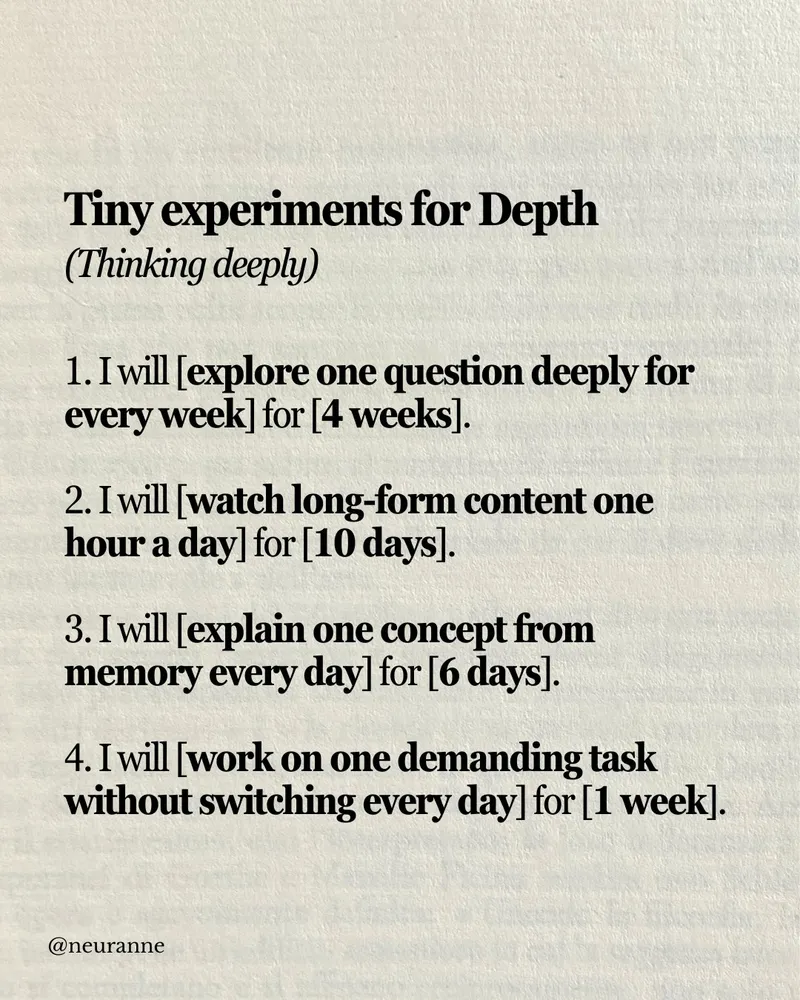
It turns the abstract idea of Depth into four specific habits with clear time periods, beginning the promised set of 12 experiments.
Tiny experiments for Depth (Thinking deeply) 1. I will [explore one question deeply for every week] for [4 weeks]. 2. I will [watch long-form content one hour a day] for [10 days]. 3. I will [explain one concept from memory every day] for [6 days]. 4. I will [work on one demanding task without switching every day] for [1 week]. @neuranne
It opens the next category loop: viewers still need experiments for Agency and Spaciousness to complete the framework.
It fulfills the hook’s promise to provide small experiments for reclaiming lost mental space and develops the Depth category introduced on slide 2.
A paper-texture slide lists four experiments for Depth, framed as ways to think deeply. The layout uses large serif type and numbered commitments.
Slide 4 · Category 2: Agency Experiments
It continues the list with four practical ways to strengthen independent thought and reduce passive influence from external content.
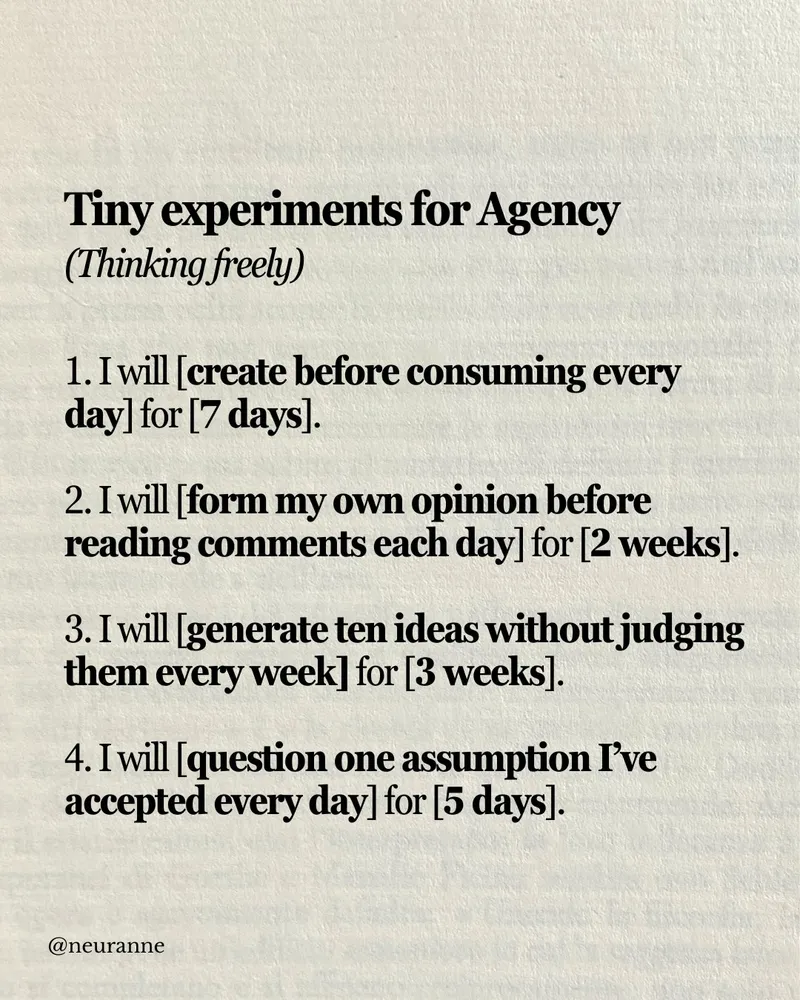
Tiny experiments for Agency (Thinking freely) 1. I will [create before consuming every day] for [7 days]. 2. I will [form my own opinion before reading comments each day] for [2 weeks]. 3. I will [generate ten ideas without judging them every week] for [3 weeks]. 4. I will [question one assumption I’ve accepted every day] for [5 days]. @neuranne
It creates anticipation for the final category: four experiments for Spaciousness and slower thinking.
It fulfills the promised experiments for the second cognitive luxury, Agency, which was named in the framework reveal.
A matching paper-texture slide presents four experiments for Agency, focused on independent thinking and idea generation. Each item includes a practice and a time frame.
Slide 5 · Category 3: Spaciousness Experiments
It completes the practical framework by delivering the final four experiments, bringing the total to 12.
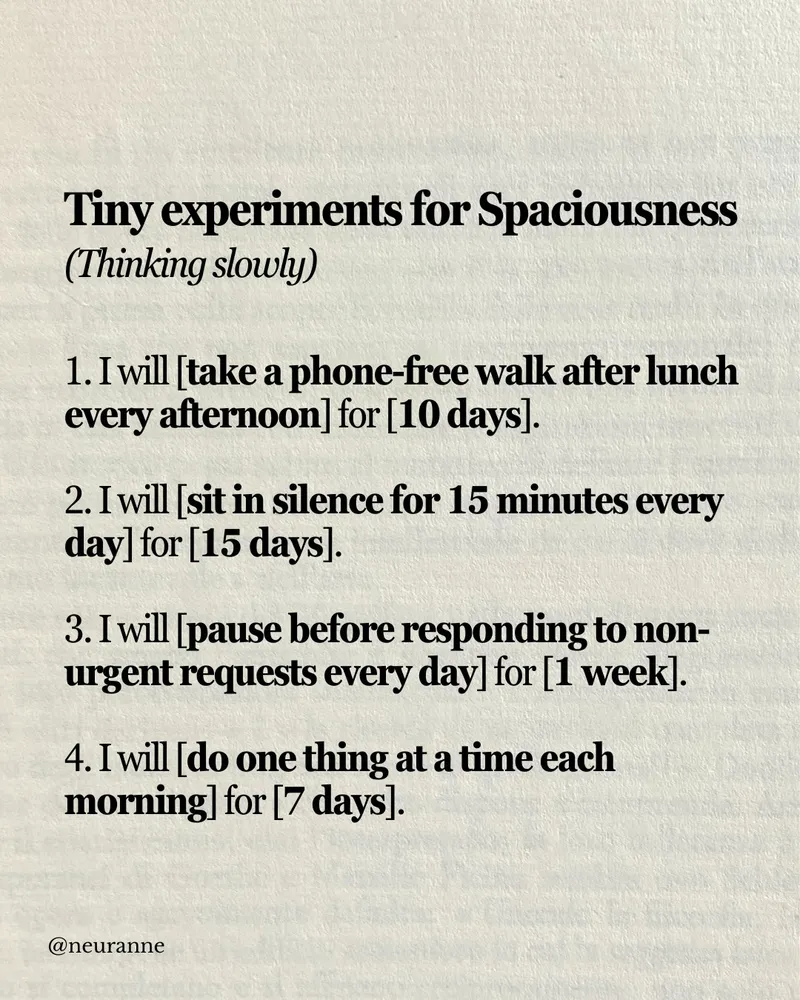
Tiny experiments for Spaciousness (Thinking slowly) 1. I will [take a phone-free walk after lunch every afternoon] for [10 days]. 2. I will [sit in silence for 15 minutes every day] for [15 days]. 3. I will [pause before responding to non-urgent requests every day] for [1 week]. 4. I will [do one thing at a time each morning] for [7 days]. @neuranne
The educational promise is complete; the next slide shifts toward an external resource and a way to continue engaging with the creator.
It fulfills the hook’s full promise of 12 tiny experiments and covers the final category, Spaciousness, from slide 2.
The third category slide lists four habits for creating mental space, including phone-free walking, silence, pausing, and single-tasking.
Slide 6 · Newsletter and Follow CTA
It closes the educational sequence by directing interested viewers to a newsletter and the creator’s account for more related content.
Discover science-backed insights on mindful productivity, curiosity, and experimentation. Join the Ness Labs newsletter at nesslabs.com and follow @neuranne for more content like this. email address...
Join the Ness Labs newsletter at nesslabs.com and follow @neuranne for more content like this.
It promises continued science-backed insights on mindful productivity, curiosity, and experimentation through the newsletter and account.
It supports the broader promise of ongoing, practical insight into attention and mindful productivity, but does not add another experiment.
A closing slide promotes the Ness Labs newsletter and the @neuranne account. A laptop graphic with an email field reinforces the newsletter signup.