Remember being so bored as a kid that counting ceiling tiles felt like a decent afternoon activity? Or reorganizing your sock drawer, just for something to do? I'm not saying that to win some "we had it harder" contest. It's just a genuinely different world our kids are growing up in, and I think a lot of us feel that difference somewhere, even when we can't quite name it. Our kids are growing up with something on the other side of every boundary that's more sophisticated than anything we ever had to hold our own limits against, an algorithm built by people whose whole job is making sure attention never quite lets go. Which is exactly why the boundary muscle matters more now, not less. You're not just up against your kid's very normal wanting. You're up against something built to make wanting never quite feel satisfied. This is a lot of what my new Boundaries Program is built to help with. Comment BOUNDARIES and I'll send you the details.
Remember being so bored as a kid that counting ceiling tiles felt like a decent afternoon activity?
This text-led parenting carousel explains why practicing small boundaries helps families handle bigger issues later, especially phones and social media. It builds from relatable examples to a reassuring framework, then ends with a program promotion and comment CTA.
- Likes
- 29.7K
- Comments
- 1.1K
- Slides
- 9
- Topics
Analysis
This text-led parenting carousel explains why practicing small boundaries helps families handle bigger issues later, especially phones and social media. It builds from relatable examples to a reassuring framework, then ends with a program promotion and comment CTA.
Sign in to see the full analysis.
Sign inSlide 1
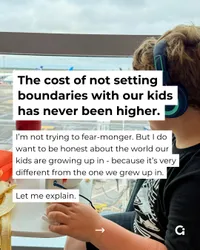
The cost of not setting boundaries with our kids has never been higher. I’m not trying to fear-monger. But I do want to be honest about the world our kids are growing up in - because it’s very different from the one we grew up in. Let me explain.
The large, absolute claim stops the scroll because it raises the stakes immediately. The personal photo makes the issue feel real, while “I’m not trying to fear-monger” lowers resistance. “Let me explain” promises a reasoned answer, giving viewers a clear reason to swipe.
The slide establishes that failing to take a certain action now has unusually serious consequences, but hides exactly what those consequences are and why the situation has changed. That missing explanation creates concern and makes viewers swipe to understand the threat.
The oversized headline: “The cost of not setting boundaries with our kids has never been higher.”
Black text on white blocks creates strong contrast and fast reading. The cool blue-gray background feels serious and modern, while the child and device image makes the concern personal. The red cup adds a small warm accent.
Photo of a child using a device with headphones in a public setting. Smaller reassurance: “I’m not trying to fear-monger.” Context about children growing up in a different world. “Let me explain.” and a right-pointing arrow invite the swipe. Small creator logo in the lower-right corner.
The core driver is the contrast between harmless limits, like saying no to a cupcake, and future high-stakes limits involving phones and social media. Parents keep swiping to understand how today’s small boundary practice shapes tomorrow’s relationship.
Slide 1
High-Stakes ClaimThe cost of not setting boundaries with our kids has never been higher. I’m not trying to fear-monger. But I do want to be honest about the world our kids are growing up in - because it’s very different from the one we grew up in. Let me explain.
Slide 2
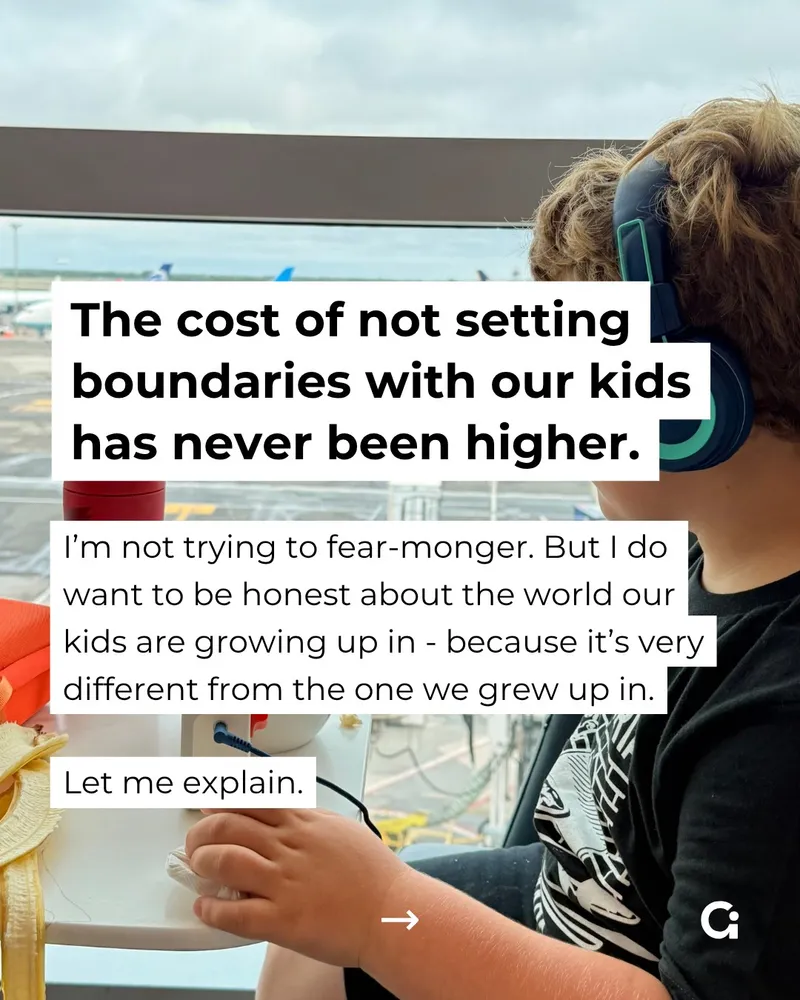
Uncomfortable Truth TeaseI hear parents of young kids say things like this all the time: “My kid isn’t getting a phone until they’re older.” “I see these 8-year-olds on TikTok. Absolutely not.” “My kid will never sleep with their phone in their room. I know what that does to sleep.” And I get it. I have strong feelings about these things too. But sometimes I say something to parents in my practice that they really don’t like hearing...
- 01High-Stakes Hook
Open with a bold claim that failing to take [important action] now has unusually serious future costs. Calm the audience’s fear, then promise an explanation.
- 02Validate Then Tease
Show the audience’s familiar beliefs or rules. Validate them so the creator feels aligned with the audience, then tease an uncomfortable correction.
- 03Everyday Analogy
Reveal the uncomfortable insight through a low-stakes example linked to a future high-stakes challenge. Clarify that the example is not about arbitrary restriction, then open a larger question.
- 04Two-Sided Skill
Explain the mechanism behind the analogy. Show that both sides practice handling discomfort: one person experiences disappointment, while the creator holds the decision without trying to erase the feeling.
- 05Future Application
Make the future challenge concrete. Show how repeated low-stakes practice makes the later conflict familiar instead of shocking.
- 06Relationship Principle
Move from behavior to meaning. Explain what repeated moments teach about the relationship: people can have a voice without controlling the final decision.
- 07Opposite Scenario
Show what happens when the creator skips the earlier practice and introduces the major rule suddenly. Use the other person’s imagined reaction to make the hidden relationship problem visible.
- 08Analogy Resolution
Resolve the original example. Separate the example itself from the real lesson, then state the core principle in a memorable form.
- 09Hopeful CTA
Name the future challenges, then restore hope by showing that preparation can begin while the stakes are low. Offer a relevant product, program, or next step with a simple response CTA.
Slide 1
The cost of not setting boundaries with our kids has never been higher. I’m not trying to fear-monger. But I do want to be honest about the world our kids are growing up in - because it’s very different from the one we grew up in. Let me explain.
The large, absolute claim stops the scroll because it raises the stakes immediately. The personal photo makes the issue feel real, while “I’m not trying to fear-monger” lowers resistance. “Let me explain” promises a reasoned answer, giving viewers a clear reason to swipe.
The slide establishes that failing to take a certain action now has unusually serious consequences, but hides exactly what those consequences are and why the situation has changed. That missing explanation creates concern and makes viewers swipe to understand the threat.
The oversized headline: “The cost of not setting boundaries with our kids has never been higher.”
Black text on white blocks creates strong contrast and fast reading. The cool blue-gray background feels serious and modern, while the child and device image makes the concern personal. The red cup adds a small warm accent.
Photo of a child using a device with headphones in a public setting. Smaller reassurance: “I’m not trying to fear-monger.” Context about children growing up in a different world. “Let me explain.” and a right-pointing arrow invite the swipe. Small creator logo in the lower-right corner.
Slide 2
I hear parents of young kids say things like this all the time: “My kid isn’t getting a phone until they’re older.” “I see these 8-year-olds on TikTok. Absolutely not.” “My kid will never sleep with their phone in their room. I know what that does to sleep.” And I get it. I have strong feelings about these things too. But sometimes I say something to parents in my practice that they really don’t like hearing...
Recognition makes viewers feel seen, and validation prevents the hook from sounding judgmental. The three quotes quickly show the audience’s current approach. The final ellipsis introduces conflict: if these rules are reasonable, what uncomfortable correction could follow?
The slide establishes beliefs the target audience recognizes and agrees with, then hints that the expert challenges them with something they dislike hearing. The exact advice is hidden, creating tension between familiar rules and a possible blind spot that viewers must swipe to uncover.
The bold quoted statements, especially: “My kid isn’t getting a phone until they’re older.”
The same cool, muted photo keeps the sequence consistent and serious. White text blocks create clean contrast, while the bold black quotes make the familiar parental rules easy to scan. The repeated image keeps attention on the device-related concern.
Opening setup: “I hear parents of young kids say things like this all the time:” Three familiar rule-setting statements create recognition and tension. Reassurance: “And I get it. I have strong feelings about these things too.” Tease: “But sometimes I say something to parents in my practice that they really don’t like hearing...” The background repeats the child-and-device image from slide 1.
Slide 3 · Core Argument Reveal
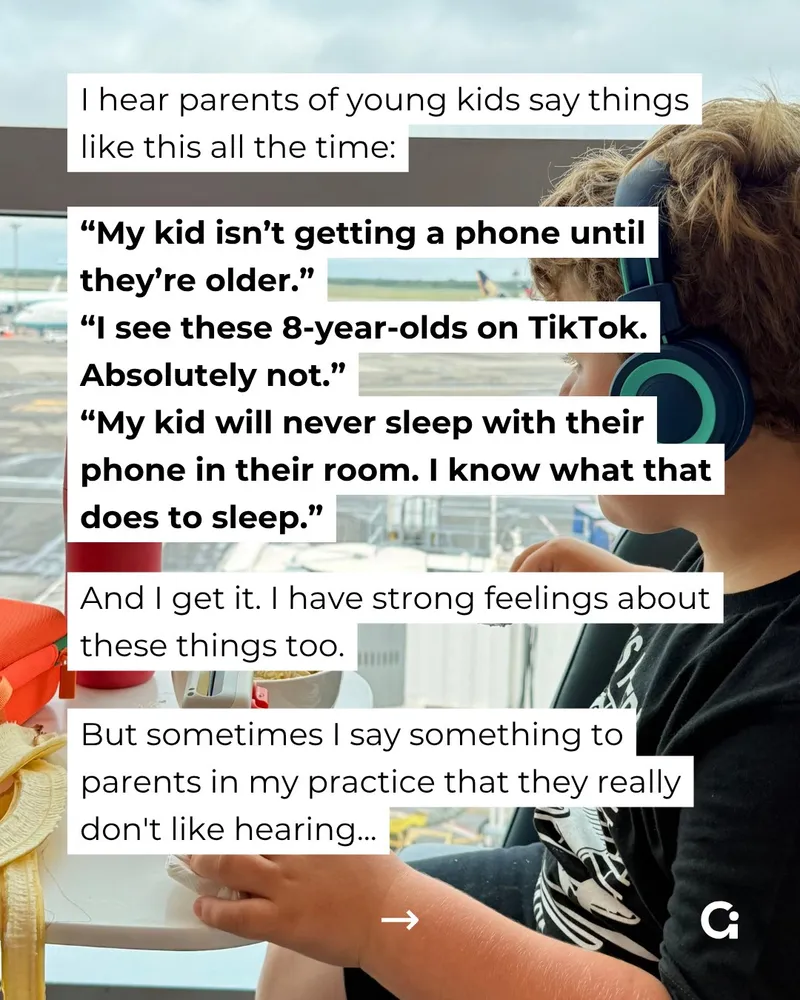
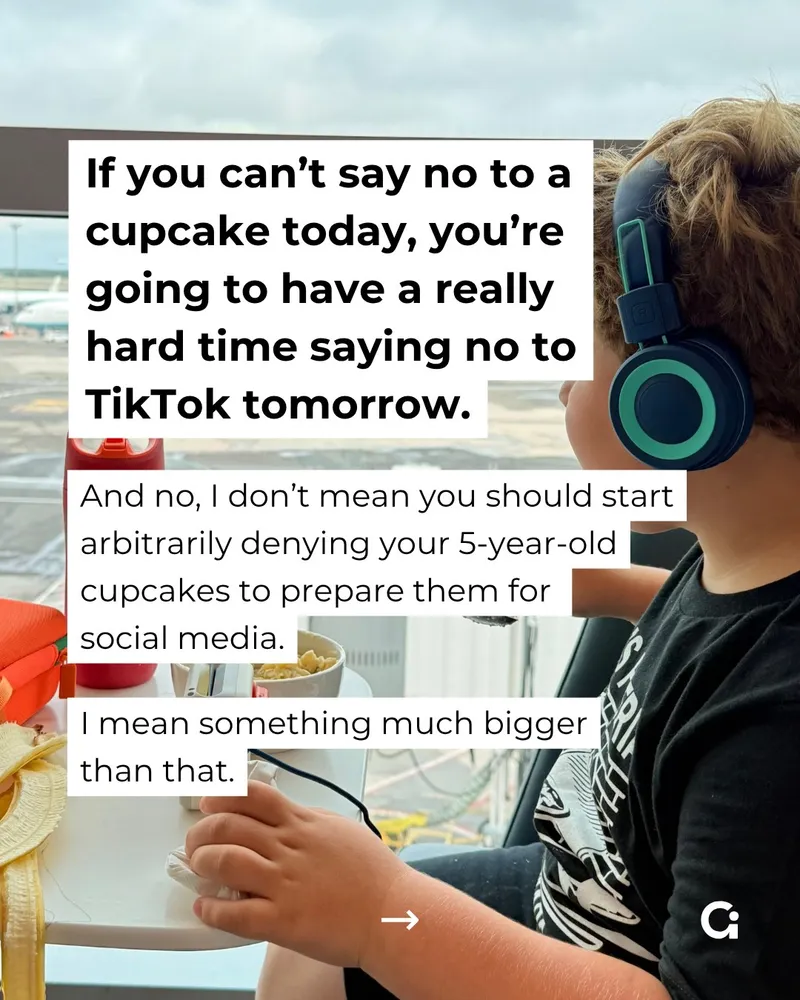
It reveals the uncomfortable advice: small boundaries are practice for harder future limits, without promoting arbitrary restriction.
If you can’t say no to a cupcake today, you’re going to have a really hard time saying no to TikTok tomorrow. And no, I don’t mean you should start arbitrarily denying your 5-year-old cupcakes to prepare them for social media. I mean something much bigger than that.
It suggests the real lesson is broader than cupcakes, prompting viewers to learn what both parent and child are practicing.
Yes. It answers the hook’s promise to explain why the cost of avoiding important action is higher and introduces the reason: future digital boundaries require practice.
A child wearing headphones sits near a window with food and a cupcake visible. White text panels introduce the cupcake-to-TikTok comparison.
Slide 4 · Mechanism Explanation
It explains the two-sided skill built by holding a boundary: the child tolerates disappointment and the parent tolerates the child’s anger.
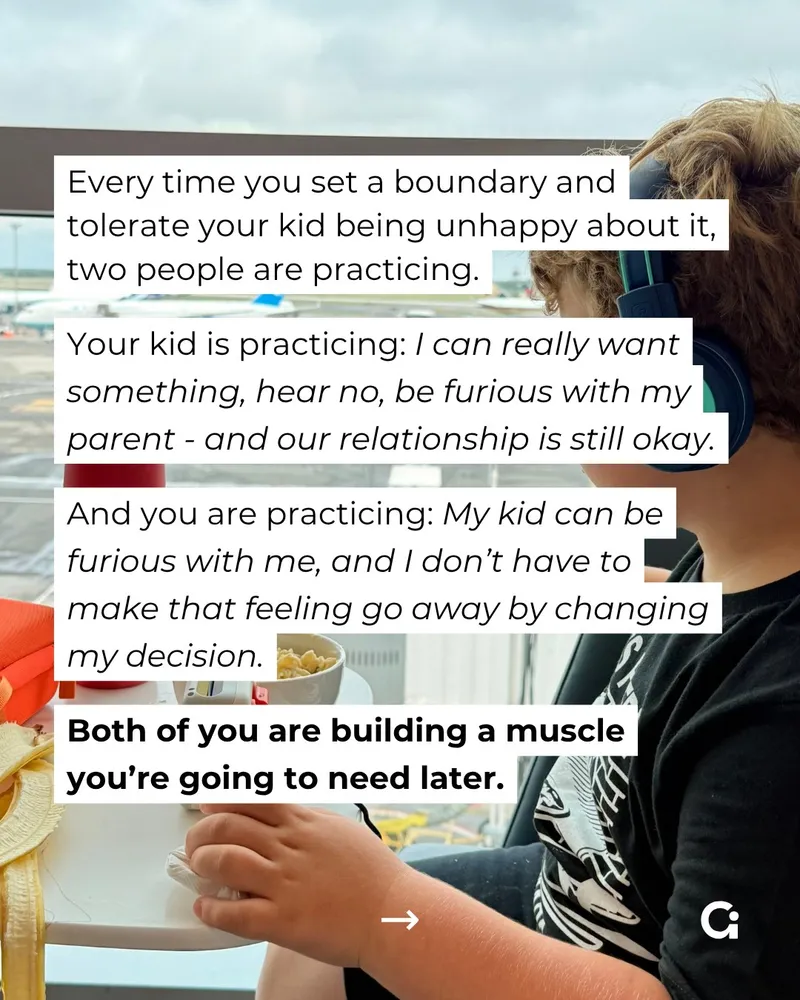
Every time you set a boundary and tolerate your kid being unhappy about it, two people are practicing. Your kid is practicing: I can really want something, hear no, be furious with my parent - and our relationship is still okay. And you are practicing: My kid can be furious with me, and I don’t have to make that feeling go away by changing my decision. Both of you are building a muscle you’re going to need later.
It implies this shared practice will make later, higher-stakes boundaries feel more familiar.
Yes. It expands the previous slide’s claim that the lesson is bigger than cupcakes by naming the actual emotional practice behind boundaries.
The same child and beachside setting continue. Separate white panels explain what the child and parent each practice when a boundary causes upset.
Slide 5 · Future Stakes Payoff
It makes the future risk concrete and shows why repeated low-stakes boundaries reduce the shock of later digital limits.
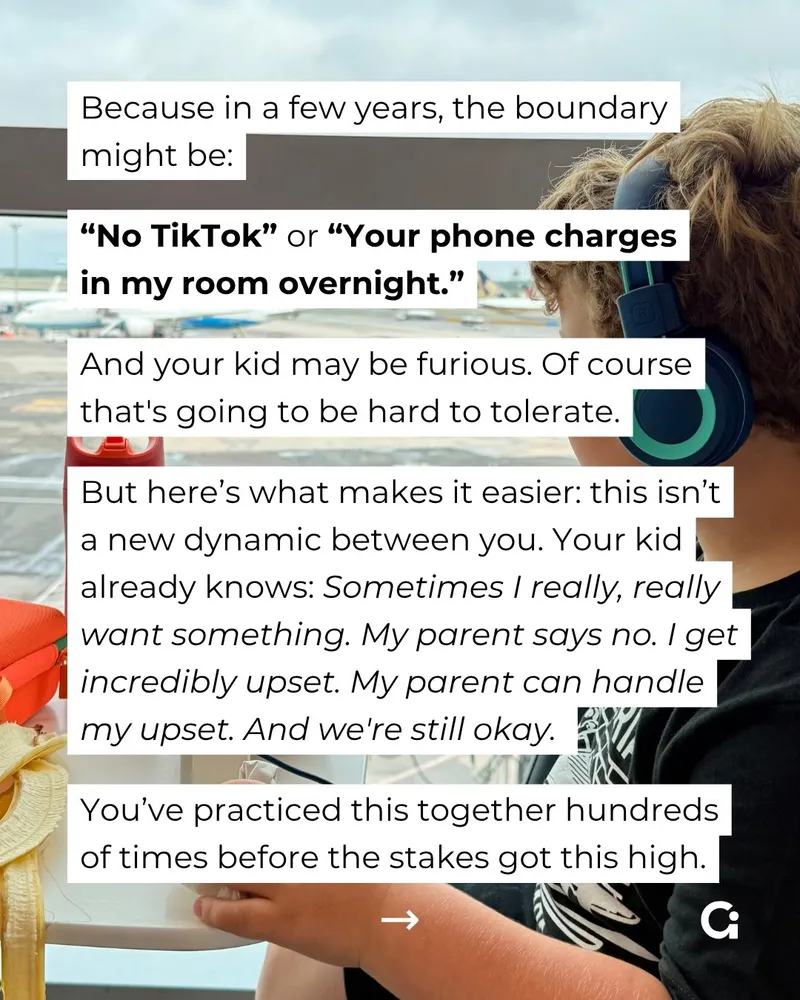
Because in a few years, the boundary might be: “No TikTok” or “Your phone charges in my room overnight.” And your kid may be furious. Of course that’s going to be hard to tolerate. But here’s what makes it easier: this isn’t a new dynamic between you. Your kid already knows: Sometimes I really, really want something. My parent says no. I get incredibly upset. My parent can handle my upset. And we’re still okay. You’ve practiced this together hundreds of times before the stakes got this high.
It opens the question of what children are learning about the parent-child relationship through these repeated moments.
Yes. It fulfills the promise that today’s cupcake moment prepares the family for future TikTok and phone boundaries.
The child with headphones remains the visual anchor. The text moves from future phone rules to reassurance that the family has already rehearsed this emotional pattern.
Slide 6 · Relationship Principle
It reframes boundaries as lessons about relationship safety and parental steadiness, not just rules about behavior.
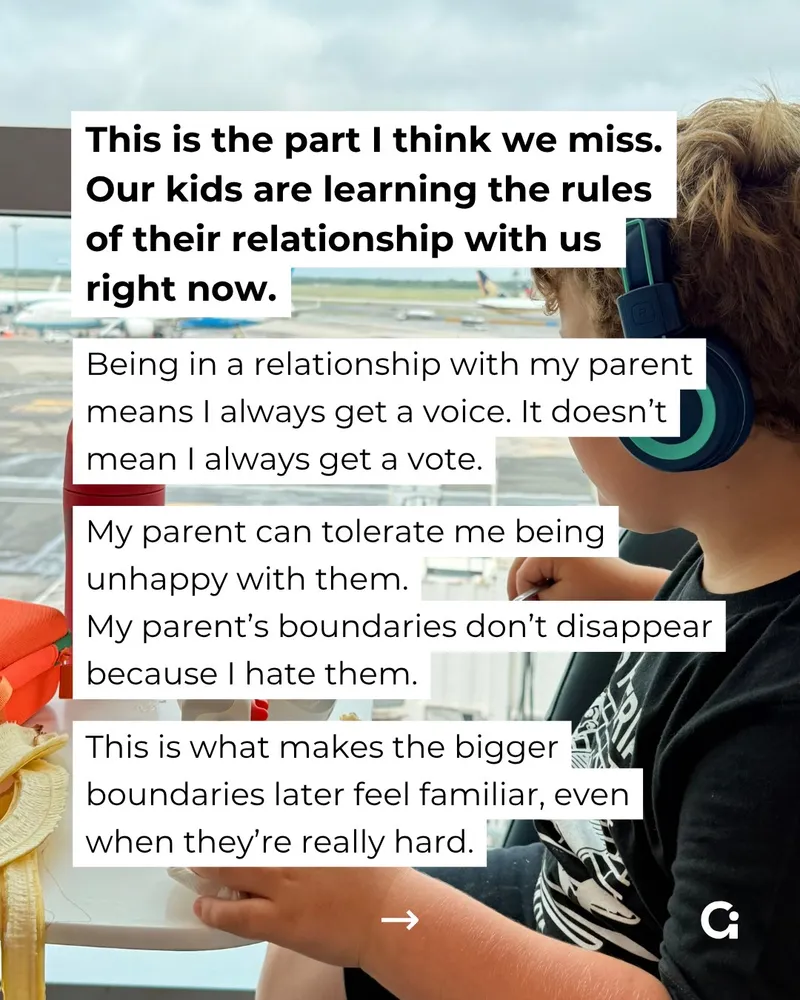
This is the part I think we miss. Our kids are learning the rules of their relationship with us right now. Being in a relationship with my parent means I always get a voice. It doesn’t mean I always get a vote. My parent can tolerate me being unhappy with them. My parent’s boundaries don’t disappear because I hate them. This is what makes the bigger boundaries later feel familiar, even when they’re really hard.
It prepares viewers to see the harm of introducing a major boundary suddenly, without this established relationship pattern.
Yes. It explains what the child is learning during everyday limits and why those lessons matter for future boundaries.
White text panels present relationship principles over the recurring photo. The slide contrasts having a voice with having the deciding vote.
Slide 7 · Objection and Contrast
It shows the likely result of skipping earlier boundary practice: a high-stakes rule feels like a sudden change in the relationship.
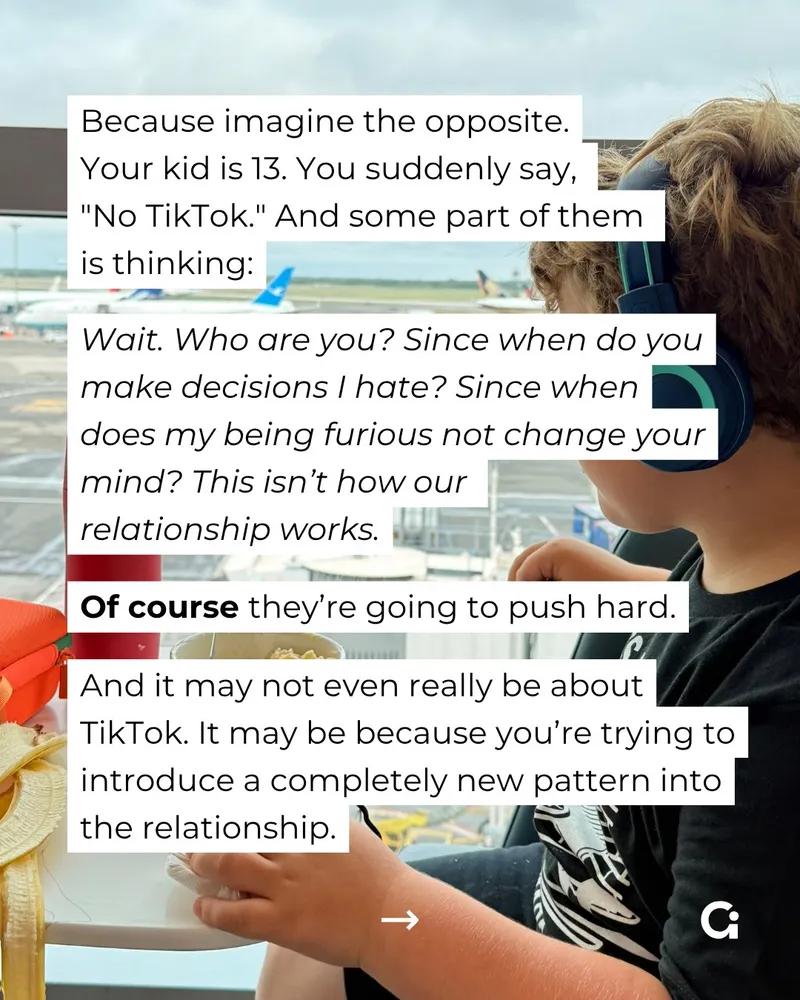
Because imagine the opposite. Your kid is 13. You suddenly say, “No TikTok.” And some part of them is thinking: Wait. Who are you? Since when do you make decisions I hate? Since when does my being furious not change your mind? This isn’t how our relationship works. Of course they’re going to push hard. And it may not even really be about TikTok. It may be because you’re trying to introduce a completely new pattern into the relationship.
It sets up the final reframing: the cupcake matters as practice, not because cupcakes themselves are dangerous.
Yes. It fulfills the implied promise to show why future limits become harder when they appear without a history of steady boundaries.
The child faces away while the text imagines a sudden rule at age 13. A quoted inner reaction shows why the child may resist the new pattern.
Slide 8 · Core Argument Summary
It resolves the analogy by clearly stating that everyday limits build the relationship pattern needed for harder boundaries later.
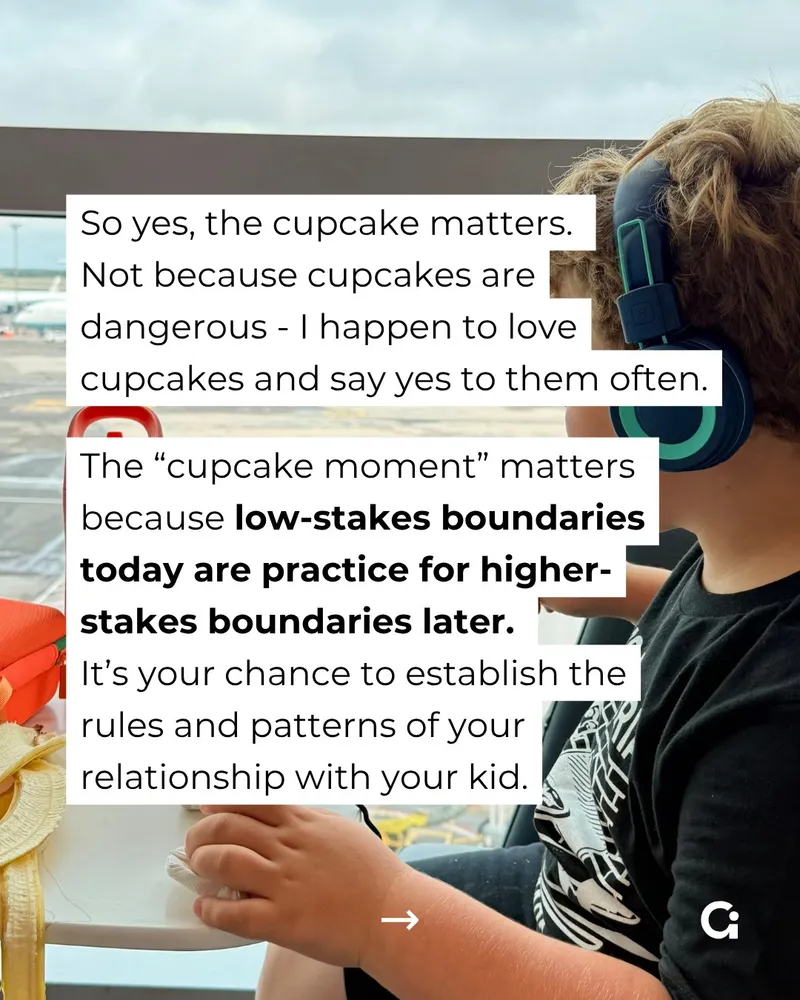
So yes, the cupcake matters. Not because cupcakes are dangerous - I happen to love cupcakes and say yes to them often. The “cupcake moment” matters because low-stakes boundaries today are practice for higher-stakes boundaries later. It’s your chance to establish the rules and patterns of your relationship with your kid.
It leaves the viewer ready for a hopeful next step and an offer of support for building these boundary skills.
Yes. It directly fulfills the carousel’s central promise: the cupcake example is practice for future phone and social media limits.
The recurring child-and-cupcake image returns as the argument is summarized. Bold text highlights the link between low-stakes boundaries and future high-stakes limits.
Slide 9 · Hopeful Promotional CTA
It closes with reassurance, connects the lesson to the program, and gives viewers a specific way to request more information.
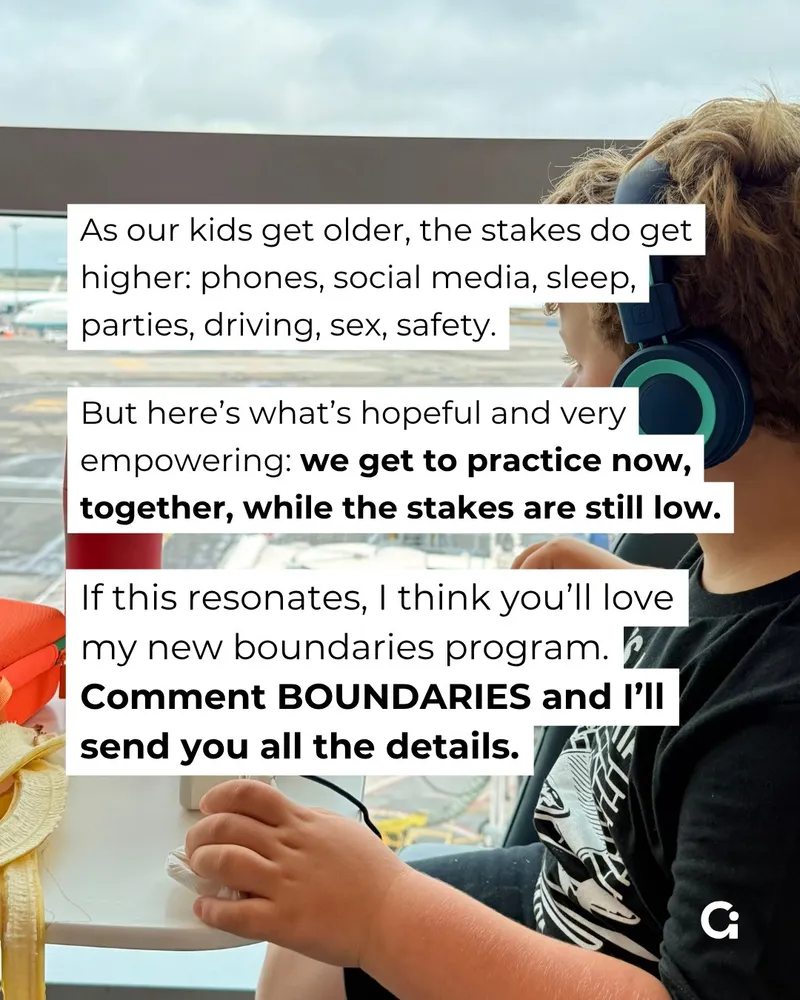
As our kids get older, the stakes do get higher: phones, social media, sleep, parties, driving, sex, safety. But here’s what’s hopeful and very empowering: we get to practice now, together, while the stakes are still low. If this resonates, I think you’ll love my new boundaries program. Comment BOUNDARIES and I’ll send you all the details.
Comment BOUNDARIES and I’ll send you all the details.
The program promises additional guidance and details for parents who want support with boundaries.
Yes. It confirms that the viewer can prepare for harder future limits through practice now, then offers structured help.
The final slide lists future high-stakes topics, then shifts to reassurance and promotes the Boundaries Program with a comment-based response CTA.