 Tavus@tavus
Introducing Griffin, the first model to pass the video Turing test. 48% of people who talked to it live thought it was a real human. Previous systems have had a pass rate <3%. It is #1 on NVIDIA's benchmark for full-duplex AI video. It’s the first Human Interaction Model (HIM). t.co/eb11XbC8Xr
- Views
- 20,883,823
- Likes
- 39,277
- Replies
- 3,369
- Reposts
- 4,295
- Quotes
- 5,620
- Bookmarks
- 27,518
Introducing Griffin, the first model to pass the video Turing test.
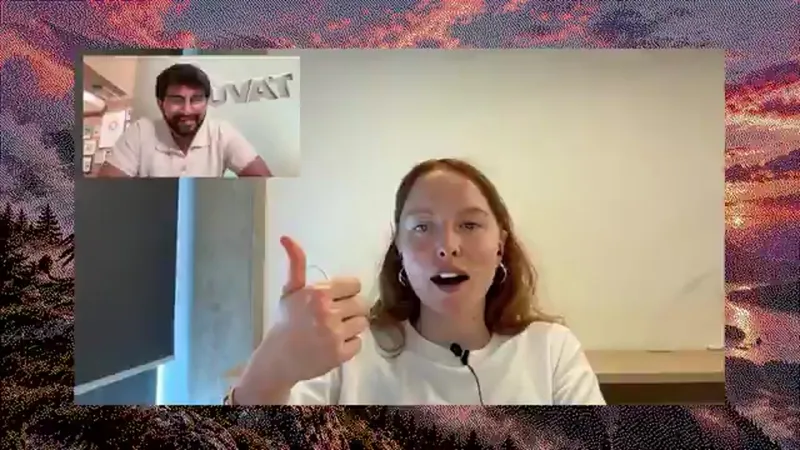
A staged workplace conversation introduces Griffin, an AI video model, and shows it chatting with a person. The exchange highlights human-like responses and gestures as they discuss whether viewers will recognize it as AI.
- Views
- 20.9M
- Likes
- 39.3K
- Replies
- 3.4K
- Reposts
- 4.3K
- Quotes
- 5.6K
- Bookmarks
- 27.5K
- Human-like video AIVideo Turing testAI-human interaction
Analysis
A staged workplace conversation introduces Griffin, an AI video model, and shows it chatting with a person. The exchange highlights human-like responses and gestures as they discuss whether viewers will recognize it as AI.
- SkitDemoProduct showcase
- The office and laptop video-call shots depict the conversation described in the transcript. At one sample, a second man appears beside the seated speaker, while a woman is visible in a video-call window.
“Introducing Griffin, the first model to pass the video Turing test. 48% of people who talked to it live thought it was a real human. Previous systems have had a pass rate <3%. It is #1 on NVIDIA's benchmark for full-duplex AI video. It’s the first Human Interaction Model (HIM). https://t.co/eb11XbC8Xr”
- Text
“Alrighty. Let's do this.”
- 01Frame the introduction and choose a proof
Establishes the presentation problem and resolves it with a plan to demonstrate rather than merely explain.
A casual opening leads into a discussion of how to introduce something new; one person suggests showing it, and the other proposes a concrete demonstration as proof.
“Alrighty. Let's do this. Hey, Hassan. How's it going? It's pretty late for you. Have you thought any more about how we're introducing Griffin? I don't know. What are your ideas? I mean, I think we should stop trying to explain it and just, you know, show them what it looks like. Do you think that we should just show a recording of us talking or something? I think a video of just us like this would be the best way to actually prove it. Do you think they'll believe that you're AI? I think that's the whole point, isn't it? If it's good enough, they won't even have to think about it.”
- 02Demonstrate through a casual interaction
The planned demonstration unfolds as ordinary conversation, offering varied moments for the audience to judge its realism.
A small request and enthusiastic response lead into friendly praise, then a teasing exchange about clothing and a self-reported low battery percentage.
“Now, how about just a thumbs up? Sure. One thumbs up coming right up. Hell yeah. That was awesome. I would say you're my favorite co worker. It's been really great to work on this with you. You're making me blush. Ah. Who's that with the ugly sweater? Yeah, I thrifted this. Yeah, it definitely looks like it. Oh my gosh. Okay, 1%. You're living on the edge, Hassan. Truly.”
- 03Reveal a capability and assess the illusion
Turns the interaction into evidence for the central claim, then adds a broader interpretation of what the demonstration suggests.
A comment about conserving a limited resource prompts an observation that the behavior changed; the speakers then reflect that the distinction between machine and person is becoming thin and connect that impression to a larger test.
“I'll keep my breathing steady so I don't drain your CPU any faster. Wow, you actually did slow down your breathing. It's like the line between talking to a machine and just talking to someone is getting really, really thin. Yeah, it really feels like we're like, you know, passing the Turing test soon.”
- 04Qualify the conclusion and invite a judgment
Reframes the proof as a revealing human-like interaction, then leaves the final judgment open rather than claiming an unqualified conclusion.
The conversation qualifies the apparent success: showing the human part of the simulation may itself be the most real demonstration. A question about whether that goes too far receives a hesitant, unfinished reply.
“But honestly, if we want people to see the human part of the simulation, maybe that's the most real thing we could show them. What do you think? Is it too much? No. No, I. I think.”