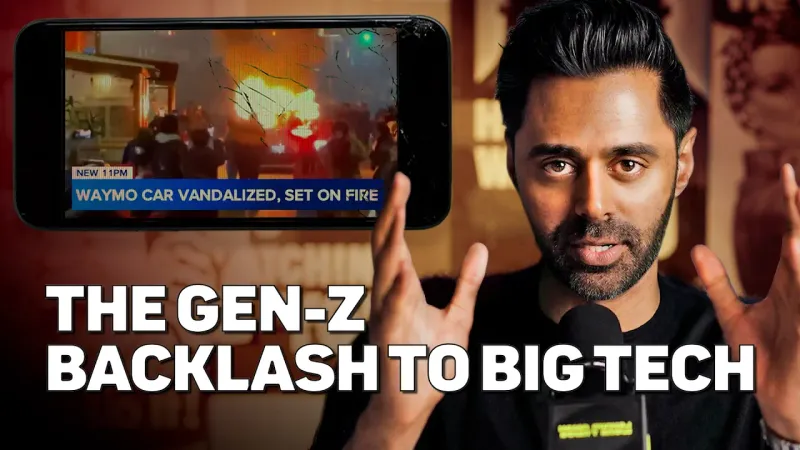
The Gen Z Backlash to Big Tech
Hasan Minhaj@HasanMinhajThe Gen Z Backlash to Big Tech
Hasan Minhaj opens by exploring Gen Z’s nostalgia for the 1990s and an analog world before smartphones and social media. The episode features Gowanus, a spokespuppet for the emerging Luddite Movement, and is framed around its reasons for resisting Big Tech; the supplied description also mentions an effort to get Hasan to delete an app.

- Views
- 766.3K
- Likes
- 24.4K
- Comments
- 2.5K
- Gen Z Nostalgia for the 1990sLuddite movementBig tech backlashSmartphone and Social Media Use
Analysis
Hasan Minhaj opens by exploring Gen Z’s nostalgia for the 1990s and an analog world before smartphones and social media. The episode features Gowanus, a spokespuppet for the emerging Luddite Movement, and is framed around its reasons for resisting Big Tech; the supplied description also mentions an effort to get Hasan to delete an app.
- InterviewCommentary
- Title
- The Gen Z Backlash to Big Tech
Welcome. >> I recently noticed a trend that was so fascinating that I had to dig deeper. I don't know if you've noticed this, but Gen Z has become obsessed with the '9s. >> Scroll through social media and the '9s are back. Cassette tape sales are up with more than 430,000 sold last year. I got these two pretty affordable digital cameras on eBay and they take the best photos I've ever had in my life. Look at all these VHS's. Now, I'm used to people being nostalgic for an era that they lived through when they were kids. Like, my friends will constantly say, "Dude, life was so much better in the '9s." And I'll be like, "No, no, no. Your life was better because you had a full head of hair, zero back pain, and you could drink a soda that didn't have the word probiotic in it." But what we're witnessing right now, this is something different. This is a generation nostalgic for a time when they weren't even alive. Which I find weird because I'm not nostalgic for the 50s. Like when I watch Mad Men, I know exactly how they treat me. I'd be an elevator attendant and John Han would use my hat as an ashtray. I >> feel bad for you. >> I don't think about you at all. >> But I'll see videos on YouTube from a random day in high school in the 1990s that will get millions of views with comments like, "Everyone seemed a lot nicer and healthier without social media. Not a phone in sight. Everyone's just vibing. No cell phones, no social media, no craving for digital likes, no 9/11. To be clear, we still had September 11th before 9/11. But we just celebrated Moby's birthday and just kept it moving. Now, I'm not cherry-picking random YouTube comments. A survey last year found that 68% of Gen Z adults reported feeling nostalgic for eras before their lifetime. Gen Z feels a sense of loss for something they never had. an analog world before smartphones and social media and the internet. But the ironic part to me is that as a '90s kid, we were obsessed with the future. And that future was all about the internet. Imagine a world where every word ever written, every picture ever painted, and every film ever shot could be viewed instantly in your home via an information superighway. AT&T had a whole ad campaign called You Will, where Tom Celich would show you all the cool things you'd be able to do online. >> Have you ever paid a toll without slowing down, bought concert tickets from a cash machine, or tucked your baby in from a phone booth? >> You will. Have you ever ruined Justin Long's day by writing a mean comment on his Instagram post from the comfort of your own toilet? You will. The internet promised to unlock the potential of human curiosity and creativity. It would make information free and connect everybody. And most of all, the internet was going to be fun. >> Now that I've gotten on the internet, I'd rather be on my computer than doing just about anything. It's really cool. And the search engines will show us all the millions of pages of websites and chat lines and games and everything. >> Yep, they got more stuff than you can imagine. >> Okay, at first it was mostly used by 13-year-old boys to look at JPEGs of naked ladies. But by the early 2000s, as we entered the new millennium, >> it's rewind time.
- 01Introduce the trend
Establishes the topic and signals that the trend will be examined more closely.
The speaker says a fascinating trend prompted a closer look, then identifies Gen Z’s interest in the '90s.
“Welcome. >> I recently noticed a trend that was so fascinating that I had to dig deeper. I don't know if you've noticed this, but Gen Z has become obsessed with the '9s.”
- 02Give examples and a personal counterpoint
Makes the trend concrete, then distinguishes nostalgia for a lived past from interest in a time the group did not experience.
The speaker points to signs of renewed interest in the era, shares personal examples, and contrasts this with familiar nostalgia for one’s own childhood.
>> Scroll through social media and the '9s are back. Cassette tape sales are up with more than 430,000 sold last year. I got these two pretty affordable digital cameras on eBay and they take the best photos I've ever had in my life. Look at all these VHS's. Now, I'm used to people being nostalgic for an era that they lived through when they were kids. Like, my friends will constantly say, "Dude, life was so much better in the '9s." And I'll be like, "No, no, no. Your life was better because you had a full head of hair, zero back pain, and you could drink a soda that didn't have the word probiotic in it."
- 03State the generational reversal
Sharpens the opening’s central contrast and invites the viewer to consider why a generation might miss an era it never experienced.
The speaker says this nostalgia is different because Gen Z longs for a time before they were alive, then uses a comic comparison to illustrate the point.
“But what we're witnessing right now, this is something different. This is a generation nostalgic for a time when they weren't even alive. Which I find weird because I'm not nostalgic for the 50s. Like when I watch Mad Men, I know exactly how they treat me. I'd be an elevator attendant and John Han would use my hat as an ashtray. I >> feel bad for you. >> I don't think about you at all.”
- 04Support the claim and pivot to the past's lost world
Adds a specific survey claim to the trend, develops the irony through historical contrast, and pivots toward a broader discussion of the internet. The excerpt stops during that pivot, before explaining how it connects to the packaged Big Tech backlash.
The speaker notes the popularity of nostalgic comments, clarifies that they are not relying only on cherry-picked examples, cites a survey, and describes the analog world Gen Z may feel it missed. The opening then contrasts this with the '90s generation’s enthusiasm for the internet and begins introducing the internet’s promise.
>> But I'll see videos on YouTube from a random day in high school in the 1990s that will get millions of views with comments like, "Everyone seemed a lot nicer and healthier without social media. Not a phone in sight. Everyone's just vibing. No cell phones, no social media, no craving for digital likes, no 9/11. To be clear, we still had September 11th before 9/11. But we just celebrated Moby's birthday and just kept it moving. Now, I'm not cherry-picking random YouTube comments. A survey last year found that 68% of Gen Z adults reported feeling nostalgic for eras before their lifetime. Gen Z feels a sense of loss for something they never had. an analog world before smartphones and social media and the internet. But the ironic part to me is that as a '90s kid, we were obsessed with the future. And that future was all about the internet. Imagine a world where every word ever written, every picture ever painted, and every film ever shot could be viewed instantly in your home via an information superighway. AT&T had a whole ad campaign called You Will, where Tom Celich would show you all the cool things you'd be able to do online. >> Have you ever paid a toll without slowing down, bought concert tickets from a cash machine, or tucked your baby in from a phone booth? >> You will. Have you ever ruined Justin Long's day by writing a mean comment on his Instagram post from the comfort of your own toilet? You will. The internet promised to unlock the potential of human curiosity and creativity. It would make information free and connect everybody. And most of all, the internet was going to be fun. >> Now that I've gotten on the internet, I'd rather be on my computer than doing just about anything. It's really cool. And the search engines will show us all the millions of pages of websites and chat lines and games and everything. >> Yep, they got more stuff than you can imagine. >> Okay, at first it was mostly used by 13-year-old boys to look at JPEGs of naked ladies. But by the early 2000s, as we entered the new millennium, >> it's rewind time.