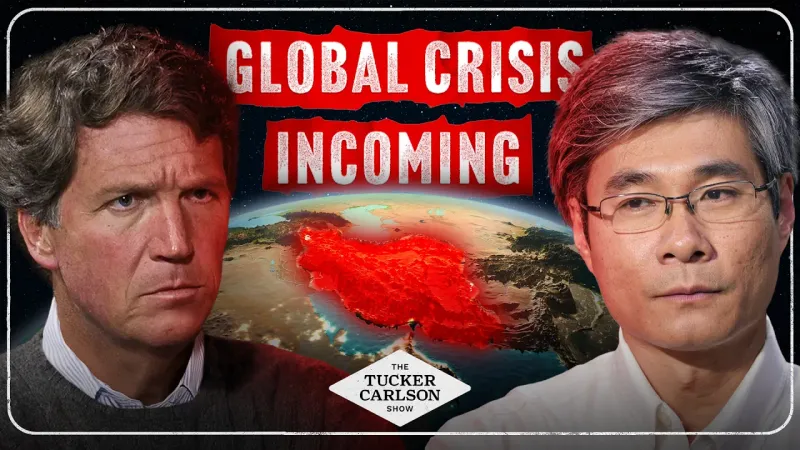
Political Prophet Predicts the Next Phase in Iran, Trump’s War Plan, & Israel’s Plot to Sabotage It
Tucker Carlson@TuckerCarlsonPolitical Prophet Predicts the Next Phase in Iran, Trump’s War Plan, & Israel’s Plot to Sabotage It
Tucker Carlson interviews Professor Jiang Xueqin about how the Iran war might unfold and affect the wider world. Jiang predicts a prolonged war of attrition, rising energy costs and broader economic disruption; the chapter list also signals discussion of regional powers, U.S. policy, Israel and the future of Europe and North America.
- Views
- 3.7M
- Likes
- 147.6K
- Comments
- 27K
- Iran war forecastGlobal energy crisisMiddle east conflictWar's Global Consequences
Analysis
Tucker Carlson interviews Professor Jiang Xueqin about how the Iran war might unfold and affect the wider world. Jiang predicts a prolonged war of attrition, rising energy costs and broader economic disruption; the chapter list also signals discussion of regional powers, U.S. policy, Israel and the future of Europe and North America.
- Interview

- Title
- Political Prophet Predicts the Next Phase in Iran, Trump’s War Plan, & Israel’s Plot to Sabotage It
“Professor, thank you very much for doing this. We've we've never met. I don't know a great deal about you, but I have seen a number uh of your videos in which you make remarkably accurate predictions. Um, so that's what I know about you and I'm impressed by that by your ability to call events before they happen. So with that in mind, let me ask you, where do you think this war in Iran is going? How will it be resolved? and what are the consequences likely to be? Well, thanks so much for inviting me, Tucker. I'm a huge fan. I've been uh among your work for a number of years now. Thank you. So, I think that this war in Iran uh will be very similar to the war in Ukraine, meaning that this will be drawn out, be a war of attrition. Uh neither side will concede defeat even though it is in their best interest to reach a ceasefire. And this will have dram dramatic consequences on the uh global economy. Um and this war could drag on for years and years. Already we're seeing major repercussions on the global economy in that flights are being cancelled. Uh in Southeast Asia they ran out of fuel. So they're asking people to stay at home and um in a few more months uh experts are predicting a food shortage meaning that nations will be forced into food rationing and um today there's a major escalation in that the Israelis struck the largest gas field in Iran and Iran retaliated by attacking energy infrastructure of the GCC. Um and Iran has stated that its purpose, its goal, its strategy is to move oil to $200 a barrel, which will have um a really significant impact on the global economy because the entire global economy is based on access to cheap energy. So unfortunately, I think that we can expect this war to drag on for years and years. Eventually, America will send in ground troops. Uh eventually the hormos will be contested. Um eventually this will spread all across the world. Eventually other nations be drawn in. So Saudi Arabia uh is thinking about declaring war on Iran and Saudi Arabia has a neutral defense pack with Pakistan. So Pakistan will be drawn into this into this war. So um things are sping out of control and um just recently um Ali uh Larajini who is the de facto head of the Iranian war effort was assassinated and um he was a pomatic um elder statesman in Iran who who had the authority to negotiate a ceasefire. Now that he's gone um there really is no more offramp. So um both sides are committed to a long war of attrition and uh the consequences for the entire global economy are quite dire. That is u I I wouldn't say that's the worst case scenario. The worst case scenario would include a nuclear strike by one or more actors and the destruction of the Oxamos complex in Jerusalem which would spark a religious war. So that's as bad as it could get. But you've just described one step before the worst which is protracted, destructive, impossible to stop. So my question is because there are so many global players, big global players, the US and China I think who would be hurt by this, why is there not an incentive to get it settled quickly and why can't that happen? Right. Um so once this war starts it um it's it it achieves a momentum and a logic of its own.”
- 01Establish the guest's reputation
This praise establishes why the guest's forecast merits attention before the host asks for one.
The host thanks the guest, notes they have not met, and says the guest's videos have made remarkably accurate predictions. The host says this ability to call events in advance is impressive.
“Professor, thank you very much for doing this. We've we've never met. I don't know a great deal about you, but I have seen a number uh of your videos in which you make remarkably accurate predictions. Um, so that's what I know about you and I'm impressed by that by your ability to call events before they happen.”
- 02Ask for the forecast
The linked questions define the subject and open several consequential parts of the forecast for the guest to address.
The host asks where the war is going, how it will be resolved, and what consequences are likely.
“So with that in mind, let me ask you, where do you think this war in Iran is going? How will it be resolved? and what are the consequences likely to be?”
- 03Guest responds and sets the forecast
The guest moves from the host's open questions to a specific, qualified forecast, establishing a long conflict and economic consequences as the central premise.
The guest thanks the host, expresses appreciation for his work, then predicts a prolonged war of attrition similar to the war in Ukraine. The guest says neither side will concede despite the interest both have in a ceasefire, and anticipates dramatic effects on the global economy.
“Well, thanks so much for inviting me, Tucker. I'm a huge fan. I've been uh among your work for a number of years now. Thank you. So, I think that this war in Iran uh will be very similar to the war in Ukraine, meaning that this will be drawn out, be a war of attrition. Uh neither side will concede defeat even though it is in their best interest to reach a ceasefire. And this will have dram dramatic consequences on the uh global economy.”
- 04Forecast wider repercussions
Specific examples give the broad economic warning context, while the oil-price claim links the conflict to a mechanism that could affect economies worldwide. These remain the guest's account and forecasts.
The guest says the war could last for years, cites flight cancellations and fuel shortages, and relays experts' prediction of a possible food shortage and rationing. The guest then describes a recent escalation and Iran's stated strategy of raising oil prices, arguing that expensive energy would significantly affect the global economy.
“Um and this war could drag on for years and years. Already we're seeing major repercussions on the global economy in that flights are being cancelled. Uh in Southeast Asia they ran out of fuel. So they're asking people to stay at home and um in a few more months uh experts are predicting a food shortage meaning that nations will be forced into food rationing and um today there's a major escalation in that the Israelis struck the largest gas field in Iran and Iran retaliated by attacking energy infrastructure of the GCC. Um and Iran has stated that its purpose, its goal, its strategy is to move oil to $200 a barrel, which will have um a really significant impact on the global economy because the entire global economy is based on access to cheap energy.”
- 05Extend the forecast and qualify the worst case
The guest broadens the forecast from economic effects to regional escalation, while the qualification distinguishes the stated dire outlook from an even worse possibility.
The guest predicts the conflict may spread, other countries may be drawn in, and Saudi Arabia may declare war, potentially involving Pakistan. The guest describes events as spiraling out of control, then cites the assassination of an Iranian figure who, according to the guest, had authority to negotiate a ceasefire. The guest concludes that there is no longer an offramp and says the consequences for the global economy are dire, while clarifying that this is not the worst-case scenario.
“So unfortunately, I think that we can expect this war to drag on for years and years. Eventually, America will send in ground troops. Uh eventually the hormos will be contested. Um eventually this will spread all across the world. Eventually other nations be drawn in. So Saudi Arabia uh is thinking about declaring war on Iran and Saudi Arabia has a neutral defense pack with Pakistan. So Pakistan will be drawn into this into this war. So um things are sping out of control and um just recently um Ali uh Larajini who is the de facto head of the Iranian war effort was assassinated and um he was a pomatic um elder statesman in Iran who who had the authority to negotiate a ceasefire. Now that he's gone um there really is no more offramp. So um both sides are committed to a long war of attrition and uh the consequences for the entire global economy are quite dire. That is u I I wouldn't say that's the worst case scenario. The worst case scenario would include a nuclear strike by one or more actors and the destruction of the Oxamos complex in Jerusalem which would spark a religious war. So that's as bad as it could get.”
- 06Host asks why settlement is difficult
The host turns the forecast into a question about the obstacles to resolution. The guest's initial answer begins, but the excerpt ends before that explanation develops, so this is the boundary of the available introduction.
The host observes that the guest has described a devastating conflict short of the worst case, then asks why major global players such as the United States and China lack an incentive to settle it quickly. The guest begins answering that a war develops momentum and its own logic.
“But you've just described one step before the worst which is protracted, destructive, impossible to stop. So my question is because there are so many global players, big global players, the US and China I think who would be hurt by this, why is there not an incentive to get it settled quickly and why can't that happen? Right. Um so once this war starts it um it's it it achieves a momentum and a logic of its own.”