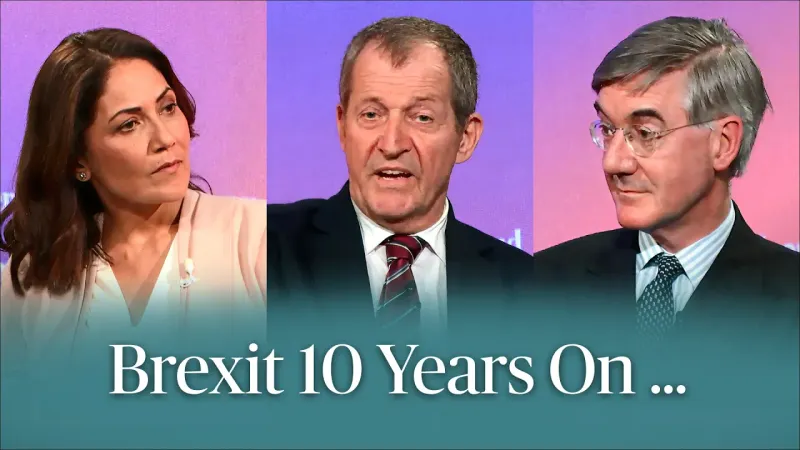
Alastair Campbell and Jacob Rees-Mogg Debate Brexit | The Mishal Husain Show
Bloomberg Podcasts@BloombergPodcastsAlastair Campbell and Jacob Rees-Mogg Debate Brexit | The Mishal Husain Show
Mishal Husain moderates Alastair Campbell and Jacob Rees-Mogg in a public debate marking ten years since the Brexit vote. They discuss its economic and political effects, campaigning after the result, immigration, the prospect of another referendum and the UK's future relationship with the EU.

- Views
- 319.6K
- Likes
- 4.2K
- Comments
- 2.9K
- Brexit's Economic ImpactBrexit and UK PoliticsUK-EU RelationsFuture of Brexit
Analysis
Mishal Husain moderates Alastair Campbell and Jacob Rees-Mogg in a public debate marking ten years since the Brexit vote. They discuss its economic and political effects, campaigning after the result, immigration, the prospect of another referendum and the UK's future relationship with the EU.
- InterviewNews analysis
- Title
- Alastair Campbell and Jacob Rees-Mogg Debate Brexit | The Mishal Husain Show
“Does it have any impact upon you, these reasonably intelligent group of people actually think that what you inflicted upon the country has damaged the country. What I think is that the British people voted for it. Yes, they voted for it based upon ... And we should respect to democratic result, which you have never wanted to do. It was a day that changed Britain and Europe. And 10 years on Alastair Campbell and Jacob Rees-Mogg go head to head on Brexit. Do you think that Brexit has led us to the much more multi-party politics that we are in now? One of the reasons for Brexit is that people felt whoever they voted for, nothing changed. Very little has changed in the 10 years since, and now they're looking at other parties. A lot of people who voted for Brexit are disappointed that hasn't delivered a better life for them. From Bloomberg Weekend. This is The Mishal Husain Show. Now, hopefully you all know by now that this show is a place where we try to make sense of the world with one essential conversation every week. That is the case with episodes every Friday, except when there's more to say. That's how it is this week because it is exactly 10 years since voters in the UK faced a big choice, having their say on membership of the European Union. 2016, 48% of people voted to remain in the EU, 52% voted to leave, the moment when the Brexit process began. Even though episodes here are usually one-to-one, this one is a debate because we wanted to bring together two of the most high profile campaigners for and against Brexit. Two people who still feel strongly about it 10 years on it's Jacob Rees-Mogg and Alastair Campbell, and we brought them together on a stage, in London, in front of an audience of Bloomberg subscribers. So let's get to it. Here's what happened when they both joined me on stage. I think I can definitely say that these two do not love each other. They do love politics and debate and they are with us to Mark 10 years since the vote to leave the EU. So please welcome Alastair Campbell and Jacob Rees-Mogg. Welcome. Now, some of you will remember that it was at Bloomberg, not in this building, in our old headquarters where David Cameron made the fateful pledge that he was in favor of having an in-out referendum on the EU. 10 years ago, Jacob Rees-Mogg, you were a Conservative MP. You campaigned to leave the EU. Alastair Campbell, you were very much on the other side in 2016, but people knew you already from your work with Tony Blair in Downing Street. In the time we have, I want to look back at the economic impact and the political impact of Brexit in the last 10 years and also your views on the future and what could or should be the future of the UK's relationship with the EU.”
- 01Opposing positions
The immediate disagreement establishes the debate’s central tension and gives the viewer competing interpretations to weigh.
A pointed question about the consequences of a decision is followed by an answer emphasizing the people’s choice and the need to respect it.
“Does it have any impact upon you, these reasonably intelligent group of people actually think that what you inflicted upon the country has damaged the country. What I think is that the British people voted for it. Yes, they voted for it based upon ... And we should respect to democratic result, which you have never wanted to do.”
- 02Anniversary premise
This establishes the retrospective frame and confirms the subject and opposing speakers before the episode’s broader introduction.
The opening marks the decision’s effect on Britain and Europe, then names the anniversary debate and its two participants.
“It was a day that changed Britain and Europe. And 10 years on Alastair Campbell and Jacob Rees-Mogg go head to head on Brexit.”
- 03Debate preview
The preview offers an initial account of the political aftermath, while leaving the wider anniversary debate’s consequences open for examination.
A question about the decision’s possible political consequences prompts an explanation of why people turned toward other parties and why some voters were disappointed.
“Do you think that Brexit has led us to the much more multi-party politics that we are in now? One of the reasons for Brexit is that people felt whoever they voted for, nothing changed. Very little has changed in the 10 years since, and now they're looking at other parties. A lot of people who voted for Brexit are disappointed that hasn't delivered a better life for them.”
- 04Show and episode identification
The show identification follows the cold open and establishes the recurring format and editorial context for the episode.
A brief source credit is followed by the show’s name and its recurring purpose: making sense of the world through a weekly conversation.
“From Bloomberg Weekend. This is The Mishal Husain Show. Now, hopefully you all know by now that this show is a place where we try to make sense of the world with one essential conversation every week. That is the case with episodes every Friday, except when there's more to say.”
- 05Why this episode, and what it covers
The episode’s date and format explain why these guests are together now. The roadmap names the political and economic record and the future relationship with the EU; this is the introduction’s final framing before the host turns to the first question.
The host explains the anniversary occasion, gives the referendum result, distinguishes this episode’s debate format from the usual one-to-one conversation, introduces the opposing campaigners and venue, and previews the retrospective topics.
“That's how it is this week because it is exactly 10 years since voters in the UK faced a big choice, having their say on membership of the European Union. 2016, 48% of people voted to remain in the EU, 52% voted to leave, the moment when the Brexit process began. Even though episodes here are usually one-to-one, this one is a debate because we wanted to bring together two of the most high profile campaigners for and against Brexit. Two people who still feel strongly about it 10 years on it's Jacob Rees-Mogg and Alastair Campbell, and we brought them together on a stage, in London, in front of an audience of Bloomberg subscribers. So let's get to it. Here's what happened when they both joined me on stage. I think I can definitely say that these two do not love each other. They do love politics and debate and they are with us to Mark 10 years since the vote to leave the EU. So please welcome Alastair Campbell and Jacob Rees-Mogg. Welcome. Now, some of you will remember that it was at Bloomberg, not in this building, in our old headquarters where David Cameron made the fateful pledge that he was in favor of having an in-out referendum on the EU. 10 years ago, Jacob Rees-Mogg, you were a Conservative MP. You campaigned to leave the EU. Alastair Campbell, you were very much on the other side in 2016, but people knew you already from your work with Tony Blair in Downing Street. In the time we have, I want to look back at the economic impact and the political impact of Brexit in the last 10 years and also your views on the future and what could or should be the future of the UK's relationship with the EU.”