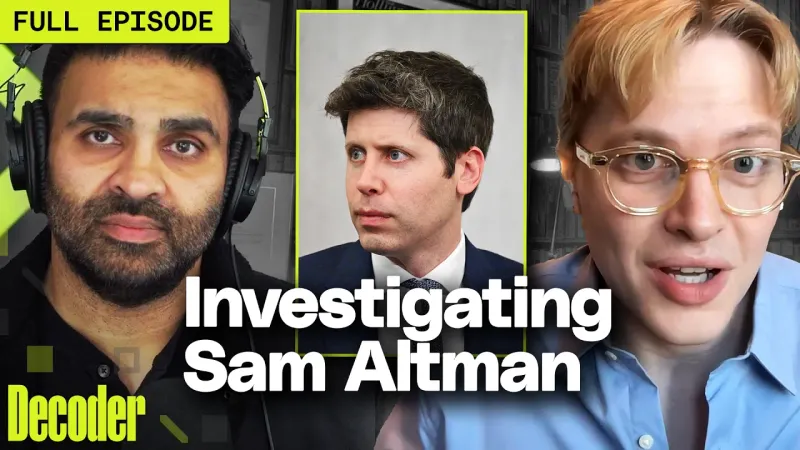
Ronan Farrow on Sam Altman's strained relationship with the truth | Decoder
Decoder with Nilay Patel@DecoderPodRonan Farrow on Sam Altman's strained relationship with the truth | Decoder
Decoder host Nilay Patel interviews investigative reporter Ronan Farrow about his New Yorker feature on Sam Altman, OpenAI’s rise, and Farrow’s reporting process. The episode examines claims about Altman’s truthfulness, the culture around OpenAI, AI oversight, and whether public institutions can keep pace with the industry.

- Views
- 53.2K
- Likes
- 1K
- Comments
- 109
- Sam Altman’s TrustworthinessOpenAI’s RiseInvestigative reportingAI oversight
Analysis
Decoder host Nilay Patel interviews investigative reporter Ronan Farrow about his New Yorker feature on Sam Altman, OpenAI’s rise, and Farrow’s reporting process. The episode examines claims about Altman’s truthfulness, the culture around OpenAI, AI oversight, and whether public institutions can keep pace with the industry.
- InterviewPodcast episode

- Title
- Ronan Farrow on Sam Altman's strained relationship with the truth | Decoder
“There's a line in the story that to me feels like the the thesis of the story. Sam Alman is unconstrained by the truth and that he has two traits that are almost never seen in the same person. The first is a strong desire to please people to be liked in any given interaction. And the second is an almost sociopathic lack of concern for the consequences that may come from deceiving someone. So many other people around it who had the concerns and voiced them urgently just folded like napkins and changed their tune the moment they saw the wind was blowing the other way and they wanted in on the profit train. It's pretty dark honestly from my standpoint as a reporter. >> But then I think back to Sam getting fired. I took a source call at the Bronx Zoo at 7:00 p.m. on a Friday and it was someone saying they're going to try to get Sam back. Well, first of all, sorry to your daughter and my partner and all the other people around journalist weekend for everyone. Um, yeah, no, it does take over one's life. >> Hello and welcome to Decoder. I'm Neil Patel, editor and chief of the Verge, and Decoder is my show about big ideas and other problems. Today, I'm talking with Ronan Pharaoh, one of the biggest stars of investigative reporting working today. Ronin broke the Harvey Weinstein story among many, many others. And just last week, he and co-author Andrew Morance published an incredible deep dive feature in The New Yorker about OpenAI CEO Sam Alman, his trustworthiness, and the rise of OpenAI itself. One note before we go any further here. The New Yorker published that story, and Ronin and I had this conversation before the attacks on Sam Alman's home, so you won't hear us talk about them directly, but just to say it, I think violence of any kind is unacceptable. these attacks on Sam were unacceptable and that the kind of helplessness that people feel which leads to this kind of violence is also unacceptable and it's worth more scrutiny from both the industry and our political leaders. I hope that's clear. All that said, there is a lot of swirl around Sam Alman that's fair game for rigorous reporting. The kind of reporting that Ronin set out to do. Thanks to the popularity of ChatBevt, Alman has emerged as the most visible figurehead of the AI industry. having turned a once nonprofit research lab into an almost trillion dollar private company in just a few years. But the myth of Sam Alman is deeply conflicted, defined equally by both his obvious steel-making ability and the tendency which Ronin reported to well lie to everyone around him. Ronin talked to Alman many times over the 18 months he spent reporting the story. And so one of the main things I was curious about was whether Ronin sensed any change in Alman over that time. After all, a lot has happened in AI, in tech, and in the world over the past year and a half. You'll hear Ronin talk about that very directly, as well as a sense that people have become much more willing to talk about Alman's ability to stretch the truth. Okay, Ronan Pharaoh on Sam Alman AI and the truth. Here we go. Ronan Pharaoh, you're an investigative reporter and contributor to The New Yorker. Welcome to Decoder. >> Glad to be here. Thanks for having me. >> I am very excited to talk to you. You just wrote a big piece for the New Yorker.”
- 01Guest’s thesis
A pointed interpretation establishes the conversation’s central tension and invites the viewer to consider its basis. The account is the guest’s characterization, not independent verification.
The guest presents a central interpretation of a person, describes two traits as rarely found together, and says people around the subject changed their position when circumstances favored them. The guest adds a personal assessment from a reporter’s perspective.
“There's a line in the story that to me feels like the the thesis of the story. Sam Alman is unconstrained by the truth and that he has two traits that are almost never seen in the same person. The first is a strong desire to please people to be liked in any given interaction. And the second is an almost sociopathic lack of concern for the consequences that may come from deceiving someone. So many other people around it who had the concerns and voiced them urgently just folded like napkins and changed their tune the moment they saw the wind was blowing the other way and they wanted in on the profit train. It's pretty dark honestly from my standpoint as a reporter.”
- 02A personal reporting anecdote
This brief anecdote grounds the exchange in the reporting experience and provides a human moment before the host formally introduces the show. It is not a complete account of the firing or its aftermath.
The guest recalls a source call at the Bronx Zoo after the subject was fired, then responds to a remark about the effect of a journalist’s weekend on family and partners.
“>> But then I think back to Sam getting fired. I took a source call at the Bronx Zoo at 7:00 p.m. on a Friday and it was someone saying they're going to try to get Sam back. Well, first of all, sorry to your daughter and my partner and all the other people around journalist weekend for everyone. Um, yeah, no, it does take over one's life.”
- 03Show, host, and guest introduction
The formal identification follows the opening exchange and establishes who is hosting, who the guest is, and why his reporting is relevant to the coming discussion.
The host welcomes listeners to Decoder, identifies himself and the show’s remit, then introduces Ronan Farrow and his investigative reporting, including the Weinstein story.
“>> Hello and welcome to Decoder. I'm Neil Patel, editor and chief of the Verge, and Decoder is my show about big ideas and other problems. Today, I'm talking with Ronan Pharaoh, one of the biggest stars of investigative reporting working today. Ronin broke the Harvey Weinstein story among many, many others.”
- 04Feature and topical qualification
The feature gives the interview a clear reporting basis. The timing note marks the limits of what the conversation can address, while the host’s statement makes his position on the attacks explicit.
The host cites a recent New Yorker feature by the guest and a co-author about OpenAI’s CEO, his trustworthiness, and OpenAI’s rise. He clarifies that the interview happened before attacks on the subject’s home, condemns the violence, and says the associated helplessness warrants scrutiny.
“And just last week, he and co-author Andrew Morance published an incredible deep dive feature in The New Yorker about OpenAI CEO Sam Alman, his trustworthiness, and the rise of OpenAI itself. One note before we go any further here. The New Yorker published that story, and Ronin and I had this conversation before the attacks on Sam Alman's home, so you won't hear us talk about them directly, but just to say it, I think violence of any kind is unacceptable. these attacks on Sam were unacceptable and that the kind of helplessness that people feel which leads to this kind of violence is also unacceptable and it's worth more scrutiny from both the industry and our political leaders. I hope that's clear.”
- 05Reporting context and conversation roadmap
This final framing connects the guest’s reporting to the opening thesis and leaves the viewer with a specific question about change over time, plus a preview of the conversation’s related topic. The excerpt then transitions into the guest’s introduction and the interview itself.
The host says rigorous reporting on the subject is fair game, summarizes the subject’s prominence and company growth, and describes the reported tension between ability and truthfulness. He notes the guest’s reporting span, raises whether the subject changed, and previews discussion of shifting willingness to talk about his relationship with the truth.
“All that said, there is a lot of swirl around Sam Alman that's fair game for rigorous reporting. The kind of reporting that Ronin set out to do. Thanks to the popularity of ChatBevt, Alman has emerged as the most visible figurehead of the AI industry. having turned a once nonprofit research lab into an almost trillion dollar private company in just a few years. But the myth of Sam Alman is deeply conflicted, defined equally by both his obvious steel-making ability and the tendency which Ronin reported to well lie to everyone around him. Ronin talked to Alman many times over the 18 months he spent reporting the story. And so one of the main things I was curious about was whether Ronin sensed any change in Alman over that time. After all, a lot has happened in AI, in tech, and in the world over the past year and a half. You'll hear Ronin talk about that very directly, as well as a sense that people have become much more willing to talk about Alman's ability to stretch the truth. Okay, Ronan Pharaoh on Sam Alman AI and the truth. Here we go. Ronan Pharaoh, you're an investigative reporter and contributor to The New Yorker. Welcome to Decoder. >> Glad to be here. Thanks for having me. >> I am very excited to talk to you. You just wrote a big piece for the New Yorker.”