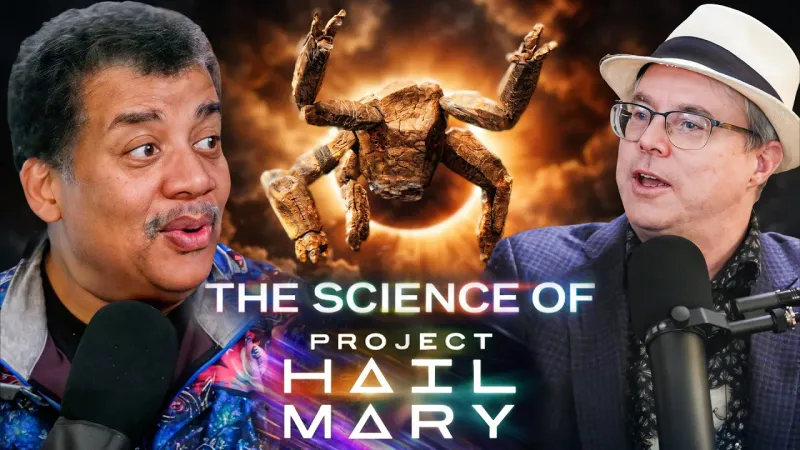
Neil deGrasse Tyson Confronts Andy Weir on the Science of Project Hail Mary
StarTalk@StarTalkNeil deGrasse Tyson Confronts Andy Weir on the Science of Project Hail Mary
Neil deGrasse Tyson and Chuck Nice talk with author Andy Weir about the science and storytelling behind Project Hail Mary, including Rocky’s biology and the book’s alien world. They also discuss The Martian’s path to film, choices in the adaptation, and Weir’s advice for aspiring writers.

- Views
- 2.9M
- Likes
- 72.1K
- Comments
- 3.9K
- Project hail mary scienceRocky alien biologyAndy weir writingScience fiction adaptation
Analysis
Neil deGrasse Tyson and Chuck Nice talk with author Andy Weir about the science and storytelling behind Project Hail Mary, including Rocky’s biology and the book’s alien world. They also discuss The Martian’s path to film, choices in the adaptation, and Weir’s advice for aspiring writers.
- InterviewPodcast episode

- Title
- Neil deGrasse Tyson Confronts Andy Weir on the Science of Project Hail Mary
“This other alien, it kind of looks like a pile of rocks. So the way it does a technical location is just like we have nerve endings for touch, he has nerve endings for sound. Because of that, they have a constant input of their 3D environment. Wouldn't it be neat if you could just go like this and the room gets brighter for a second? You could be like If they suddenly can't hear anything, they will lose all of that information. If you close your eyes, you know where everything is in the room. They don't have that part of a brain. They don't have to track that because they constantly have three hundred and six degree input. This is StarTalk. Neil deGrasse Tyson, your personal astrophysicist. And right next to me, I got Lord Chuck Nice. What's up, Neil? Chuck, how you doing, man? How you feeling? Man, I'm feeling great. Yeah. Yeah. You look good. Well, thank you, sir. You know, looking healthy. Well, that may not be the case, but You know, it's good to look that way. Whether or not you actually are healthy. Who cares if I'm actually healthy or not, as long as I look good. We got a good show today. We certainly do. Oh my God, we have a repeat guest. That's correct. Many times. Many times. I looked at the numbers. Multiple appearances. I said, hasn't boy been on this show that many times? Yeah. And I said, no, yeah. We have the one, the only, Andy Weir. Andy. Hello. Welcome back to StarTalk. Thanks for having me again. This is like your 6th time. You'd think you guys would learn by now. You'd think. You keep writing books and we keep bringing you back. I like it. You were birthed into this world as a, was it a software engineer? Well, it took me a while between birth and becoming a software engineer, but yes. I was going to say that is, that was one seriously developmental womb. Yeah. There wasn't a lot of software engineering in 19 72. I mean, there was some, though. I mean, Apollo program. Turned sci-fi novelist. Yes, sir. Extraordinaire. Man. Extraordinaire. From The Martian, a best-selling book. Yeah. Which became a best A very popular movie. A hit. A hit movie. A hit movie. A hit movie with all kinds of marquee actors in it. Right. Jessica Chastain. Right. Matt Damon. Matt Damon. Who was Mark Watley. Watney. Oh, is it Watney? It is Watney. Oh, okay. Says the guy who wrote it. Whatever. At the time I lived in Boston when I first started writing it and I lived alone because I was a loser. And I was like, at the time I was really into Red Sox games and they had a sideline reporter named Heidi Watney. Oh, really? And so I'm like, I like that name. I like that name. I'm taking it. Okay. So Heidi Watney, if you're out there. Mark's named after you. Actually, Heidi, no, no, no, no, he's not because we don't want to owe you any money. Andy doesn't know what he's saying. He's been drinking since noon. StarTalk personally takes responsibility for any monetary compensation. There you go. So what year did The Martian come out? Well, it took me years to write the book. I started writing it in 2009, finished around 2012. The book came out, I think, 23. It's early teens. Yeah. And so the movie comes out in. 20 15. 20 15. The movie. Yeah. So that's a quick turnaround between.”
- 01Make the unfamiliar concrete
This cold open makes an unfamiliar feature easier to picture and gives the viewer a reason to follow the explanation before the show is identified.
The speaker describes an unusual subject through an everyday sensory comparison and an imagined example, then explains the relevant difference.
“This other alien, it kind of looks like a pile of rocks. So the way it does a technical location is just like we have nerve endings for touch, he has nerve endings for sound. Because of that, they have a constant input of their 3D environment. Wouldn't it be neat if you could just go like this and the room gets brighter for a second? You could be like If they suddenly can't hear anything, they will lose all of that information. If you close your eyes, you know where everything is in the room. They don't have that part of a brain. They don't have to track that because they constantly have three hundred and six degree input.”
- 02Identify the show and host
After the subject-first opening, the show and host identification orient the viewer and lead into the guest exchange.
The host names the recurring show and introduces himself with a playful role description, then presents the guest.
“This is StarTalk. Neil deGrasse Tyson, your personal astrophysicist. And right next to me, I got Lord Chuck Nice.”
- 03Build rapport with the guest
The friendly exchange establishes the conversational relationship before the host introduces the returning guest and the episode's background.
Host and guest exchange greetings and brief jokes about looking healthy, then agree that the episode should be a good one.
“What's up, Neil? Chuck, how you doing, man? How you feeling? Man, I'm feeling great. Yeah. Yeah. You look good. Well, thank you, sir. You know, looking healthy. Well, that may not be the case, but You know, it's good to look that way. Whether or not you actually are healthy. Who cares if I'm actually healthy or not, as long as I look good. We got a good show today. We certainly do.”
- 04Establish the returning guest
This exchange confirms the guest's established relationship with the show and completes the welcome before moving to his background.
The host and guest joke about the guest's many appearances, identify him by name, and welcome him back to the show.
“Oh my God, we have a repeat guest. That's correct. Many times. Many times. I looked at the numbers. Multiple appearances. I said, hasn't boy been on this show that many times? Yeah. And I said, no, yeah. We have the one, the only, Andy Weir. Andy. Hello. Welcome back to StarTalk. Thanks for having me again. ”
- 05Sketch the guest's path
The background connects the guest's experience to the subject of science fiction, while the banter keeps the introduction conversational. This is still context-setting rather than the promised Project Hail Mary discussion.
The conversation jokes about how often the guest has returned, then traces his path from software engineering through the Apollo era to science-fiction writing and The Martian's popular film adaptation.
“This is like your 6th time. You'd think you guys would learn by now. You'd think. You keep writing books and we keep bringing you back. I like it. You were birthed into this world as a, was it a software engineer? Well, it took me a while between birth and becoming a software engineer, but yes. I was going to say that is, that was one seriously developmental womb. Yeah. There wasn't a lot of software engineering in 19 72. I mean, there was some, though. I mean, Apollo program. Turned sci-fi novelist. Yes, sir. Extraordinaire. Man. Extraordinaire. From The Martian, a best-selling book. Yeah. Which became a best A very popular movie. A hit. A hit movie. A hit movie. A hit movie with all kinds of marquee actors in it. Right. Jessica Chastain. Right. Matt Damon. Matt Damon. Who was Mark Watley. Watney. Oh, is it Watney? It is Watney. Oh, okay. Says the guy who wrote it. Whatever. At the time I lived in Boston when I first started writing it and I lived alone because I was a loser. And I was like, at the time I was really into Red Sox games and they had a sideline reporter named Heidi Watney. Oh, really? And so I'm like, I like that name. I like that name. I'm taking it. Okay. So Heidi Watney, if you're out there. Mark's named after you. Actually, Heidi, no, no, no, no, he's not because we don't want to owe you any money. Andy doesn't know what he's saying. He's been drinking since noon. StarTalk personally takes responsibility for any monetary compensation. There you go.”
- 06Turn to a work's release history
The question begins a more specific discussion of the guest's work, but the bounded transcript cuts off before the introduction's eventual transition can be established; no complete introduction ending is inferred.
The host asks when The Martian came out, and the guest gives an approximate account of writing and publication dates before the excerpt ends during a question about the film.
“So what year did The Martian come out? Well, it took me years to write the book. I started writing it in 2009, finished around 2012. The book came out, I think, 23. It's early teens. Yeah. And so the movie comes out in. 20 15. 20 15. The movie. Yeah. So that's a quick turnaround between.”