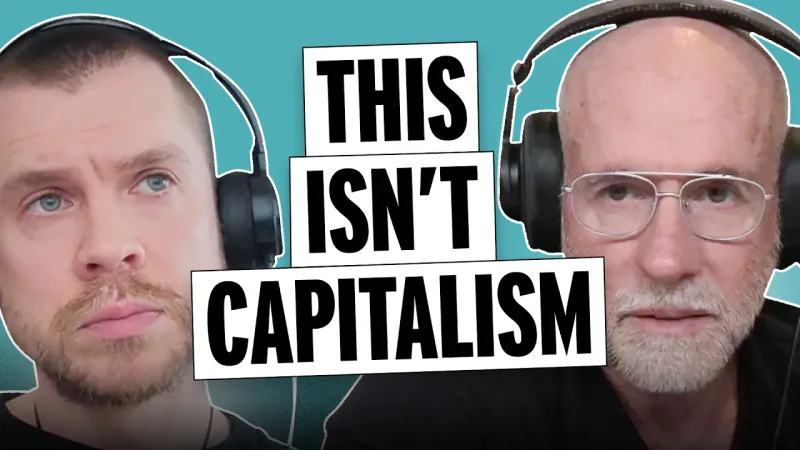
Gary Stevenson: “Your Kids Will Be Poorer Than You” | Prof G Conversations
The Prof G Pod – Scott Galloway@TheProfGPodGary Stevenson: “Your Kids Will Be Poorer Than You” | Prof G Conversations
Gary Stevenson and Scott Galloway discuss rising wealth inequality, taxes on high wealth, and the pressures they say are shrinking the middle class. Stevenson argues that economies increasingly reward ownership over work and warns younger generations may be poorer than their parents; the conversation also covers tax proposals and enforcement.

- Views
- 352.7K
- Likes
- 11.1K
- Comments
- 2.7K
- Wealth inequalityWealth tax policyMiddle class declineIntergenerational living standards
Analysis
Gary Stevenson and Scott Galloway discuss rising wealth inequality, taxes on high wealth, and the pressures they say are shrinking the middle class. Stevenson argues that economies increasingly reward ownership over work and warns younger generations may be poorer than their parents; the conversation also covers tax proposals and enforcement.
- InterviewPodcast episode
- Title
- Gary Stevenson: “Your Kids Will Be Poorer Than You” | Prof G Conversations
“Do you want everything to be owned by the tiny elite or not? If you do not want everything to be owned by a tiny elite, you have to aggressively tax extremely high levels of wealth. Because otherwise, if you're Jeff Bezos, what is what's he worth? $300 million, $300 billion, right? Even if he makes 5% a year, right? Which he's going to make way more than that. Even if he makes 5% a year, he's making $15 billion a year, right? And it's just going to grow, right? It's going to grow unbelievably quickly. >> Gary, where does this podcast find you? [music] >> Uh, I'm in my flat in uh London, East London, close to Canary Warf. >> Oh, nice. I live in Marleone. >> Okay. Fancy. >> Yeah, very fancy. That's what I was going for. That's what I said to the real estate broker. Fancy. Um, it's actually it's all about the dogs were right across from the park. Uh, okay. Uh, let's bust right into it. Uh, you were on property markets about a year ago. And at that time, the wealth tax conversation has picked up significantly in the US. The top 1% of households now hold a staggering 32% of all wealth. Uh, the greatest share since the Fed began tracking in '89, roughly equal to the combined wealth of the bottom 90%. I should also have the top 10% own 90% of the stocks. And at the same time, the portion of GDP going to workers just hit its lowest level in 75 years. So, this has given rise to a bunch of um different proposals. Um, one of which has gotten the most attention is in California, they're actively debating a onetime 5% tax on residents, essentially a wealth tax with a net worth exceeding $1 billion. Uh, let's start more broadly and then we'll talk about the wealth tax. Do you feel like we're in an inflection point around a serious conversation around inequality? When I say serious, that will actually lead to different tax policies. >> I think there's obviously been an increase in the salience of discussions around in particular taxation of the rich. If I'm totally honest, I think still when these conversations take place, as much as obviously from my perspective, it's great that they're taking place more often, I think they are still often a little bit fasile in the sense that they and and I think that is because especially in the US context, they're happening in this context of this incredibly factional political debate where it's very much my side, your side, and it's very frustrating for me because my background as you know is I'm an economist. I'm a trader and what I see is rapidly growing inequality of wealth which I think is increasingly obviously pretty directly causing rapidly increasing poverty, rapidly falling living standards. And what I would like there to be is like a grownup sensible conversation where we say okay how do we stop this? But in reality that's not really what is happening. What what tends to happen is people like well to be honest it's often not people like me it's it's sort of become two sides. It's like tax the rich and no don't tax the rich because it's impossible. And it's the conversation has it it has become factional in this way that it has not really created the space which I would say really allows anybody even me to have a really sensible conversation about how can we actually do this in a way that actually works.”
- 01Frame the issue and state the proposed response
This establishes the central question and takes a clear position immediately, giving the viewer a concrete claim to assess.
The speaker asks whether viewers want ownership concentrated among a small elite, then says that preventing it requires aggressively taxing very high wealth.
“Do you want everything to be owned by the tiny elite or not? If you do not want everything to be owned by a tiny elite, you have to aggressively tax extremely high levels of wealth.”
- 02Illustrate accumulation with a named example
The example makes the abstract claim about concentrated wealth tangible and develops interest in how quickly it can accumulate.
The speaker uses Jeff Bezos as an example, asks how much he is worth, and estimates the annual return and resulting growth of his wealth.
“Because otherwise, if you're Jeff Bezos, what is what's he worth? $300 million, $300 billion, right? Even if he makes 5% a year, right? Which he's going to make way more than that. Even if he makes 5% a year, he's making $15 billion a year, right? And it's just going to grow, right? It's going to grow unbelievably quickly.”
- 03Brief host handoff and location exchange
This conversational handoff identifies the guest by name and transitions from the opening claim into the interview. It is brief connective material rather than a separate substantive promise.
The host asks Gary where he is, and the guest says he is at his flat in East London. The host mentions their own location, prompting a short exchange about its being fancy.
“>> Gary, where does this podcast find you? [music] >> Uh, I'm in my flat in uh London, East London, close to Canary Warf. >> Oh, nice. I live in Marleone. >> Okay. Fancy. >> Yeah, very fancy. That's what I was going for. That's what I said to the real estate broker. Fancy.”
- 04Light aside and move into the topic
The aside closes the location exchange; the host’s transition then turns the conversation toward the substantive interview.
The guest clarifies that the location choice was about being near a park for the dogs. The host acknowledges this and announces that they will get into the discussion.
“Um, it's actually it's all about the dogs were right across from the park. Uh, okay. Uh, let's bust right into it.”
- 05Set the topic and introduce economic context
The host situates the conversation in current debates and supplies quantitative context for why wealth taxation is under discussion. These figures are presented as the host’s claims, not independently verified facts.
The host notes the guest’s prior appearance discussing property markets, then describes increased attention to wealth taxes in the United States and cites claims about the shares of wealth held by top households and the lowest share of GDP going to workers in 75 years.
“Uh, you were on property markets about a year ago. And at that time, the wealth tax conversation has picked up significantly in the US. The top 1% of households now hold a staggering 32% of all wealth. Uh, the greatest share since the Fed began tracking in '89, roughly equal to the combined wealth of the bottom 90%. I should also have the top 10% own 90% of the stocks. And at the same time, the portion of GDP going to workers just hit its lowest level in 75 years.”
- 06Name a policy proposal and broaden the question
A specific proposal gives the broad debate a concrete example. The host’s question then opens the floor to the guest on whether the discussion is changing in a consequential way.
The host says the figures have prompted proposals, mentions California’s debated one-time 5% tax on residents with net worth above $1 billion, then asks whether society is at an inflection point for a serious discussion of inequality and different tax policies.
“So, this has given rise to a bunch of um different proposals. Um, one of which has gotten the most attention is in California, they're actively debating a onetime 5% tax on residents, essentially a wealth tax with a net worth exceeding $1 billion. Uh, let's start more broadly and then we'll talk about the wealth tax. Do you feel like we're in an inflection point around a serious conversation around inequality? When I say serious, that will actually lead to different tax policies.”
- 07Guest describes the debate’s limits and his perspective
The guest acknowledges the increased attention while challenging the quality of the conversation. His stated expertise and account of the consequences frame the problem he wants to discuss; the supplied excerpt cuts off before this explanation concludes.
The guest agrees that discussion of taxing the rich has become more prominent, but says it often turns factional. He identifies himself as an economist and trader, describes what he sees as rising inequality and falling living standards, and says he wants a sensible conversation about how to address the problem. He then explains that the debate tends to divide into opposing sides and ends by saying it has not created space for a sensible discussion of what would work.
“>> I think there's obviously been an increase in the salience of discussions around in particular taxation of the rich. If I'm totally honest, I think still when these conversations take place, as much as obviously from my perspective, it's great that they're taking place more often, I think they are still often a little bit fasile in the sense that they and and I think that is because especially in the US context, they're happening in this context of this incredibly factional political debate where it's very much my side, your side, and it's very frustrating for me because my background as you know is I'm an economist. I'm a trader and what I see is rapidly growing inequality of wealth which I think is increasingly obviously pretty directly causing rapidly increasing poverty, rapidly falling living standards. And what I would like there to be is like a grownup sensible conversation where we say okay how do we stop this? But in reality that's not really what is happening. What what tends to happen is people like well to be honest it's often not people like me it's it's sort of become two sides. It's like tax the rich and no don't tax the rich because it's impossible. And it's the conversation has it it has become factional in this way that it has not really created the space which I would say really allows anybody even me to have a really sensible conversation about how can we actually do this in a way that actually works.”