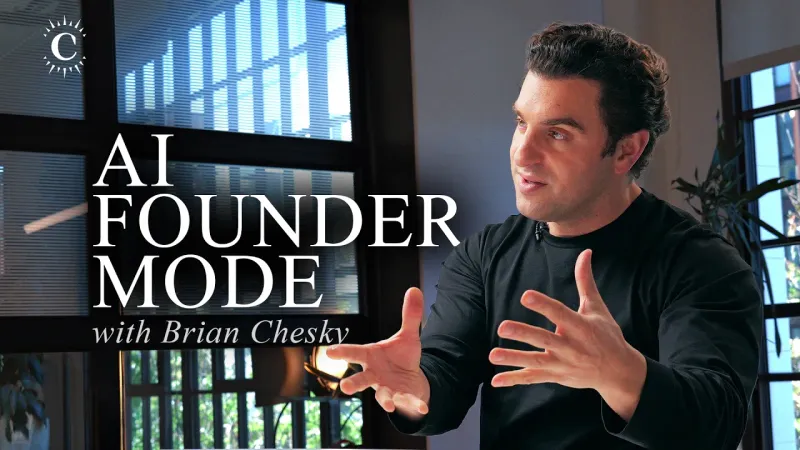
How Brian Chesky Is Redesigning Airbnb for the AI Era
Invest Like The Best@ILTB_PodcastHow Brian Chesky Is Redesigning Airbnb for the AI Era
Patrick O'Shaughnessy interviews Airbnb CEO Brian Chesky about his path from industrial design to company leadership and the shift from founder to CEO. They discuss design principles, hiring and team focus, Airbnb's future, and Chesky's view that AI could open new possibilities for consumer products.

- Views
- 183.3K
- Likes
- 3.5K
- Comments
- 158
- Brian chesky leadershipAI and Consumer ProductsIndustrial designAirbnb strategy
Analysis
Patrick O'Shaughnessy interviews Airbnb CEO Brian Chesky about his path from industrial design to company leadership and the shift from founder to CEO. They discuss design principles, hiring and team focus, Airbnb's future, and Chesky's view that AI could open new possibilities for consumer products.
- Interview
- Title
- How Brian Chesky Is Redesigning Airbnb for the AI Era
No one is born a good CEO. I think people are basically born good founders or said differently it's innate. You don't have to learn how to be a good founder. The job of CEO is completely counterintuitive and almost all of your intuition about what to do is wrong. We founders were taught to learn by doing and that's great for a founder. It's not good as a CEO. You do not want to learn on the job how to be a CEO. And so I learned the hard way and it was really about not apologizing about how you want to run a company, being in the details. Before we hit go here, we were talking about industrial design, which you studied at Risie. And I have this weird affinity for the history of this topic just because Raymond Loey, one of the famous industrial designers, helped me a lot in my career indirectly. I'd love to hear you just riff on the influence that guys like him had in your early studies and why you studied that in the first place. Such an interesting background. >> I went to I was an artist growing up, but I didn't know what to do with my life. And I went to the Rhode Island School of Design and at Risy when you're a freshman, you have to pick a major. >> I'm 17 years old and I'm like, "Okay, in three months I have to decide what I'm going to do the rest of my life." And there were 18 majors. And I remember the department head for industrial design came. I never even heard of the term industrial design. I don't know what it was. And they said industrial design, design of everything from a toothbrush to a spaceship and everything in between. I immediately said that's what I want to do with my life cuz I was thinking of maybe being an architect or something like that. And so I started learning about industrial design and I learned about Charles from Ray Emmes. Raymond Loey. Raymond Loey probably the most important industrial designer of the 20th century. Designed so many incredible products. his first designer, Air Force One. He designed like, you know, a lot of like consumer products, very beautiful consumer products. He had a profound impact, I think, on society.
- 01Separate two roles
This establishes the discussion’s central distinction and challenges the assumption that skill in one role automatically transfers to another.
The speaker contrasts innate ability in one role with the counterintuitive demands of another, then explains what learning by doing does and does not prepare someone to do.
“No one is born a good CEO. I think people are basically born good founders or said differently it's innate. You don't have to learn how to be a good founder. The job of CEO is completely counterintuitive and almost all of your intuition about what to do is wrong. We founders were taught to learn by doing and that's great for a founder. It's not good as a CEO. You do not want to learn on the job how to be a CEO.”
- 02Lesson learned firsthand
The personal experience grounds the earlier claim in a concrete leadership lesson before the conversation changes subject.
The speaker says he learned the demands of the role the hard way and identifies not apologizing for how he wanted to run a company and staying involved in the details as part of that lesson.
“And so I learned the hard way and it was really about not apologizing about how you want to run a company, being in the details.”
- 03Question about formative studies
The question opens a new line of discussion about the guest’s educational background and the people who shaped it. The brief response begins that account, but the excerpt ends before its development or the introduction’s eventual transition can be established.
The interviewer recalls a conversation about the guest’s studies in a field, connects their own interest in its history to a designer’s indirect influence on their career, and asks about the influence of such designers and why the guest studied the field.
Before we hit go here, we were talking about industrial design, which you studied at Risie. And I have this weird affinity for the history of this topic just because Raymond Loey, one of the famous industrial designers, helped me a lot in my career indirectly. I'd love to hear you just riff on the influence that guys like him had in your early studies and why you studied that in the first place. Such an interesting background. >> I went to I was an artist growing up, but I didn't know what to do with my life. And I went to the Rhode Island School of Design and at Risy when you're a freshman, you have to pick a major. >> I'm 17 years old and I'm like, "Okay, in three months I have to decide what I'm going to do the rest of my life." And there were 18 majors. And I remember the department head for industrial design came. I never even heard of the term industrial design. I don't know what it was. And they said industrial design, design of everything from a toothbrush to a spaceship and everything in between. I immediately said that's what I want to do with my life cuz I was thinking of maybe being an architect or something like that. And so I started learning about industrial design and I learned about Charles from Ray Emmes. Raymond Loey. Raymond Loey probably the most important industrial designer of the 20th century. Designed so many incredible products. his first designer, Air Force One. He designed like, you know, a lot of like consumer products, very beautiful consumer products. He had a profound impact, I think, on society.