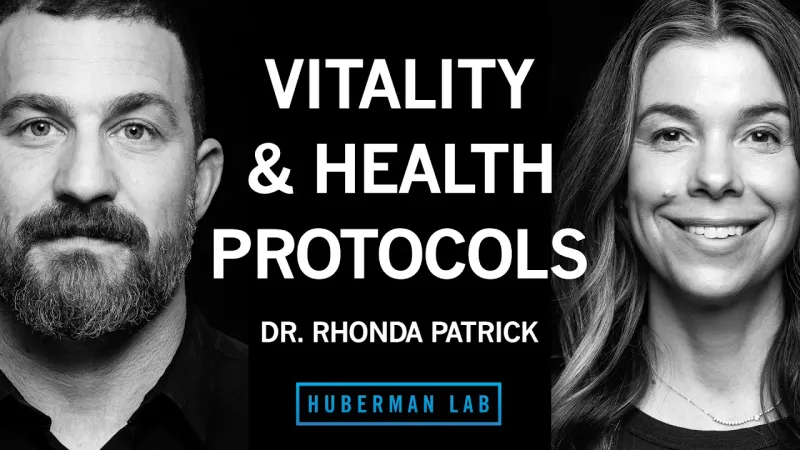
The Best Vitality & Health Protocols | Dr. Rhonda Patrick
Andrew Huberman@hubermanlabThe Best Vitality & Health Protocols | Dr. Rhonda Patrick
Andrew Huberman interviews Dr. Rhonda Patrick about research-informed health practices, including exercise, nutrition, fasting, supplements, sleep, and sauna use. The episode promises detailed discussion of the evidence and reasoning behind protocols, and how to adapt them to individual goals and biology; the opening cites reported associations between brief exercise sessions and lower mortality.

- Views
- 424.1K
- Likes
- 6.5K
- Comments
- 530
- Exercise and FitnessNutrition and FastingSupplements and SafetyDisease risk reductionPersonalized health protocols
Analysis
Andrew Huberman interviews Dr. Rhonda Patrick about research-informed health practices, including exercise, nutrition, fasting, supplements, sleep, and sauna use. The episode promises detailed discussion of the evidence and reasoning behind protocols, and how to adapt them to individual goals and biology; the opening cites reported associations between brief exercise sessions and lower mortality.
- InterviewPodcast episode

- Title
- The Best Vitality & Health Protocols | Dr. Rhonda Patrick
“There's lots of data now showing that people that are doing these like short bursts at at least a minute long, but [clears throat] up to 3 minutes. They're moving faster with intent and it's having outsize effects on on health outcomes. So, for example, individuals that do on the high end, so they're doing, you know, 3 minutes of this short burst of an unstructured type of exercise snack, and they do it three times a day. So, it's a total of 9 minutes a day. Okay? That's associated with a 40% reduction in all-cause mortality, 40% reduction in cancer-related mortality, a 50% reduction in cardiovascular-related mortality. >> Wow. >> 9 minutes a day. >> Welcome to the Huberman Lab Podcast, where we discuss science and science-based tools for everyday life. I'm Andrew Huberman and I'm a professor of neurobiology and ophthalmology at Stanford School of Medicine. My guest today is Dr. Rhonda Patrick, a biomedical scientist and leading public health educator. For over a decade, Rhonda has been one of the most trusted voices in building science-based health protocols. Today, we discuss what the latest and best research says we should all be doing to improve our health and vitality and avoid disease. Rhonda shares with us her exact exercise, nutrition, supplementation, and sauna protocols, and we get really detailed about the mechanisms and logic behind each one. We also discuss the things that science say you can do to significantly reduce your cancer and cardiovascular risk, including how to reduce visceral fat and arterial plaque. Today's discussion truly leaves no stone unturned. We discuss how eating can increase inflammation, believe it or not, ways to support your gut health, creatine, vitamin D, why broad vitamin and mineral and fiber support is crucial, as well as the different forms of magnesium and each of their unique effects. We also discuss omega-3s and why prescription sources of omega-3s may be the cleanest and most cost-efficient way to obtain sufficient omega-3 intake. We also discuss the importance of prioritizing regular resistance training and hit workouts over protein. You still need protein, but emphasizing the exercise component is crucial. And we discuss fiber, micronutrients, and why short-term fasting can be beneficial. Dr. Rhonda Patrick is a true wealth of knowledge, and today she generously provides us a masterclass on how you can design and adjust the exact health protocols to meet your specific needs. Before we begin, I'd like to emphasize that this podcast is separate from my teaching and research roles at Stanford. It is, however, part of my desire and effort to bring zero cost to consumer information about science and science-related tools to the general public. In keeping with that theme, today's episode does include sponsors. And now for my discussion with Dr. Rhonda Patrick. Welcome back, Dr. Rhonda Patrick. >> Excited to be here. >> It's been a while. I'm so excited. There's so much to go into. And I'll start off the same way I started last time because it's even more true. Thank you for being first person into this public science health education business. I don't know if everyone's aware of it, but you were the first person in, which is why I didn't say first man in, because the first person in was and is a woman, and you've done a marvelous job of educating people on science, how to parse papers and data, health practices, and um you know, the rest of us are just trying to follow in your wake. So, thank you very much. I just want to thank you for being first.”
- 01Lead with a consequential claim
This begins with a specific, consequential result and a concise example, giving the discussion an evidence-based claim to examine. The figures are presented as associated outcomes, not as proof that the routine causes them.
The speaker presents a claim about a short, repeated activity and its association with major health outcomes, then gives a concrete example and the stated mortality reductions.
“There's lots of data now showing that people that are doing these like short bursts at at least a minute long, but [clears throat] up to 3 minutes. They're moving faster with intent and it's having outsize effects on on health outcomes. So, for example, individuals that do on the high end, so they're doing, you know, 3 minutes of this short burst of an unstructured type of exercise snack, and they do it three times a day. So, it's a total of 9 minutes a day. Okay? That's associated with a 40% reduction in all-cause mortality, 40% reduction in cancer-related mortality, a 50% reduction in cardiovascular-related mortality.”
- 02Identify the show, host, and guest
The reaction reinforces the striking example, while the show and speaker introductions establish the subject and relevant credentials before the broader episode preview.
A brief response reacts to the nine-minute figure. The host then identifies the podcast, its focus, his academic role, and the guest's scientific and public-health background.
“>> Wow. >> 9 minutes a day. >> Welcome to the Huberman Lab Podcast, where we discuss science and science-based tools for everyday life. I'm Andrew Huberman and I'm a professor of neurobiology and ophthalmology at Stanford School of Medicine. My guest today is Dr. Rhonda Patrick, a biomedical scientist and leading public health educator.”
- 03Establish the guest's relevance and preview the discussion
The guest's stated experience supports the episode's guide framing. The roadmap tells viewers what topics and explanations the conversation will cover, extending the initial claim into a wider health-protocol discussion.
The host describes the guest's experience, outlines the episode's protocol topics and their mechanisms, and promises discussion of research-backed ways to improve health and reduce disease risk.
“For over a decade, Rhonda has been one of the most trusted voices in building science-based health protocols. Today, we discuss what the latest and best research says we should all be doing to improve our health and vitality and avoid disease. Rhonda shares with us her exact exercise, nutrition, supplementation, and sauna protocols, and we get really detailed about the mechanisms and logic behind each one. We also discuss the things that science say you can do to significantly reduce your cancer and cardiovascular risk, including how to reduce visceral fat and arterial plaque. Today's discussion truly leaves no stone unturned. We discuss how eating can increase inflammation, believe it or not, ways to support your gut health, creatine, vitamin D, why broad vitamin and mineral and fiber support is crucial, as well as the different forms of magnesium and each of their unique effects. We also discuss omega-3s and why prescription sources of omega-3s may be the cleanest and most cost-efficient way to obtain sufficient omega-3 intake. We also discuss the importance of prioritizing regular resistance training and hit workouts over protein. You still need protein, but emphasizing the exercise component is crucial. And we discuss fiber, micronutrients, and why short-term fasting can be beneficial.”
- 04Strengthen the guide framing and qualify the show
This closes the overview by emphasizing the guest's guidance and the promised tailoring of protocols. The host's role clarification and sponsorship disclosure provide context before the interview begins.
The host praises the guest's expertise and describes the episode as a masterclass in adapting protocols to individual needs. He then distinguishes the podcast from his Stanford roles, describes its public-information purpose, discloses that the episode has sponsors, and transitions to the conversation.
“Dr. Rhonda Patrick is a true wealth of knowledge, and today she generously provides us a masterclass on how you can design and adjust the exact health protocols to meet your specific needs. Before we begin, I'd like to emphasize that this podcast is separate from my teaching and research roles at Stanford. It is, however, part of my desire and effort to bring zero cost to consumer information about science and science-related tools to the general public. In keeping with that theme, today's episode does include sponsors. And now for my discussion with Dr. Rhonda Patrick. Welcome back, Dr. Rhonda Patrick. >> Excited to be here. >> It's been a while. I'm so excited. There's so much to go into. And I'll start off the same way I started last time because it's even more true. Thank you for being first person into this public science health education business. I don't know if everyone's aware of it, but you were the first person in, which is why I didn't say first man in, because the first person in was and is a woman, and you've done a marvelous job of educating people on science, how to parse papers and data, health practices, and um you know, the rest of us are just trying to follow in your wake. So, thank you very much. I just want to thank you for being first.”