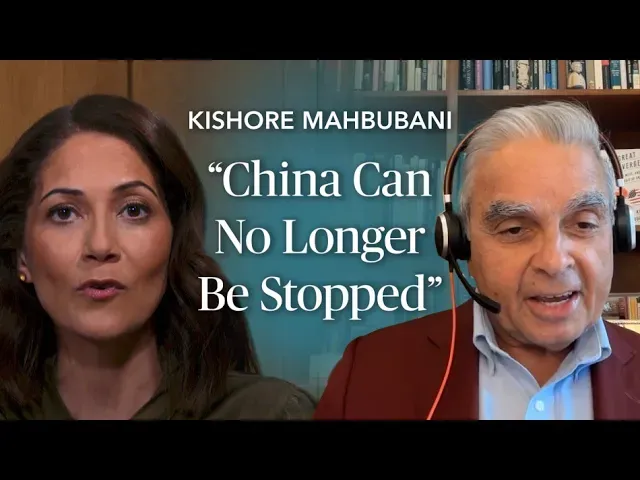
China Versus the US: Kishore Mahbubani on a Zero-Sum Rivalry | The Mishal Husain Show
Bloomberg Podcasts@BloombergPodcastsChina Versus the US: Kishore Mahbubani on a Zero-Sum Rivalry | The Mishal Husain Show
Mishal Husain speaks with Kishore Mahbubani about the long-running contest between the United States and China, including its Cold War comparisons and the risks of treating it as a zero-sum rivalry. The conversation also introduces Mahbubani’s perspective as a Singaporean diplomat and previews discussion of his upbringing and Singapore’s growth.

- Views
- 467.3K
- Likes
- 6.7K
- Comments
- 1.2K
- US-China Power RivalryChina's RiseSingaporean diplomatic careerMahbubani's Upbringing
Analysis
Mishal Husain speaks with Kishore Mahbubani about the long-running contest between the United States and China, including its Cold War comparisons and the risks of treating it as a zero-sum rivalry. The conversation also introduces Mahbubani’s perspective as a Singaporean diplomat and previews discussion of his upbringing and Singapore’s growth.
- InterviewPodcast episode
- Title
- China Versus the US: Kishore Mahbubani on a Zero-Sum Rivalry | The Mishal Husain Show
“Never before in human history have we had two powers of the size the scale and reach of United States and China confronting each other in the way that they are today. China has become a tiger, and so we have to learn to live with a much stronger power. Kishore Mahbubani, academic diplomat, someone who has seen the rise of China from his native Singapore. You said that this what's happening now is like the Cold War. Only America now is behaving as the Soviet Union was. It's a very unflattering comparison. The goal of my writings is not to say that China should win, or United States should win, is to say that China and US should step back and reflect whether it is in their larger, long term interests, to engage in such a zero sum contest from Bloomberg Weekend. This is The Mishal Husain Show. By now, you've probably seen a fair amount of news emerging from Beijing, where President Trump has been meeting China's XI Jinping 1:1, face to face meetings of this kind don't come around often, but there is a much bigger story to tell than that of these two men or any two leaders of these countries, actually. The real story is an epic tale that has been unfolding for about 30 years, and it's about supremacy, the battle to be the world's number one power. That's what we wanted to dive into this weekend. The story beyond the handshake, the readout, the Truth Social posts. And we wanted to do it from the perspective of someone who is neither American nor Chinese, but has witnessed the rise of China from his own country, which is tiny in comparison.... Singapore. Kishore Mahbubani was for three decades a Singaporean diplomat, rising to become its ambassador at the United Nations. He's from Singapore's minority Indian community, and although I've known him for years, I only recently understood the circumstances, the tough circumstances in which he grew up in the 1950s and 60s. He's written many books. His most recent is called Living the Asian Century, and it's also his most personal, as ever, for the context beyond the conversation. For more on the people, the places we talk about, have a look at bloomberg.com/mishal. That is where you'll find the written version of this with my reflections and pictures which add to the story. But here's Kishore Mahbubani, in his own words, talking first about why the US and China matters so much right now. It is by far the most important contests of our time. And I think what most people don't realize is that never before in human history have we had two powers of the size the scale and reach of United States and China confronting each other in the way that they are today. Because the United States is a remarkably powerful country, much more powerful than any other great power has been in human history. And of course, uh, when the when the Soviet Union collapsed, the United States was left alone as the sole superpower in the world, and few expected China to come up so quickly. But now China has clearly achieved near parity, uh, with the United States in in the scope and scale of its power, too. And therefore, you notice when President Trump launches, um, uh, tariff wars on, uh, all the countries in the world, only one country stood up to the United States, and that was China. In this contest then do you see it as bigger than the economics of it? The desire on the part of the United States to maintain its position as the world's biggest economy.”
- 01Establish the unprecedented contest
This puts the central rivalry immediately in view and makes its magnitude the reason to keep listening. The claims set up the question of how the two countries should live with this changed balance.
The opening frames the US and China as two powers whose size, scale and reach are confronting each other in an unprecedented way, then characterizes China as a much stronger power.
“Never before in human history have we had two powers of the size the scale and reach of United States and China confronting each other in the way that they are today. China has become a tiger, and so we have to learn to live with a much stronger power.”
- 02Introduce the guest and a provocative comparison
The guest’s relevant experience gives context for his perspective, while the reversal in the Cold War comparison adds a pointed interpretation of the rivalry. The exchange also tees up his clarification of what he intends his writing to argue.
The host identifies Mahbubani through his academic and diplomatic background and Singaporean perspective, then recalls his comparison of the present moment with the Cold War, including the claim that America is behaving as the Soviet Union did.
“Kishore Mahbubani, academic diplomat, someone who has seen the rise of China from his native Singapore. You said that this what's happening now is like the Cold War. Only America now is behaving as the Soviet Union was. It's a very unflattering comparison.”
- 03Clarify the argument and introduce the show
This qualification distinguishes his argument from advocacy for either side and states the larger question the discussion will examine. The show identification closes the opening clip before the host provides broader episode context.
Mahbubani says his aim is not for either side to win, but for both to consider their long-term interests before engaging in a zero-sum contest. The show identifies itself.
“The goal of my writings is not to say that China should win, or United States should win, is to say that China and US should step back and reflect whether it is in their larger, long term interests, to engage in such a zero sum contest from Bloomberg Weekend. This is The Mishal Husain Show.”
- 04Broaden the story beyond the meeting
This roadmap makes clear that the discussion will look beyond a single news event and offers a perspective outside either country. The guest’s biography and the handoff prepare the central discussion. The introduction ends when Mahbubani begins a sustained explanation of the contest and its history.
The host connects the episode to current US–China news, says the story is larger than the two leaders’ meeting, and frames it as a decades-long contest over global supremacy. She explains that the episode will explore that story through a Singaporean witness’s perspective and gives his background, then mentions a written companion and hands over to the guest.
“By now, you've probably seen a fair amount of news emerging from Beijing, where President Trump has been meeting China's XI Jinping 1:1, face to face meetings of this kind don't come around often, but there is a much bigger story to tell than that of these two men or any two leaders of these countries, actually. The real story is an epic tale that has been unfolding for about 30 years, and it's about supremacy, the battle to be the world's number one power. That's what we wanted to dive into this weekend. The story beyond the handshake, the readout, the Truth Social posts. And we wanted to do it from the perspective of someone who is neither American nor Chinese, but has witnessed the rise of China from his own country, which is tiny in comparison.... Singapore. Kishore Mahbubani was for three decades a Singaporean diplomat, rising to become its ambassador at the United Nations. He's from Singapore's minority Indian community, and although I've known him for years, I only recently understood the circumstances, the tough circumstances in which he grew up in the 1950s and 60s. He's written many books. His most recent is called Living the Asian Century, and it's also his most personal, as ever, for the context beyond the conversation. For more on the people, the places we talk about, have a look at bloomberg.com/mishal. That is where you'll find the written version of this with my reflections and pictures which add to the story. But here's Kishore Mahbubani, in his own words, talking first about why the US and China matters so much right now.”
- 05Guest opens with the stakes and scale
The guest begins to substantiate the episode’s premise with historical context and his assessment of the shifting balance. His question about whether the contest exceeds economics opens the next part of the conversation. The supplied excerpt ends during his answer, so this is the boundary of the identified introduction, not a completed discussion.
Mahbubani calls the contest one of the most important of the era and says its unprecedented feature is two powers of comparable scale confronting one another. He argues that the US was uniquely powerful after the Soviet Union collapsed, that China’s rise surprised many, and that China has now achieved near parity. He cites China’s response to US tariff wars and asks whether the contest is about more than economics.
“It is by far the most important contests of our time. And I think what most people don't realize is that never before in human history have we had two powers of the size the scale and reach of United States and China confronting each other in the way that they are today. Because the United States is a remarkably powerful country, much more powerful than any other great power has been in human history. And of course, uh, when the when the Soviet Union collapsed, the United States was left alone as the sole superpower in the world, and few expected China to come up so quickly. But now China has clearly achieved near parity, uh, with the United States in in the scope and scale of its power, too. And therefore, you notice when President Trump launches, um, uh, tariff wars on, uh, all the countries in the world, only one country stood up to the United States, and that was China. In this contest then do you see it as bigger than the economics of it? The desire on the part of the United States to maintain its position as the world's biggest economy.”