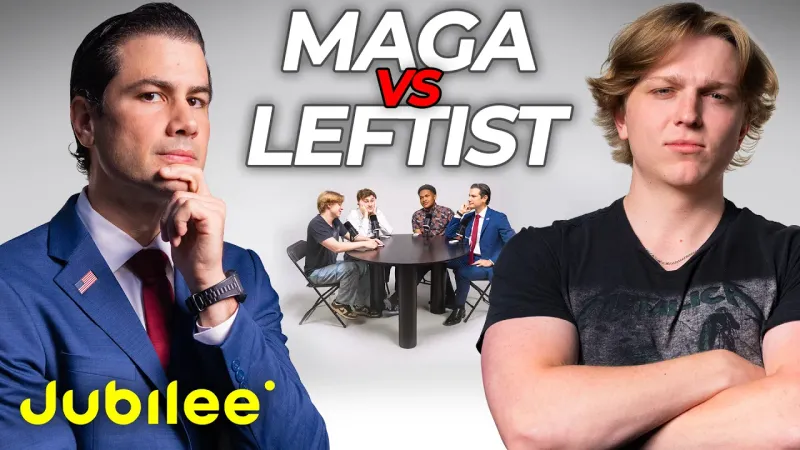
Dean Withers & Parker vs MAGA | Roundtable
Jubilee@jubileeDean Withers & Parker vs MAGA | Roundtable
Progressive and conservative participants debate US politics and foreign policy in a roundtable discussion. The opening focuses on whether Trump's approach to Iran demonstrates “peace through strength,” including disagreement over the JCPOA, Iran's regional role, and the consequences of military action. Listed later topics include IRS corruption, super PACs, Trump's health, AI regulation, and Spencer Pratt.

- Views
- 1.3M
- Likes
- 29K
- Comments
- 5.6K
- US political debateIran nuclear dealUS foreign policyPolitical perspectives
Analysis
Progressive and conservative participants debate US politics and foreign policy in a roundtable discussion. The opening focuses on whether Trump's approach to Iran demonstrates “peace through strength,” including disagreement over the JCPOA, Iran's regional role, and the consequences of military action. Listed later topics include IRS corruption, super PACs, Trump's health, AI regulation, and Spencer Pratt.
- Roundtable
- Title
- Dean Withers & Parker vs MAGA | Roundtable
“I don't know what he believes. That's the point. I don't know. I think a lot of you know what he believes. I don't I don't think that we definitively know 100,000% what Trump believes. Just like I don't definitely know what you believe. You may be secretly homosexual or something. I don't know whether or not that's true. Like say that's a possibility. I'm I'm saying secretly that's a possibility, right? Okay. That's not a possibility. >> No, because I'm I'm myself. I know whether or not I'm straight. >> Oh my god. Stop, guys. You later find out you're gay. Conservative. I would off the group you're telling me who will push homosexuality on you. >> Parker, you're gay. PARKER, YOU'RE YOU SAY THAT. I just said it to me. I'm not >> okay. I mean, the fact that you're fighting is hard, man. >> I'm Dean Withers and I'm a progressive liberal. >> I'm Parker and I'm a progressive liberal. >> I'm Matt and I am a classical conservative. >> I'm Dennis Ftosa. I'm an America first conservative. I'm running for Congress. And you are watching Round Table. You >> know, so far they haven't gotten there. We're not satisfied with it, but we will be. We will be either that or we'll have to just finish the job. But uh their Navy is gone. As I've said a thousand times, their Navy is gone. Their air force is gone. Everything's gone. And they're negotiating on fumes. But we'll see what happens. Maybe we have to go back and finish it. Maybe we don't. >> Trump is proving that peace through strength works. Iran is negotiating because it knows America is finally willing to finish the job. If we're considering that quote unquote be a demonstrating peace through strength is uh getting Iran to negotiate and more specifically getting them to negotiate by first starting a war. Well then I don't think that this is something that's been proven to work considering the fact that we were in a better position a decade ago under Obama with the JCPOA without a war in Iran. >> Yeah, I would just disagree with that immediately. I don't think that the JCPOA um was peaceful, right? Okay, because the JCPOA essentially allowed the B administration to unfreeze billions of Iranian assets that were held in Qar, held in Iraq and so on and so forth. Under the Obama administration, they unfroze assets and under the Biden administration, they also unfroze assets. And this essentially allowed the IRGC as they are the number one state sponsor of terrorism to support groups like the Houthis in Yemen that have disrupted global maritime trade in the Red Sea. I I believe specifically $200 billion of e economic damage that was done in the Red Sea because of the support of the IRGC. They created the Yemen civil war in 2011, for example, um with conflicts with one of their largest economic partners of Saudi Arabia. Um they fueled and funded Hamas to support them and gave them intelligence to conduct October 7th, which was the second largest terrorist attack in the 21st century. I mean, the Husba, for example, in southern Lebanon, right, in their war with Israel and their South American drug trafficking operation that was like Operation Cassandra, I believe, exposed in 2008 by the DEA. Sure, like the JCPOA limited their enrichment, right? It wasn't at 60%. But the issue with the JCPOA doesn't account for Iran being the main state sponsor of terrorism and it also didn't account for them having the largest missile stockpile in the Middle East.”
- 01Open on uncertainty and provocation
This begins in the middle of a personal dispute rather than explaining the episode first. The pointed speculation creates immediate friction and leaves the disagreement unresolved.
A speaker says they do not know what another person believes, then compares that uncertainty with not knowing what the listener believes and raises a provocative possibility.
“I don't know what he believes. That's the point. I don't know. I think a lot of you know what he believes. I don't I don't think that we definitively know 100,000% what Trump believes. Just like I don't definitely know what you believe. You may be secretly homosexual or something. I don't know whether or not that's true. Like say that's a possibility. I'm I'm saying secretly that's a possibility, right?”
- 02Push back and identify the participants
The rebuttal turns the opening provocation into a live disagreement. The participant introductions and show identification then orient viewers before the roundtable moves into its political discussion.
The other speaker rejects the speculation, participants exchange provocative remarks, and the group identifies its political perspectives before naming the show.
“Okay. That's not a possibility. >> No, because I'm I'm myself. I know whether or not I'm straight. >> Oh my god. Stop, guys. You later find out you're gay. Conservative. I would off the group you're telling me who will push homosexuality on you. >> Parker, you're gay. PARKER, YOU'RE YOU SAY THAT. I just said it to me. I'm not >> okay. I mean, the fact that you're fighting is hard, man. >> I'm Dean Withers and I'm a progressive liberal. >> I'm Parker and I'm a progressive liberal. >> I'm Matt and I am a classical conservative. >> I'm Dennis Ftosa. I'm an America first conservative. I'm running for Congress. And you are watching Round Table. You >> know, so far they haven't gotten there.”
- 03Set up the central policy disagreement
This exchange makes the roundtable's policy conflict concrete: whether military force is producing a worthwhile result or whether diplomacy was the better path. The opposing explanations invite viewers to hear the debate continue; the supplied excerpt cuts off during a detailed response, so the introduction's later transition cannot be identified here.
A speaker argues that Iran is negotiating after military damage and raises whether the conflict should be finished. Another speaker says Trump is demonstrating that peace through strength works; a reply questions whether starting a war to get negotiations proves that claim and points to the JCPOA as a peaceful alternative.
“We're not satisfied with it, but we will be. We will be either that or we'll have to just finish the job. But uh their Navy is gone. As I've said a thousand times, their Navy is gone. Their air force is gone. Everything's gone. And they're negotiating on fumes. But we'll see what happens. Maybe we have to go back and finish it. Maybe we don't. >> Trump is proving that peace through strength works. Iran is negotiating because it knows America is finally willing to finish the job. If we're considering that quote unquote be a demonstrating peace through strength is uh getting Iran to negotiate and more specifically getting them to negotiate by first starting a war. Well then I don't think that this is something that's been proven to work considering the fact that we were in a better position a decade ago under Obama with the JCPOA without a war in Iran. >> Yeah, I would just disagree with that immediately. I don't think that the JCPOA um was peaceful, right? Okay, because the JCPOA essentially allowed the B administration to unfreeze billions of Iranian assets that were held in Qar, held in Iraq and so on and so forth. Under the Obama administration, they unfroze assets and under the Biden administration, they also unfroze assets. And this essentially allowed the IRGC as they are the number one state sponsor of terrorism to support groups like the Houthis in Yemen that have disrupted global maritime trade in the Red Sea. I I believe specifically $200 billion of e economic damage that was done in the Red Sea because of the support of the IRGC. They created the Yemen civil war in 2011, for example, um with conflicts with one of their largest economic partners of Saudi Arabia. Um they fueled and funded Hamas to support them and gave them intelligence to conduct October 7th, which was the second largest terrorist attack in the 21st century. I mean, the Husba, for example, in southern Lebanon, right, in their war with Israel and their South American drug trafficking operation that was like Operation Cassandra, I believe, exposed in 2008 by the DEA. Sure, like the JCPOA limited their enrichment, right? It wasn't at 60%. But the issue with the JCPOA doesn't account for Iran being the main state sponsor of terrorism and it also didn't account for them having the largest missile stockpile in the Middle East.”