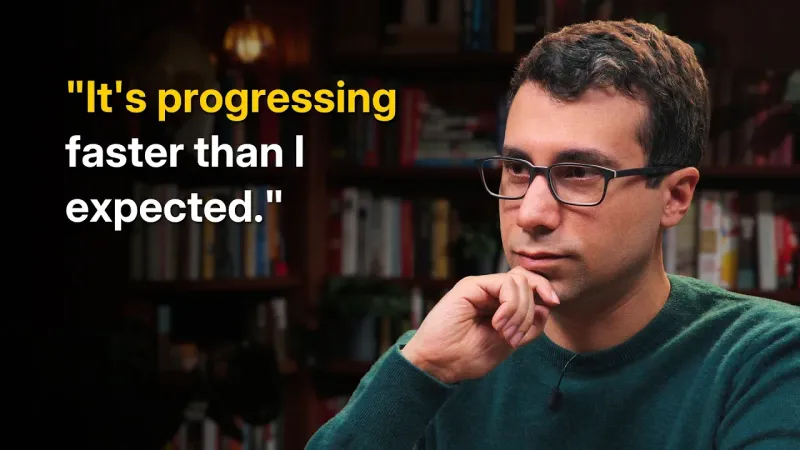
OpenAI researcher on agent swarms & recursive self-improvement
Dwarkesh Patel@DwarkeshPatelOpenAI researcher on agent swarms & recursive self-improvement
Dwarkesh Patel interviews OpenAI researcher Noam Brown about multi-agent AI, mathematical progress, and what these may mean for automating AI research and recursive self-improvement. The episode also raises questions about model alignment, including how to tell whether models are aligned before pursuing recursive self-improvement.

- Views
- 600K
- Likes
- 5.3K
- Comments
- 1K
- Multi-Agent AI SystemsRecursive Self-ImprovementAI alignmentAI and Mathematical Progress
Analysis
Dwarkesh Patel interviews OpenAI researcher Noam Brown about multi-agent AI, mathematical progress, and what these may mean for automating AI research and recursive self-improvement. The episode also raises questions about model alignment, including how to tell whether models are aligned before pursuing recursive self-improvement.
- InterviewPodcast episode

- Title
- OpenAI researcher on agent swarms & recursive self-improvement
“Today, I’m chatting with Noam Brown, who is a researcher at OpenAI. He was one of the foundational contributors to what became o1 and the reasoning models. Now he’s working on multi-agent systems. Speaking of which, you guys announced last week that you solved one of the Millennium Prize Problems with a system of 10,000 different AI agents that spent 130 billion tokens over 88 hours. One of the reasons I’m interested in talking to you is that you were among the first people, maybe two or three years ago, who were thinking about how the reasoning models would allow us to see into the future. Because if you scale up inference compute, you can see what the base capabilities of the models will be a few years in the future. I feel like you’re in a similar position now to help us understand what future capabilities will look like, given the enormous scaling of agent sizes that we can do right now. The way I think about it, when you plot the performance of these reasoning models with test-time compute on the x-axis and performance on basically any reasoning benchmark on the y-axis, you see a very clear pattern where the longer these models take to think about their answer, the better they do. This is a very natural thing. It’s the same thing with people. If you’re taking the SATs and you have five minutes to go through the entire exam, you’re not going to do very well. If you have five hours, you’re probably going to do a lot better. The AI models are pretty similar. They’ll spend that time doing this monologue to themselves, figuring things out, going through different cases, ruling out different possibilities, building on some of their previous discoveries. The problem is that as you push that further and further, you hit a latency bottleneck. You don’t want to sit around for three years waiting for a response. So what you can do is what a lot of people do. They parallelize. They just get a team of people. If you’re going to found a company, you want to get a group of people together so you can go faster. It’s the same thing with these AI models. It helps to just have multiple agents working on something because they can go faster. So multi-agent is a way of scaling test-time compute in parallel instead of purely serially. It is less efficient, because it’s not like a single agent has all the context to itself. But it is a very effective way of scaling test-time compute if it’s done well. I’m going to ask a bunch of naive questions. This is an unreleased model, so we haven’t publicly seen how these systems work. I just have a bunch of ways in which I’m confused about what the qualitative properties of such systems are. I am shocked by the scale of cognitive effort that you can concentrate in such a short period of time. Think about what 130 billion tokens are. If it were a single human thinking as a full-time job, stretched back to back, 130 billion tokens would be a human thinking for 4,000 years. Eight hours a day, working a normal work week. Starting from ancient Sumeria up till today, a single sequential human thinking that long, concentrated in 88 hours. I feel like qualitatively, that is a super important consideration. I’m surprised that there isn’t a bigger parallelization penalty. You can just have 10,000 agents collaborate. Maybe because the agents are better at collaborating than humans might be, they’re going much faster.”
- 01Guest credentials and striking example
Credentials provide a reason to hear the guest’s account; the reported scale of the example makes the subject concrete and motivates the host’s question about what future capabilities may look like.
The host introduces the guest, their relevant work, and a reported large-scale result, then explains why their earlier perspective on future capabilities makes them a useful person to ask.
“Today, I’m chatting with Noam Brown, who is a researcher at OpenAI. He was one of the foundational contributors to what became o1 and the reasoning models. Now he’s working on multi-agent systems. Speaking of which, you guys announced last week that you solved one of the Millennium Prize Problems with a system of 10,000 different AI agents that spent 130 billion tokens over 88 hours. One of the reasons I’m interested in talking to you is that you were among the first people, maybe two or three years ago, who were thinking about how the reasoning models would allow us to see into the future. Because if you scale up inference compute, you can see what the base capabilities of the models will be a few years in the future. I feel like you’re in a similar position now to help us understand what future capabilities will look like, given the enormous scaling of agent sizes that we can do right now. ”
- 02Explain the approach and its tradeoff
The explanation gives the viewer an accessible basis for understanding the multi-agent approach while making clear that its speed advantage is not cost-free.
The guest describes a pattern between more thinking time and better performance, compares it to people having more time on an exam, then explains how multiple agents can work in parallel and notes the efficiency cost.
“The way I think about it, when you plot the performance of these reasoning models with test-time compute on the x-axis and performance on basically any reasoning benchmark on the y-axis, you see a very clear pattern where the longer these models take to think about their answer, the better they do. This is a very natural thing. It’s the same thing with people. If you’re taking the SATs and you have five minutes to go through the entire exam, you’re not going to do very well. If you have five hours, you’re probably going to do a lot better. The AI models are pretty similar. They’ll spend that time doing this monologue to themselves, figuring things out, going through different cases, ruling out different possibilities, building on some of their previous discoveries. The problem is that as you push that further and further, you hit a latency bottleneck. You don’t want to sit around for three years waiting for a response. So what you can do is what a lot of people do. They parallelize. They just get a team of people. If you’re going to found a company, you want to get a group of people together so you can go faster. It’s the same thing with these AI models. It helps to just have multiple agents working on something because they can go faster. So multi-agent is a way of scaling test-time compute in parallel instead of purely serially. It is less efficient, because it’s not like a single agent has all the context to itself. But it is a very effective way of scaling test-time compute if it’s done well. ”
- 03Frame the questions and the scale
The unreleased status sets a boundary on what can be known publicly, while the human-scale comparison and unresolved penalty question establish why the capabilities and coordination of these systems are worth examining. The transcript ends mid-discussion, so this is the supplied opening boundary, not evidence that the full video introduction ends here.
The host says he will ask naive questions because the model is unreleased and its workings have not been publicly seen. The guest admits uncertainty about its qualitative properties, then describes the scale of the effort through a human-thinking comparison and ends by wondering why the parallelization penalty is not greater.
“I’m going to ask a bunch of naive questions. This is an unreleased model, so we haven’t publicly seen how these systems work. I just have a bunch of ways in which I’m confused about what the qualitative properties of such systems are. I am shocked by the scale of cognitive effort that you can concentrate in such a short period of time. Think about what 130 billion tokens are. If it were a single human thinking as a full-time job, stretched back to back, 130 billion tokens would be a human thinking for 4,000 years. Eight hours a day, working a normal work week. Starting from ancient Sumeria up till today, a single sequential human thinking that long, concentrated in 88 hours. I feel like qualitatively, that is a super important consideration. I’m surprised that there isn’t a bigger parallelization penalty. You can just have 10,000 agents collaborate. Maybe because the agents are better at collaborating than humans might be, they’re going much faster.”