Consciousness Expert: The Level of Awareness That Makes Everything Feel Effortless | Peter Sage
Lewis Howes@lewishowesConsciousness Expert: The Level of Awareness That Makes Everything Feel Effortless | Peter Sage
Peter Sage discusses his four-level consciousness framework and argues that changing your inner world can change how you experience the outer world. The episode also covers mindset, purpose, other people's opinions, financial beliefs, and lessons from Sage's time in prison, as listed in the supplied chapter guide.

- Views
- 247.2K
- Likes
- 8K
- Comments
- 594
- Four Levels of ConsciousnessMindset and Personal GrowthPurpose and Financial BeliefsOvercoming adversity
Analysis
Peter Sage discusses his four-level consciousness framework and argues that changing your inner world can change how you experience the outer world. The episode also covers mindset, purpose, other people's opinions, financial beliefs, and lessons from Sage's time in prison, as listed in the supplied chapter guide.
- InterviewPodcast episode
- Title
- Consciousness Expert: The Level of Awareness That Makes Everything Feel Effortless | Peter Sage
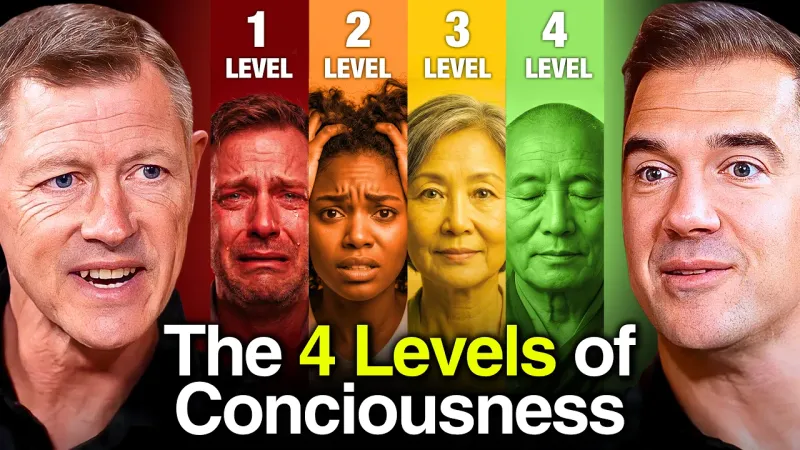
“If you look at the lowest level of consciousness, what I call that the victim mentality, it's a level that I call to me. I would have the the house, the car, the body, the money, the whatever, but everything happens to me. All stress comes from life not fitting your pictures, and the friction that that causes is really where most people get stuck. A lot of people have the premise that in order to create the life they want, they've got to try to fix the outer world, and that's where a lot of people fall down because one of the universal truths that I found in the work that I've done is that outer world follows inner world. >> He is a serial entrepreneur, a keynote speaker, and one of the most sought-after coaches in the world on human behavior and personal transformation. We have the inspiring Peter Sage in the house. >> There is an energy that is intelligent, that if you know how to tune into it, it can do a lot of the heavy lifting for you. If I believe that I live in a hostile universe, I'm separate, therefore I'm only focused on myself. And so many people are standing in front of the mirror, and they're angry because it's not smiling back. >> I'm curious, why do most people suffer today? >> I would have to say if I was going to give one overarching answer, it would be >> Uh you've been coaching people for a long time about how to unlock their greatest potential, and how to get rid of feeling stuck and suffering in their life. So, I'm curious, why do most people suffer today? >> Oh. Great starting question. And I would have to say if I was going to give one overarching answer, it would be that all stress comes from life not fitting your pictures. Meaning that the outer world doesn't fit the pictures of what you think the inner world says it should look like. >> Mhm. >> And the friction that that causes is really where most people get stuck. And so, if you imagine that a lot of people have the the premise that in order to create the life they want, they've got to try to fix the outer world to fit their pictures. And that's where a lot of people fall down because one of the universal truths that I found in the work that I've done is that outer world follows inner world. >> Mhm. >> Not the other way around. >> Mhm. >> And so if you're working on the outer world without trying to realize it's a reflection of your inner world, you're always going to get stuck in a loop. >> Mhm. So it's like there's two worlds that we're living in, the inner world and the outer world. And in order to create an outer world that is beautiful, abundant, um and really giving us what we desire, what needs to happen on the inner world first? >> Albert Einstein said something very profound. He says you cannot solve a problem at the same level of consciousness that created the problem. That sounds smart, sounds like something that Einstein would say, but you know, how do you pay your mortgage with that on Friday? >> Mhm. >> So let me share with you a a framework that will give people some context to try to make sense of that, which hopefully will help. >> Cool. >> So you know, if you take the word consciousness, the the 13-letter hard problem in science.”
- 01Name the problem and frame the claim
This starts with the episode's conceptual frame and grounds it in familiar difficulties, inviting viewers to consider how the proposed mindset relates to those experiences.
The speaker names a level of consciousness and describes the belief that events happen to the person, then connects stress and friction with feeling stuck.
“If you look at the lowest level of consciousness, what I call that the victim mentality, it's a level that I call to me. I would have the the house, the car, the body, the money, the whatever, but everything happens to me. All stress comes from life not fitting your pictures, and the friction that that causes is really where most people get stuck.”
- 02State the inner-world principle
This supplies the opening's central explanation and a counterpoint to the assumed direction of change, establishing what the later discussion will examine.
The speaker describes the idea that people try to fix the outer world to get the life they want, then presents the principle that the outer world follows the inner world.
“A lot of people have the premise that in order to create the life they want, they've got to try to fix the outer world, and that's where a lot of people fall down because one of the universal truths that I found in the work that I've done is that outer world follows inner world.”
- 03Introduce the guest and an energy metaphor
The introduction establishes the guest's relevant professional background, then adds a proposed way of understanding support beyond one's own effort.
A guest introduction lists credentials and presents Peter Sage; the following statement describes an intelligent energy that can do some of the heavy lifting when someone learns to tune into it.
“>> He is a serial entrepreneur, a keynote speaker, and one of the most sought-after coaches in the world on human behavior and personal transformation. We have the inspiring Peter Sage in the house. >> There is an energy that is intelligent, that if you know how to tune into it, it can do a lot of the heavy lifting for you.”
- 04Illustrate the model and ask the central question
The metaphor makes the proposed inner-outer relationship concrete, and the host's question directs the discussion toward an explanation of suffering.
The speaker contrasts seeing the universe as hostile and separate with the image of a person angry at a mirror for not smiling back. The host then asks why most people suffer.
“If I believe that I live in a hostile universe, I'm separate, therefore I'm only focused on myself. And so many people are standing in front of the mirror, and they're angry because it's not smiling back. >> I'm curious, why do most people suffer today?”
- 05Set up the answer and restate the principle
The exchange keeps the question active before offering a concise answer and clarification. Repeating the question reinforces the opening's central problem; the explanation begins to show how the proposed model applies.
The guest begins to offer one overarching answer, but the host interjects with the guest's coaching background and repeats the question. The guest then says stress comes from life not fitting one's pictures, explains this as a mismatch between outer reality and inner expectations, and links that friction to feeling stuck.
“>> I would have to say if I was going to give one overarching answer, it would be >> Uh you've been coaching people for a long time about how to unlock their greatest potential, and how to get rid of feeling stuck and suffering in their life. So, I'm curious, why do most people suffer today? >> Oh. Great starting question. And I would have to say if I was going to give one overarching answer, it would be that all stress comes from life not fitting your pictures. Meaning that the outer world doesn't fit the pictures of what you think the inner world says it should look like. >> Mhm. >> And the friction that that causes is really where most people get stuck.”
- 06Extend the model and pose the inner-change question
This develops the central claim into a proposed cycle and ends the opening's framing with the question that leads toward the explanatory framework. The transcript then moves into an Einstein quotation and the guest's framework, but the supplied excerpt ends before sustained framework explanation is complete.
The guest restates the idea that people try to change external conditions to fit their pictures, then says the outer world follows the inner world. The host checks the direction of the relationship, and the guest describes a loop before the host asks what must happen internally to create a desirable outer world.
“And so, if you imagine that a lot of people have the the premise that in order to create the life they want, they've got to try to fix the outer world to fit their pictures. And that's where a lot of people fall down because one of the universal truths that I found in the work that I've done is that outer world follows inner world. >> Mhm. >> Not the other way around. >> Mhm. >> And so if you're working on the outer world without trying to realize it's a reflection of your inner world, you're always going to get stuck in a loop. >> Mhm. So it's like there's two worlds that we're living in, the inner world and the outer world. And in order to create an outer world that is beautiful, abundant, um and really giving us what we desire, what needs to happen on the inner world first? >> Albert Einstein said something very profound. He says you cannot solve a problem at the same level of consciousness that created the problem. That sounds smart, sounds like something that Einstein would say, but you know, how do you pay your mortgage with that on Friday? >> Mhm. >> So let me share with you a a framework that will give people some context to try to make sense of that, which hopefully will help. >> Cool. >> So you know, if you take the word consciousness, the the 13-letter hard problem in science.”