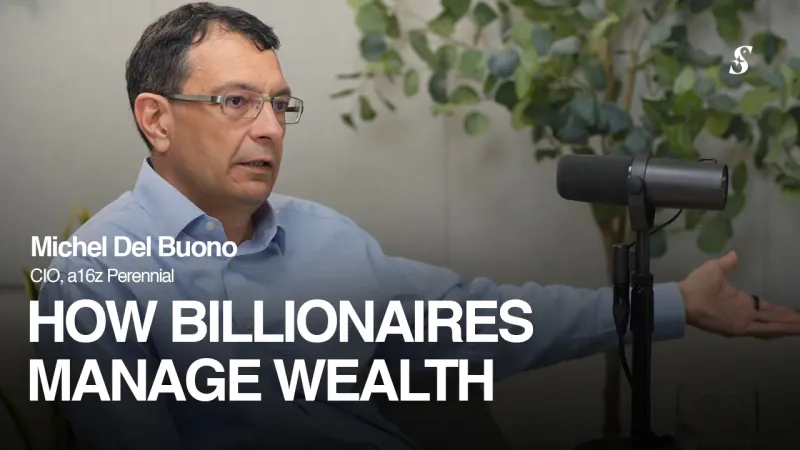
Inside Marc Andreessen & Ben Horowitz’s Multi-Family Office
Sourcery with Molly O'Shea@SourceryVCInside Marc Andreessen & Ben Horowitz’s Multi-Family Office
Michel Del Buono, CIO of a16z Perennial, discusses how its multi-family office serves founders and investors, and why its founders saw a gap in traditional wealth management. The episode covers portfolio construction, taxes, venture investing and preparing for major liquidity events, including a possible SpaceX IPO.

- Views
- 107.3K
- Likes
- 2K
- Comments
- 66
- Founder wealth managementMulti-Family OfficesLiquidity event planningInvestment portfolio strategyTax-Efficient Investing
Analysis
Michel Del Buono, CIO of a16z Perennial, discusses how its multi-family office serves founders and investors, and why its founders saw a gap in traditional wealth management. The episode covers portfolio construction, taxes, venture investing and preparing for major liquidity events, including a possible SpaceX IPO.
- InterviewPodcast episode

- Title
- Inside Marc Andreessen & Ben Horowitz’s Multi-Family Office
Is it true this is the multi-family office of Mark and Ben? It's a multi-family office for the principals here and a number of founders, the many in fact backed by the company. SpaceX is rumored and reported to to have nearly a two trillion dollar IPO incoming. How do you prepare early employees and founders for these large liquidity events? >> It'll be an interesting test of the markets if they can sort of I mean that would be the largest IPO ever for the markets to digest that. It'd be really interesting to watch. Most of the independent firms have spun out of the banks. Banks themselves don't train people to be professional investors. These people are trained to be service providers. They're trained to be responsive, helpful, but actual investment acumen when you're at a large bank sits in a separate group. You're rewarded as a wealth manager by how much you grow your book of business. You're never trained to be an investment person per se. So I'll see someone with their very very first liquidity, they take it and instead of doing something a little bit safe in case there's a rainy day, they turn around and they'll put it in a bunch of very early stage startups. You just sort of sit there and you're like, "Listen, if you're going to do venture, at least try to do it in a systematic way. Do not take 80% of what you just got and hand it to your three friends." Almost always this ends in tears. [music] >> Michelle, welcome to sorcery. Thank you. I think this is one of your first podcasts in a very long time. Yep. First modern podcast. >> First modern podcast. And so you're the CIO of a16z Perennial. Is it true this is the family office or multi-family office of Mark and Ben? It's the multi-family office for the principals here and a number of founders, not necessarily being backed by the company but many in fact backed by the company. So what's the structure of Perennial? Okay, so I I think the reason why we built Perennial or why we're building Perennial, it's about four years in now. Uh was a reflection on what's happening in the wealth management industry. I think for starters, the principals here, Mark and Ben included, um had been served by more traditional wealth management firms and they looked to the LPs of a16z and saw, you know, the big sovereign wealth funds, the the big pensions have very high-end professional investment teams come and then they look at the wealth management side, uh how they were being served personally and, you know, frankly I think most folks would agree they they felt sort of underwhelmed with the quality of the investment advice and the investment acumen. Not the whole service provision, everything, but specifically on the investment front. I mean that was one issue. Another issue or another point obviously is to build a community around a16z. a16z is all about uh its community and so this is another way to help founders uh in a different dimension of their personal life, right? So if you can take that burden off their off their hands, you know, ostensibly they can focus even more on the business. Uh and and so it's it becomes much more of a a lengthier um relationship with the founders because obviously you start when you invest with them in their startup, but even post liquidity, uh instead of having sort of an artificial end point of your relationship with them, you can continue uh helping them think about life after liquidity event, right?
- 01Identify and clarify the organization
This directly establishes the office’s scope and answers the opening question, while leaving room for the conversation to examine its structure and role.
The interviewer asks whether this is the multi-family office associated with Mark and Ben. The guest explains who it serves and that it also serves a number of founders.
“Is it true this is the multi-family office of Mark and Ben? It's a multi-family office for the principals here and a number of founders, the many in fact backed by the company.”
- 02Raise the audience’s consequential question
The question adds a consequential case to the general office premise and invites an explanation of how the firm thinks about liquidity. The transcript moves on before the preparation question receives a direct answer.
The interviewer cites a reported, very large prospective IPO and asks how to prepare early employees and founders for liquidity events. The guest begins by describing the event as an interesting test for markets.
“SpaceX is rumored and reported to to have nearly a two trillion dollar IPO incoming. How do you prepare early employees and founders for these large liquidity events? >> It'll be an interesting test of the markets if they can sort of I mean that would be the largest IPO ever for the markets to digest that. It'd be really interesting to watch.”
- 03Explain the perceived service gap
This supplies a rationale for a different wealth-management approach by distinguishing responsiveness from investment capability. The guest’s account is an explanation, not independent verification of the industry-wide claim.
The guest contrasts banks’ training in client service with investment acumen, then describes how wealth managers are rewarded and why that may leave investment expertise elsewhere.
“Most of the independent firms have spun out of the banks. Banks themselves don't train people to be professional investors. These people are trained to be service providers. They're trained to be responsive, helpful, but actual investment acumen when you're at a large bank sits in a separate group. You're rewarded as a wealth manager by how much you grow your book of business. You're never trained to be an investment person per se.”
- 04Illustrate the investment concern
The example makes the stated concern concrete and develops the guest’s view of what more deliberate advice should address. The transcript ends during this advice, so the introduction’s final boundary cannot be confirmed from the supplied excerpt.
The guest gives an example of someone receiving their first liquidity and investing a large share in very early-stage startups instead of keeping some funds safer for a rainy day, then urges a systematic approach.
So I'll see someone with their very very first liquidity, they take it and instead of doing something a little bit safe in case there's a rainy day, they turn around and they'll put it in a bunch of very early stage startups. You just sort of sit there and you're like, "Listen, if you're going to do venture, at least try to do it in a systematic way. Do not take 80% of what you just got and hand it to your three friends." Almost always this ends in tears.
- 05Welcome and identify the guest’s role
The welcome and role identification orient the listener to the interview and establish the guest’s relevant position before the host returns to the office question.
After a music cue, the host welcomes Michelle to the show, notes that this is her first modern podcast in a long time, and identifies her as the CIO of a16z Perennial.
“[music] >> Michelle, welcome to sorcery. Thank you. I think this is one of your first podcasts in a very long time. Yep. First modern podcast. >> First modern podcast. And so you're the CIO of a16z Perennial.”
- 06Clarify the office and ask how it is structured
The exchange revisits the opening premise with a clearer answer and transitions from identification to the organization’s rationale and design.
The host repeats the question about whether the office serves Mark and Ben. The guest clarifies that it serves the principals and a number of founders, then the host asks about Perennial’s structure.
“Is it true this is the family office or multi-family office of Mark and Ben? It's the multi-family office for the principals here and a number of founders, not necessarily being backed by the company but many in fact backed by the company. So what's the structure of Perennial?”
- 07Explain the motivation and intended role
This provides the central rationale for the organization and connects the identified service gap to its intended ongoing role. The excerpt ends mid-discussion of that relationship, so the exact introduction endpoint remains uncertain.
The guest says Perennial was built in response to what was happening in wealth management. She describes the principals’ prior experience with traditional firms, the perceived shortfall in investment advice, and the goal of supporting founders in their personal lives so they can focus on their businesses. She adds that the relationship can continue after liquidity.
“Okay, so I I think the reason why we built Perennial or why we're building Perennial, it's about four years in now. Uh was a reflection on what's happening in the wealth management industry. I think for starters, the principals here, Mark and Ben included, um had been served by more traditional wealth management firms and they looked to the LPs of a16z and saw, you know, the big sovereign wealth funds, the the big pensions have very high-end professional investment teams come and then they look at the wealth management side, uh how they were being served personally and, you know, frankly I think most folks would agree they they felt sort of underwhelmed with the quality of the investment advice and the investment acumen. Not the whole service provision, everything, but specifically on the investment front. I mean that was one issue. Another issue or another point obviously is to build a community around a16z. a16z is all about uh its community and so this is another way to help founders uh in a different dimension of their personal life, right? So if you can take that burden off their off their hands, you know, ostensibly they can focus even more on the business. Uh and and so it's it becomes much more of a a lengthier um relationship with the founders because obviously you start when you invest with them in their startup, but even post liquidity, uh instead of having sort of an artificial end point of your relationship with them, you can continue uh helping them think about life after liquidity event, right?”