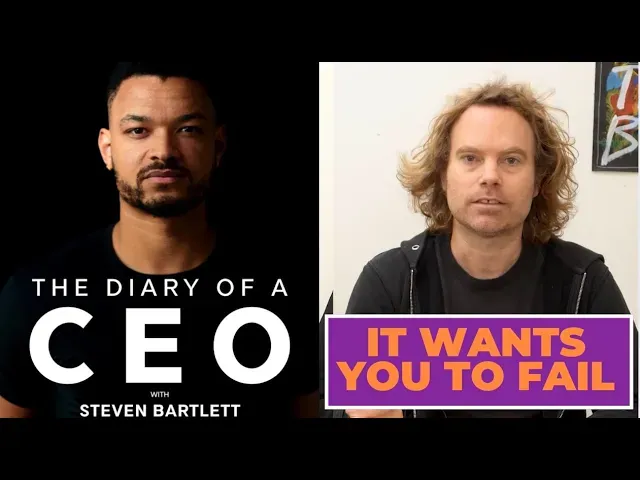
Diary Of A CEO Is Making You Less Successful - Barry's Economics
Barry's Economics@barryseconomicsDiary Of A CEO Is Making You Less Successful - Barry's Economics
Barry Ferns questions whether success podcasts such as Diary of a CEO can deliver the strategies they promise. He introduces research on expert predictions and frames the video around survivorship bias, the Dunning–Kruger effect, and the incentives behind selling success advice. The opening presents this as a critique of the model, not just its host.

- Views
- 1.5M
- Likes
- 83K
- Comments
- 11K
- Success advice critiqueSurvivorship biasBehavioral economicsSuccess podcast business models
Analysis
Barry Ferns questions whether success podcasts such as Diary of a CEO can deliver the strategies they promise. He introduces research on expert predictions and frames the video around survivorship bias, the Dunning–Kruger effect, and the incentives behind selling success advice. The opening presents this as a critique of the model, not just its host.
- Video essayCommentary

- Title
- Diary Of A CEO Is Making You Less Successful - Barry's Economics
“Hello. Welcome to Barry's Economics. Today, let me show you the science-backed uncomfortable truth about why Diary of a CEO might be the very thing standing between you and actual success. >> [laughter] >> You know what's wild? It's that right now, we are living through the most documented era of success advice in the history of the human race. Every morning, millions of people wake up, plug in their earbuds, and mainline interviews with the most successful people on the planet. CEOs of huge companies, Nobel Prize winning scientists, authors, billionaires. We've got plans, frameworks, morning routines, and actionable insights literally coming out of our ears. What if I told you that the way you are chasing love and success is the exact reason why you don't have either of them? And yet, statistically, we've never been less likely to achieve upward mobility. In fact, we're pretty much all less successful than our parents were at our age. In fact, we can't even afford a flat half the size of theirs, and we're working our asses off. On top of that, we've never been more anxious and more burnt out. I don't think that's a coincidence. Tales of success on one side and lives of relative failure on another. And the answer lies, I think, at the core of the success of podcasts like Diary of a CEO. >> I have a secret to tell you, and this is the second point in my diary this week. It's a secret that I only found out and started to deeply understand recently. When I say recently, I mean the last 24 months. It's a secret that I really started to understand, honestly, being completely honest with you, when I got rich and when I got rich friends, and those rich friends pulled back a certain curtain and allowed me to see behind it. >> For those people that are unfamiliar, Steven Bartlett's podcast, Diary of a CEO, uh Diary of a Chief Executive Officer, has 50 million listeners. And on this podcast, Steven interviews successful people, chief executives from every walk of life, chief executive celebrities, scientists, billionaires, gurus. And the show claims to give you actionable secrets, strategies, or frameworks, the ones that you need to become successful and live a better life. What a claim. And like millions of other people, I've watched it loads. I I would listen to it on my commute, at the gym. Yeah. I go to the gym. Um out on a walk, cooking dinner. Yeah. I eat. And the podcast felt like a shortcut, like I was learning directly from the source. But when I looked into the podcast more deeply, I found not only an industrial-scale distortion about how success really works, and how people really do become successful, but also that the podcast itself is actually doing the exact opposite of what it promises to do. Not only is it not helping you succeed, I think it's actively stopping you from succeeding. In fact, I go further. I think stopping you from succeeding is its actual business model. Yeah. I said it, Steven Bartlett. Come at me. I'm ready for you. I go to the gym and I eat. I'm ready for it. Actually, I'm not ready for you at all. Don't come for me. The first thing that made me feel something was off was a study that I read that was uh actually on the very field of expertise, right? That showed something really >> [laughter] >> How do I put it? Alarming. So, a researcher named Philip Tetlock at the University of California, Berkeley, he spent 20 years studying experts, like proper experts, economists, political scientists, you know, the kind of people that would go on Newsnight and speak with tremendous confidence about what's going to happen next.”
- 01Name the subject and charge
Identifies the channel and subject, then makes the critical premise clear: the show might interfere with the success it appears to offer. This frames the question the episode will examine.
The speaker welcomes viewers to the channel and says the episode will examine an uncomfortable, science-backed claim about a named show and success.
“Hello. Welcome to Barry's Economics. Today, let me show you the science-backed uncomfortable truth about why Diary of a CEO might be the very thing standing between you and actual success.”
- 02Establish the appeal and raise the contradiction
Sets the attraction of the advice against a broader account of people struggling to achieve success, then points toward the show’s role as the issue to examine. The opening question and the speaker’s explanation sustain interest without resolving the claim.
The speaker describes the abundance of success advice and its prominent guests, then asks whether the pursuit of success and love might itself be preventing people from attaining them. The speaker adds claims about declining mobility, relative success, affordability, anxiety and burnout, before connecting the contradiction to podcasts such as Diary of a CEO.
“>> [laughter] >> You know what's wild? It's that right now, we are living through the most documented era of success advice in the history of the human race. Every morning, millions of people wake up, plug in their earbuds, and mainline interviews with the most successful people on the planet. CEOs of huge companies, Nobel Prize winning scientists, authors, billionaires. We've got plans, frameworks, morning routines, and actionable insights literally coming out of our ears. What if I told you that the way you are chasing love and success is the exact reason why you don't have either of them? And yet, statistically, we've never been less likely to achieve upward mobility. In fact, we're pretty much all less successful than our parents were at our age. In fact, we can't even afford a flat half the size of theirs, and we're working our asses off. On top of that, we've never been more anxious and more burnt out. I don't think that's a coincidence. Tales of success on one side and lives of relative failure on another. And the answer lies, I think, at the core of the success of podcasts like Diary of a CEO.”
- 03Introduce the example and the speaker’s investigation
Gives the critique a concrete example of the show’s promise and establishes the speaker’s familiarity with it. The contrast between the show’s stated offer and the speaker’s conclusion sets up the explanation to follow.
A quoted passage from the show describes a newly understood secret and behind-the-scenes access. The speaker then explains the show’s scale, interview subjects and promise of actionable advice, and says they listened to it regularly in everyday settings. They describe it as a shortcut before saying that further investigation led them to see a large-scale distortion and an effect opposite to the promise.
“>> I have a secret to tell you, and this is the second point in my diary this week. It's a secret that I only found out and started to deeply understand recently. When I say recently, I mean the last 24 months. It's a secret that I really started to understand, honestly, being completely honest with you, when I got rich and when I got rich friends, and those rich friends pulled back a certain curtain and allowed me to see behind it. >> For those people that are unfamiliar, Steven Bartlett's podcast, Diary of a CEO, uh Diary of a Chief Executive Officer, has 50 million listeners. And on this podcast, Steven interviews successful people, chief executives from every walk of life, chief executive celebrities, scientists, billionaires, gurus. And the show claims to give you actionable secrets, strategies, or frameworks, the ones that you need to become successful and live a better life. What a claim. And like millions of other people, I've watched it loads. I I would listen to it on my commute, at the gym. Yeah. I go to the gym. Um out on a walk, cooking dinner. Yeah. I eat. And the podcast felt like a shortcut, like I was learning directly from the source. But when I looked into the podcast more deeply, I found not only an industrial-scale distortion about how success really works, and how people really do become successful, but also that the podcast itself is actually doing the exact opposite of what it promises to do. Not only is it not helping you succeed, I think it's actively stopping you from succeeding. In fact, I go further. I think stopping you from succeeding is its actual business model.”
- 04Reinforce the challenge and introduce the evidence
Keeps the criticism pointed while moving from assertion toward a stated basis for it. The study introduction marks the shift into the episode’s substantive explanation, so the introduction ends as that explanation begins.
The speaker directly addresses Steven Bartlett with a provocative challenge, then jokes about being ready to defend the criticism before admitting they are not. They identify a study in their area of expertise as the first sign that something was wrong and begin introducing researcher Philip Tetlock’s long-term study of experts.
“Yeah. I said it, Steven Bartlett. Come at me. I'm ready for you. I go to the gym and I eat. I'm ready for it. Actually, I'm not ready for you at all. Don't come for me. The first thing that made me feel something was off was a study that I read that was uh actually on the very field of expertise, right? That showed something really >> [laughter] >> How do I put it? Alarming. So, a researcher named Philip Tetlock at the University of California, Berkeley, he spent 20 years studying experts, like proper experts, economists, political scientists, you know, the kind of people that would go on Newsnight and speak with tremendous confidence about what's going to happen next.”