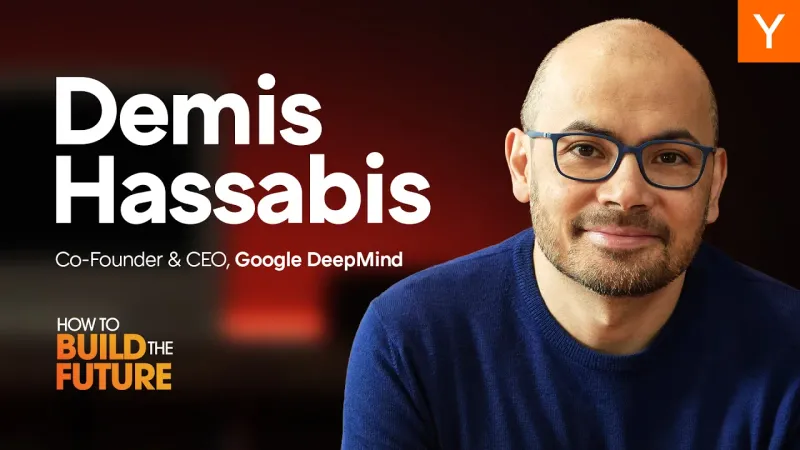
Demis Hassabis: Agents, AGI & The Next Big Scientific Breakthrough
Y Combinator@ycombinatorDemis Hassabis: Agents, AGI & The Next Big Scientific Breakthrough
In this live How to Build the Future conversation, Demis Hassabis discusses what may still be missing for AGI, including continual learning, long-term reasoning and memory, and why he sees agents as a path forward. The chapter topics also include AI-driven scientific discovery, future breakthroughs, and advice for founders.

- Views
- 273.2K
- Likes
- 5.3K
- Comments
- 246
- Artificial general intelligenceAI Agents and MemoryAI in Scientific DiscoveryAdvice for Founders
Analysis
In this live How to Build the Future conversation, Demis Hassabis discusses what may still be missing for AGI, including continual learning, long-term reasoning and memory, and why he sees agents as a path forward. The chapter topics also include AI-driven scientific discovery, future breakthroughs, and advice for founders.
- InterviewPodcast episode
- Title
- Demis Hassabis: Agents, AGI & The Next Big Scientific Breakthrough
“continual learning, long-term reasoning, uh some aspects of memory, these are still unsolved. I think all of these are going to be required for AGI. Depending on what your AGI timeline is, you know, mine's like 2030 or something like this, then if you start off on a deep tech journey net today, you have to just consider AGI appearing in the middle of that journey. It's not bad necessarily, but you have to take that into account. You have to have an active system uh that can actively solve problems for you to get to AGI. So, agents are that path, and I think we're just getting going. >> Demis Hassabis has had one of the most unusual careers in tech. He was a chess prodigy as a kid, then designed his first hit video game, Theme Park, at 17. He then went back to school, got a PhD in cognitive neuroscience, published foundational work on how memory and imagination work in the brain, and then in 2010 co-founded DeepMind with one mission, solve intelligence. And I think they've done it. Since then, uh his lab has gone on to do things most people thought were decades away. AlphaGo beat a world champion at Go, AlphaFold cracked protein structure prediction, a 50-year grand challenge in biology, and they gave it away for free to every scientist on Earth. That work won him the Nobel Prize in chemistry last year. Today, Demis leads Google DeepMind, where he's building Gemini and pushing toward the same goal he set when he was a teenager, artificial general intelligence. Please welcome Demis Hassabis. So, you've been thinking about AGI longer than almost anyone. Uh when you look at the current paradigm, large-scale pre-training, RLHF, chain of thought, how much of the final architecture for AGI do you think we already have, and what's fundamentally missing right now? >> Well, first of all, thank thanks, Gary, for that great introduction, and it's great to be here. Thanks for for welcoming here. It's amazing space, actually. I'll have to come back here often. Very inspiring that you all get to work in in in this space. So, the question is I think the the components that you just mentioned, I'm pretty sure will be part of the final architecture for AGI. So, I think they've come such a long way now, uh and we've proven out so many things about what they can do. Uh I can't see a world in which we'll sort of realize in a couple of years this was a dead end. That doesn't make sense to me. But, there still might be one or two things missing on top of uh of of of what you've you know, what we already know works. So, um continual learning, long-term reasoning, uh some aspects of memory, these are still unsolved. Um and how to get the systems to be more consistent across the board. Um I think all of these are going to be required for AGI. Now, it might be that the existing techniques can just scale up to that with some innovation and some incremental innovation. Um but, it could be that there's still one or two big ideas left uh that need to be cracked. I don't think it's more than one or two if there are out there. And I think, you know, my betting is uh about 50/50 if that's the case. So, of course, at DeepMind at Google DeepMind we work on both those things. >> I guess that's what I mean. Working with a bunch of identical systems, the wildest thing to me is to what degree it's the same weights ev- over and over.”
- 01Opening excerpt
This cold open gives viewers an initial position on the title's AGI and agents topics before the host identifies the guest. Its claims set up the question of what today's systems still lack.
The guest lists unresolved capabilities needed for AGI, argues that they are required, and says agents are a path that is just getting started.
“continual learning, long-term reasoning, uh some aspects of memory, these are still unsolved. I think all of these are going to be required for AGI. Depending on what your AGI timeline is, you know, mine's like 2030 or something like this, then if you start off on a deep tech journey net today, you have to just consider AGI appearing in the middle of that journey. It's not bad necessarily, but you have to take that into account. You have to have an active system uh that can actively solve problems for you to get to AGI. So, agents are that path, and I think we're just getting going.”
- 02Host introduces the guest
The career and achievement summary provides relevant context for hearing the guest's views on AGI. It also connects his scientific work to the title's themes without promising that this introduction will cover a specific new breakthrough.
The host summarizes Hassabis's career, educational and research background, DeepMind's founding mission, and notable work, then welcomes him.
“>> Demis Hassabis has had one of the most unusual careers in tech. He was a chess prodigy as a kid, then designed his first hit video game, Theme Park, at 17. He then went back to school, got a PhD in cognitive neuroscience, published foundational work on how memory and imagination work in the brain, and then in 2010 co-founded DeepMind with one mission, solve intelligence. And I think they've done it. Since then, uh his lab has gone on to do things most people thought were decades away. AlphaGo beat a world champion at Go, AlphaFold cracked protein structure prediction, a 50-year grand challenge in biology, and they gave it away for free to every scientist on Earth. That work won him the Nobel Prize in chemistry last year. Today, Demis leads Google DeepMind, where he's building Gemini and pushing toward the same goal he set when he was a teenager, artificial general intelligence. Please welcome Demis Hassabis.”
- 03The central interview question and first answer
The question moves from the guest's credentials to the episode's central technical topic. Hassabis's answer gives a qualified first account of what may be missing, while keeping open whether scaling existing techniques will be enough or a few major ideas remain to be discovered.
The host asks how much of the AGI architecture already exists and what is missing. After a brief greeting, Hassabis says the mentioned components will likely be part of the final architecture, notes the field's progress, and names capabilities that remain unresolved.
“So, you've been thinking about AGI longer than almost anyone. Uh when you look at the current paradigm, large-scale pre-training, RLHF, chain of thought, how much of the final architecture for AGI do you think we already have, and what's fundamentally missing right now? >> Well, first of all, thank thanks, Gary, for that great introduction, and it's great to be here. Thanks for for welcoming here. It's amazing space, actually. I'll have to come back here often. Very inspiring that you all get to work in in in this space. So, the question is I think the the components that you just mentioned, I'm pretty sure will be part of the final architecture for AGI. So, I think they've come such a long way now, uh and we've proven out so many things about what they can do. Uh I can't see a world in which we'll sort of realize in a couple of years this was a dead end. That doesn't make sense to me. But, there still might be one or two things missing on top of uh of of of what you've you know, what we already know works. So, um continual learning, long-term reasoning, uh some aspects of memory, these are still unsolved. Um and how to get the systems to be more consistent across the board. Um I think all of these are going to be required for AGI. Now, it might be that the existing techniques can just scale up to that with some innovation and some incremental innovation. Um but, it could be that there's still one or two big ideas left uh that need to be cracked. I don't think it's more than one or two if there are out there. And I think, you know, my betting is uh about 50/50 if that's the case. So, of course, at DeepMind at Google DeepMind we work on both those things.”
- 04Follow-up exchange
This exchange continues the opening's discussion of system behavior, but the ledger ends before the thought or interview transition is complete, so the introduction boundary cannot be determined more precisely from the supplied excerpt.
The host begins a follow-up, referring to identical systems and their weights; the supplied passage cuts off mid-thought.
“>> I guess that's what I mean. Working with a bunch of identical systems, the wildest thing to me is to what degree it's the same weights ev- over and over.”