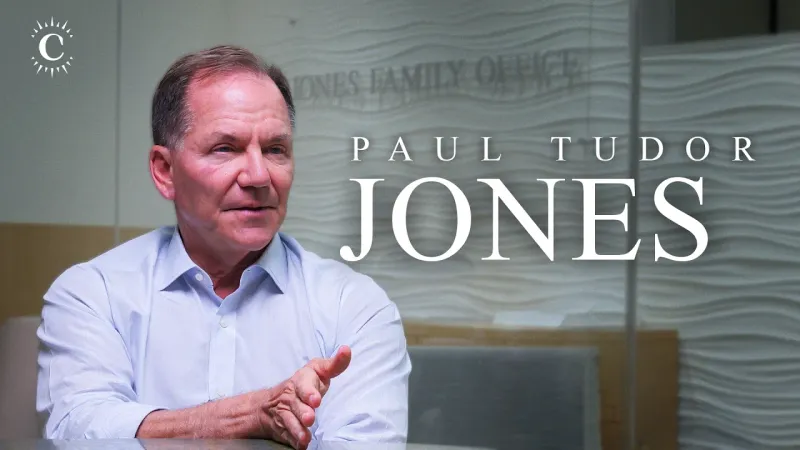
Legendary Trader Paul Tudor Jones on AI Risk, Bubbles and Buffett
Invest Like The Best@ILTB_PodcastLegendary Trader Paul Tudor Jones on AI Risk, Bubbles and Buffett
Investor Paul Tudor Jones joins Patrick O'Shaughnessy to discuss trading versus long-term investing, market bubbles and debt, and concerns about AI safety and regulation. The conversation also covers Jones's career, daily routine, philanthropy, kindness, and advice on finding meaning beyond work.
- Views
- 410.5K
- Likes
- 9.6K
- Comments
- 669
- Trading and InvestingAI Safety and RegulationMarket Bubbles and DebtKindness and PhilanthropyLife and Career Advice
Analysis
Investor Paul Tudor Jones joins Patrick O'Shaughnessy to discuss trading versus long-term investing, market bubbles and debt, and concerns about AI safety and regulation. The conversation also covers Jones's career, daily routine, philanthropy, kindness, and advice on finding meaning beyond work.
- InterviewPodcast episode
- Title
- Legendary Trader Paul Tudor Jones on AI Risk, Bubbles and Buffett
My number one bullet point is you're going to make your money by writing a trend for the very very longest time. Or you can be like Warren Buffett. You can be one of those value investors who won't spend a nickel. And I used to just sit there and rail on Warren Buffett year after year after year. And he just happened to be in the right place at the right time and caught this bull market. I was just thinking, "Oh my god, why couldn't I be Warren Buffett? just believe in America and just went you're down 50% who cares cuz America's going to bring you through. Warren, if you happen to hear this, I'm deeply apologetic. You are the OG of compound interest. There was something that we talked about when we last met that made me laugh and I thought it'd be a fun place to begin our conversation today and it was about the difference between being an investor and being a trader and you mentioned something basically saying you wished you could be an investor. Life would be so easy. I'd love you to describe the difference between the two and the life of a trader. >> I promise I'll do that. and we'll talk about markets and AI and everything and at the end >> I'll say were you not entertained and I bet you'll say yes but of all the things that you do on your podcast the one that I think is the most important if you don't mind I'd love to start with that one which is that question you ask everyone at the end >> I'm in I love it >> and the reason why is because um it's so funny I gave this commencement address one time to what is now Roads College in Memphis. I remember when I was writing it, I was in there thinking, damn, who gave my commencement address? And I couldn't remember. It was funny. No one remembers. Can you remember who gave your commencement? You're so young. You might. >> It was the president of Ireland at the time. I went to Notre Dame. So, >> and you're Irish, right? Okay. But it was so funny because no one remembers who gave their commencement address because and I was sitting there thinking, "God, I'm getting ready to do this for 15 or 20 minutes and no one's going to remember a damn thing. How do I make it special?" Uh, and so on this podcast, I'm assuming people listen to millions of podcasts and they probably can't really remember, but fractions of them. So if there's anything they remember from this, I hope I hope it's this part. >> All right. So, everyone that listens knows that the question is, what is the kindest thing that anyone's ever done for you? >> It's such a great question because the kindest thing was also my very, very, very first childhood memory. I was probably two and a half or three. It was probably 1957, something like that. And I was with my mother at this place called the Curb Market. And uh I got separated from my mother. And boy, you can imagine being 2 and 1/2 years old and separated from your mother. You just it's it's you're terror stricken. And this elderly black gentleman came up and I was sitting there balling my eyes out cuz I thought my mother had left me and said, "What's the matter, little boy?" And I said, "I lost my mama." And he said, "Here, don't you worry.
- 01Contrast and former opinion
This establishes the investing contrast and gives it a personal complication, making the guest’s perspective the opening’s main point of interest.
The guest contrasts trend-following with Buffett-style investing, then recounts criticizing Buffett and wishing he could invest like him.
My number one bullet point is you're going to make your money by writing a trend for the very very longest time. Or you can be like Warren Buffett. You can be one of those value investors who won't spend a nickel. And I used to just sit there and rail on Warren Buffett year after year after year. And he just happened to be in the right place at the right time and caught this bull market. I was just thinking, "Oh my god, why couldn't I be Warren Buffett? just believe in America and just went you're down 50% who cares cuz America's going to bring you through. Warren, if you happen to hear this, I'm deeply apologetic. You are the OG of compound interest.
- 02Why this conversation starts here
The question turns the opening’s contrast into a clear conversational topic and invites the guest to describe the trader’s life.
The host recalls a funny point from a previous meeting and asks the guest to explain the difference between being an investor and being a trader.
“There was something that we talked about when we last met that made me laugh and I thought it'd be a fun place to begin our conversation today and it was about the difference between being an investor and being a trader and you mentioned something basically saying you wished you could be an investor. Life would be so easy. I'd love you to describe the difference between the two and the life of a trader. >> I promise I'll do that.”
- 03Anecdote and recurring question
The anecdote supplies a light, personal detour and brings the introduction to a recognizable interview question. The supplied excerpt ends as the guest begins answering it, so the full introduction boundary cannot be confirmed here.
The speakers preview markets and AI, then exchange a humorous story about a commencement address and introduce the podcast’s recurring question about kindness.
and we'll talk about markets and AI and everything and at the end >> I'll say were you not entertained and I bet you'll say yes but of all the things that you do on your podcast the one that I think is the most important if you don't mind I'd love to start with that one which is that question you ask everyone at the end >> I'm in I love it >> and the reason why is because um it's so funny I gave this commencement address one time to what is now Roads College in Memphis. I remember when I was writing it, I was in there thinking, damn, who gave my commencement address? And I couldn't remember. It was funny. No one remembers. Can you remember who gave your commencement? You're so young. You might. >> It was the president of Ireland at the time. I went to Notre Dame. So, >> and you're Irish, right? Okay. But it was so funny because no one remembers who gave their commencement address because and I was sitting there thinking, "God, I'm getting ready to do this for 15 or 20 minutes and no one's going to remember a damn thing. How do I make it special?" Uh, and so on this podcast, I'm assuming people listen to millions of podcasts and they probably can't really remember, but fractions of them. So if there's anything they remember from this, I hope I hope it's this part. >> All right. So, everyone that listens knows that the question is, what is the kindest thing that anyone's ever done for you? >> It's such a great question because the kindest thing was also my very, very, very first childhood memory. I was probably two and a half or three. It was probably 1957, something like that. And I was with my mother at this place called the Curb Market. And uh I got separated from my mother. And boy, you can imagine being 2 and 1/2 years old and separated from your mother. You just it's it's you're terror stricken. And this elderly black gentleman came up and I was sitting there balling my eyes out cuz I thought my mother had left me and said, "What's the matter, little boy?" And I said, "I lost my mama." And he said, "Here, don't you worry.