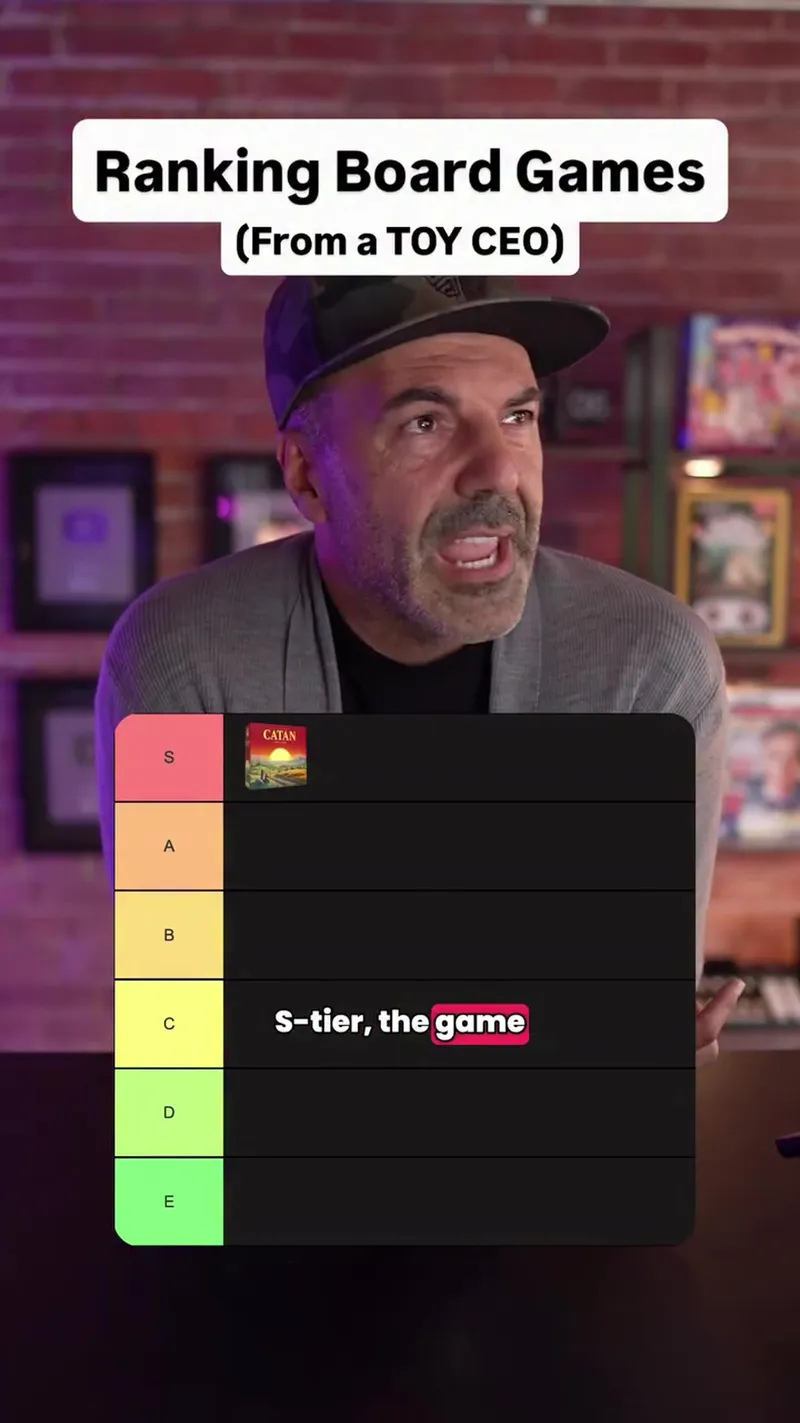
A professional Toy CEO ranks iconic board games using a tier list format, providing expert opinions on their gameplay and appeal. He praises strategy games like Catan and Sequence while critiquing the long-term engagement of classics like Monopoly and Mouse Trap.
Toy CEO's Ultimate Board Game Tier List
A toy CEO ranks classic board games in a tier chart, from Catan and Sequence at the top to games like Chutes and Ladders and Mouse Trap near the bottom. He gives brief, humorous reasons for his ratings, including how the games play across generations.
- Views
- 2.1M
- Likes
- 57.7K
- Comments
- 416
- Classic board gamesBoard game tier rankings
Analysis
A toy CEO ranks classic board games in a tier chart, from Catan and Sequence at the top to games like Chutes and Ladders and Mouse Trap near the bottom. He gives brief, humorous reasons for his ratings, including how the games play across generations.
- Talking headRanked list
- Spoken
- Original
“Katan. Oh my God. S Tier the game that finally got people to admit that Monopoly sucks.”
- On-screen text
- Original
“Ranking Board Games (From a TOY CEO)”
- Visual
- Text-led ranking composition with a supporting tier-board graphicA centered presenter holds the featured board-game box beneath a prominent headline. A tier-list graphic appears below him in the later opening samples, with the game shown in the S row.
- The tier chart updates with game images as the speaker rates each one, while captions highlight parts of his commentary.
“Katan. Oh my God. S Tier the game that finally got people to admit that Monopoly sucks. Shoots a ladder. D tier for me. A great way of teaching kids how unfair life is. Guess who? A tier the Greatest Deduction Game. Every kid asks the same first question. Jenga. A tier all day. The game isn't about the tower. It's about making fun of dad when he knocks it over. Sequence. Oh my God. S tier all day. Grandpa can play with grandkids. Full out Battle operation. B tier it's great at helping you realize that you're not going to be a doctor when you grow up. B tier should be an A tier. There's a lot of waiting. If we can add a timer in there, it'd be an A tier all day. Day. Mousetrap. D tier for me. 20 minutes to build and 10 seconds of staring at a ball. Monopoly. I mean. C tier for me. An absolute monster of a game. I've just never seen anyone finish it.”
- 01Opening top-tier verdict
Establishes the ranking format and the evaluator’s sharp, opinionated tone.
Names an item, reacts emphatically, places it in the top tier, and gives a pointed comparison as justification.
“Katan. Oh my God. S Tier the game that finally got people to admit that Monopoly sucks.”
- 02Low-tier contrast
Contrasts the opening praise with a comic, dismissive evaluation.
Ranks another item low and frames it as a lesson in life’s unfairness.
“Shoots a ladder. D tier for me. A great way of teaching kids how unfair life is.”
- 03High rank with a repeated-question observation
Supports the favorable ranking with a memorable social detail.
Gives an item a high rank, labels it as exceptional, then adds a concise observation about what users ask.
“Guess who? A tier the Greatest Deduction Game. Every kid asks the same first question.”
- 04Top-tier rationale as a joke
Turns the ranking into a specific comic payoff rather than a generic endorsement.
Ranks an item highly, then reframes its appeal as teasing someone when a mishap occurs.
“Jenga. A tier all day. The game isn't about the tower. It's about making fun of dad when he knocks it over.”
- 05Strong rank with an audience-fit reason
Adds a simple, concrete reason for the favorable placement.
Reacts emphatically, gives an item the highest tier, and explains its appeal through a particular audience being able to participate.
“Sequence. Oh my God. S tier all day. Grandpa can play with grandkids.”
- 06Mixed ranking with a self-deprecating jab
Balances the list with a comic criticism grounded in the item's implied skill or career association.
Gives an item a middling rank and jokes that it reveals the evaluator will not reach an ambitious future role.
“Full out Battle operation. B tier it's great at helping you realize that you're not going to be a doctor when you grow up.”
- 07Reconsideration and conditional upgrade
Develops the initial rating into a qualification and payoff: the item could earn the better tier if a specific limitation were fixed.
Repeats the current ranking, argues for a higher one, identifies a drawback, and proposes a change that would justify the upgrade.
“B tier should be an A tier. There's a lot of waiting. If we can add a timer in there, it'd be an A tier all day. Day.”
- 08Low rank through time-versus-payoff contrast
Makes the negative evaluation vivid through a compact mismatch between effort and reward.
Ranks an item low, then contrasts the long setup with a very brief payoff.
“Mousetrap. D tier for me. 20 minutes to build and 10 seconds of staring at a ball.”
- 09Final middling verdict and experience-based evidence
Closes the sequence with a concrete personal observation supporting the final judgment.
Returns to an earlier item, gives it a middling tier, calls it imposing, then cites never seeing anyone finish it.
“Monopoly. I mean. C tier for me. An absolute monster of a game. I've just never seen anyone finish it.”