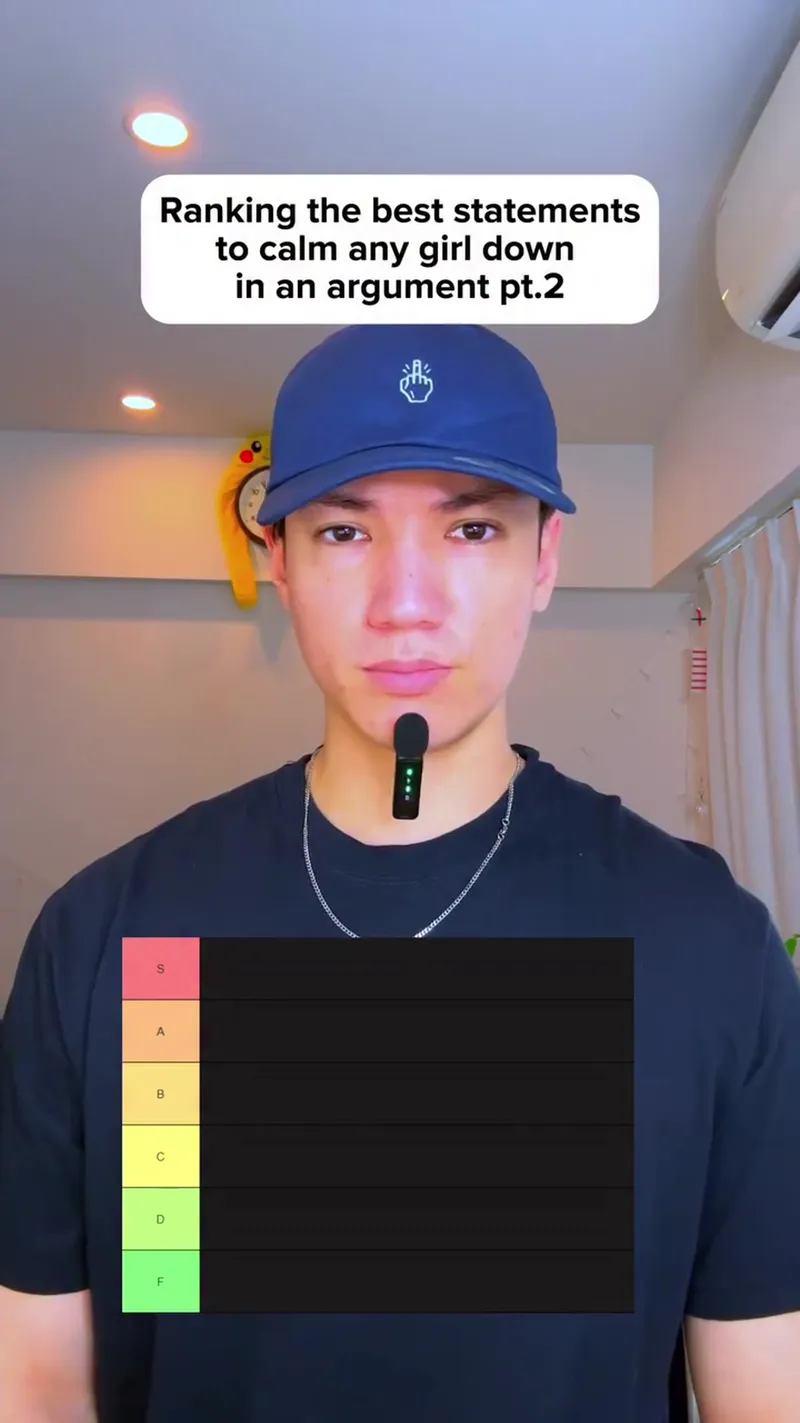
The video presents a humorous tier list ranking phrases used during arguments. It ironically suggests that rude or dismissive comments are the most effective, while sincere apologies are the least effective.
Satirical Rankings: The Best Ways to Handle an Argument
A presenter ranks phrases people might use during an argument, placing them in tiers from S to F. The list mixes supportive, dismissive, and sarcastic lines, with the tier chart updated as he goes.
- Views
- 684.8K
- Likes
- 56K
- Comments
- 244
- Argument phrases rankedRelationship conflict
Analysis
A presenter ranks phrases people might use during an argument, placing them in tiers from S to F. The list mixes supportive, dismissive, and sarcastic lines, with the tier chart updated as he goes.
- Talking headRanked listCommentary
- Spoken
- Original
“Ranking. Best statements to calm any girl down in an argument.”
- On-screen text
- Original
“Ranking the best statements to calm any girl down in an argument pt.2”
- Visual
- Text-led composition with a ranking-format graphicA centered presenter faces the camera in a medium shot, with a prominent headline above and an empty, color-banded tier-list graphic across the lower torso.
- The presenter speaks each phrase as its caption appears, while the tier chart shows its ranking; the chart also summarizes the accumulated choices.
“Ranking. Best statements to calm any girl down in an argument. That's your opinion. That's your opinion. That's your opinion. B tier. That sounded better in your head, huh? C tier. Big feelings today, huh? D tier. Do you hear yourself? A tier. So no head. S tier. A. Cool it. C tier. Wait. Dishes. B tier. You're right. I shouldn't have said that. F tier. Hold on, I'm listening. A tier. Skip dialogue. Skip dialogue. Skip dialogue. Skip dialogue. Skip. S tier. I want to understand your perspective. D tier. Here we go again. B tier. I like you better when you're quiet. B tier. You lost me when you open your mouth. C tier. Perhaps, perhaps, perhaps, perhaps. A tier. I'm sorry. I was wrong. Not on the list. Someone's got their shield up. You're getting defensive. S tier. Emotions deducted. Opinions rejected. A tier. B tier. Oh, wait, wait, wait, wait, wait, wait, wait. A tier. That's what you sound like. A tier. Did you take your pills today? D tier. I'm sorry. I overreacted. F tier. Babe, you're right. F tier. I care about you more than winning this argument. F tier. Uncle Gilbert. S. Dear.”
- 01Introduce the ranking and establish the pattern
Establishes the format and gives an initial example that demonstrates the terse, evaluative style.
Names the ranking topic, then repeats one sample statement three times before assigning a tier and teasing its phrasing.
“Ranking. Best statements to calm any girl down in an argument. That's your opinion. That's your opinion. That's your opinion. B tier. That sounded better in your head, huh?”
- 02Rapid-fire ranked examples
Develops the ranking through varied sample lines, balancing dismissive put-downs, a positive response, and a pause-like interruption.
Runs through several examples, assigning each a tier and adding a short reaction, critique, or qualification; some entries are repeated or deliberately brief.
“C tier. Big feelings today, huh? D tier. Do you hear yourself? A tier. So no head. S tier. A. Cool it. C tier. Wait. Dishes. B tier. You're right. I shouldn't have said that. F tier. Hold on, I'm listening. A tier. Skip dialogue. Skip dialogue. Skip dialogue. Skip dialogue. Skip.”
- 03Continue with contrasting evaluations
Extends the list with contrasting kinds of statements, showing how the same tier format accommodates sincere, dismissive, and exaggerated examples.
Ranks a considerate statement highly, dismisses another, and follows with two insulting examples and a repeated-word entry.
“S tier. I want to understand your perspective. D tier. Here we go again. B tier. I like you better when you're quiet. B tier. You lost me when you open your mouth. C tier. Perhaps, perhaps, perhaps, perhaps.”
- 04Rank the apology, then reject it
Creates a sharp reversal: an apparently conciliatory entry is removed from the list, followed by remarks that explain the dismissive stance of the ranking.
Presents an apology as a high-tier statement, immediately withdraws it, and adds two observations about defensiveness.
“A tier. I'm sorry. I was wrong. Not on the list. Someone's got their shield up. You're getting defensive.”
- 05Escalate the mock grading, then close with a sincere contrast
The exaggerated grading continues the joke, while the final entry shifts from insults to care, giving the ranking a contrasting closing beat.
Uses bureaucratic-sounding reasons to reject emotion and opinions, pauses, adds a cutting comparison and a personal jab, then ranks an apology low before ending on an affectionate statement about valuing the relationship over winning.
“S tier. Emotions deducted. Opinions rejected. A tier. B tier. Oh, wait, wait, wait, wait, wait, wait, wait. A tier. That's what you sound like. A tier. Did you take your pills today? D tier. I'm sorry. I overreacted. F tier. Babe, you're right. F tier. I care about you more than winning this argument. F tier. Uncle Gilbert. S. Dear.”