Do Push-Ups Like This For Bigger Shoulders
FitnessFAQs@FitnessFAQsDo Push-Ups Like This For Bigger Shoulders
A fitness presenter explains how pseudo planche push-ups can target the front delts. He advises leaning forward carefully, keeping scapular control, and using shoulder fatigue as a sign the exercise is emphasizing the delts.
- Views
- 103K
- Likes
- 816
- Comments
- 14
- Front delt trainingPseudo planche push-upsPush-up form
Analysis
A fitness presenter explains how pseudo planche push-ups can target the front delts. He advises leaning forward carefully, keeping scapular control, and using shoulder fatigue as a sign the exercise is emphasizing the delts.
- Talking headVoiceoverDemoTutorial
- Spoken
- Original
“These are some of the best bodyweight exercises for front delts and overall shoulder size.”
- On-screen text
- Original
“THESE ARE SOME OF THE BEST BODYWEIGHT EXERCISES”
- Visual
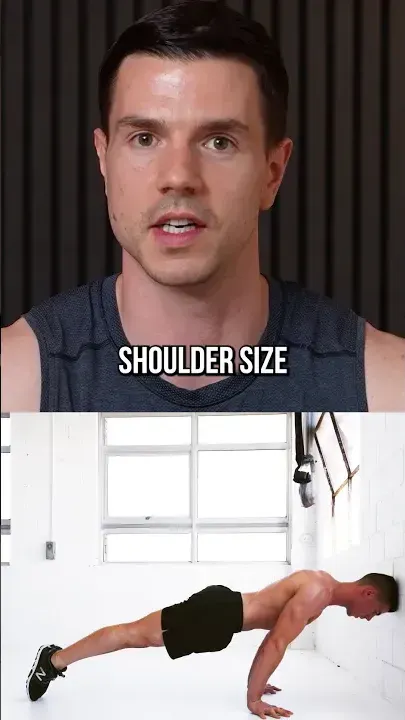
- Split-screen demonstrationA vertical split-screen places a centered, direct-to-camera speaker in the upper panel and a person performing a push-up in a bright room in the lower panel. Bold captions sit over the speaker’s chest.
- The presenter speaks while sampled clips show push-up variations; the captions highlight phrases from his advice, including the warning about an “ugly banana” body position.
“These are some of the best bodyweight exercises for front delts and overall shoulder size. Please remember, a few centimeters further feels like you're lifting much heavier weights, so you've got to be realistic with how you're leaning. Otherwise your reps will fall off a cliff, or you'll start losing all scapular control and your body position will turn into a really ugly banana. So how do you know if your form's on point? If you feel that your shoulders are getting absolutely cooked after a handful of reps, it's a good sign that you're biasing the front delts instead of the pecs with pseudo planche push ups. Lean forward, Challenge yourself and your shoulders will grow. Lean back, stay in the comfort zone, and your shoulders won't improve.”
- 01Name the useful exercise
Establishes the recommendation and the goal the following technique advice supports.
Introduces bodyweight exercises as effective for a particular muscle group and size goal.
“These are some of the best bodyweight exercises for front delts and overall shoulder size.”
- 02Warn against overreaching
Qualifies the recommendation with a concrete form warning, setting up the question of how to tell whether the movement is being performed well.
Explains that a small increase in difficulty can feel much heavier, advises realistic positioning, and describes the resulting drop in reps and loss of control with a humorous image.
“Please remember, a few centimeters further feels like you're lifting much heavier weights, so you've got to be realistic with how you're leaning. Otherwise your reps will fall off a cliff, or you'll start losing all scapular control and your body position will turn into a really ugly banana. So how do you know if your form's on point?”
- 03Give a form check and effort contrast
Answers the form question with a practical check and concludes with a direct contrast linking effort to the stated improvement goal.
Offers a bodily effort cue as evidence of correct emphasis, then contrasts a challenging variation that supports progress with a comfortable approach that does not.
“If you feel that your shoulders are getting absolutely cooked after a handful of reps, it's a good sign that you're biasing the front delts instead of the pecs with pseudo planche push ups. Lean forward, Challenge yourself and your shoulders will grow. Lean back, stay in the comfort zone, and your shoulders won't improve.”