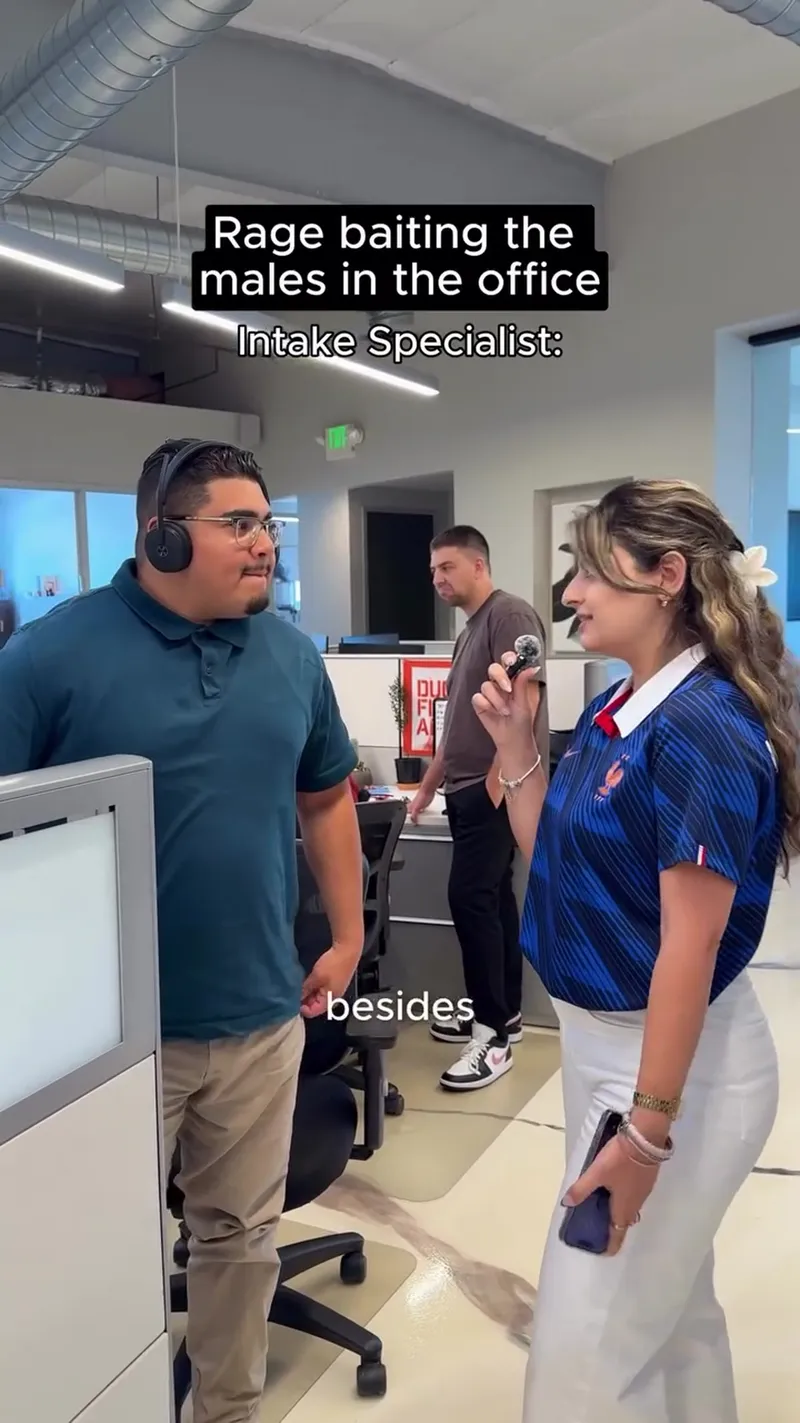
A woman at a law firm playfully pranks her male colleagues by asking them insulting questions disguised as serious interview prompts. She targets their fashion sense, career choices, and personalities to get a reaction for the camera.
Rage Baiting Coworkers with Backhanded Questions
A woman asks male coworkers deliberately insulting questions about their company, people skills, fashion sense, and jobs. Their confused and amused replies turn the office interview into a prank.
- Likes
- 132.9K
- Comments
- 591
- Office prank interviewsRage-bait questionsWorkplace banter
Analysis
A woman asks male coworkers deliberately insulting questions about their company, people skills, fashion sense, and jobs. Their confused and amused replies turn the office interview into a prank.
- InterviewSkit
- Spoken
- Original
“If you could change one thing about yourself, besides the obvious, what would it be?”
- On-screen text
- Original
“Rage baiting the males in the office Intake Specialist:”
- Visual
- Text-led interview sceneA vertical office scene shows an interviewer on the right holding a microphone toward a male coworker on the left, with another worker in the background. A prominent two-line headline sits near the top.
- The visuals show the interviewer approaching different male coworkers with a microphone, matching the transcript’s question-and-answer exchange. On-screen labels identify the interviewer and coworkers’ roles.
“If you could change one thing about yourself, besides the obvious, what would it be? What's the obvious? If you could start a real company, what would it be? Like, an actual company. What role do you think you would be in if you were a people person? That's funny. I am a people's person. So I guess we'll never not like actually a people person. Wait, can you stop? If you had a real fashion sense, what trend would you. It's this kind of day today. If I had a real fashion sense, what trend would you try? I would try dressing more like you and being real cool. If you had a real job, what would it be? I don't know. Would a real job be construction? Oh, you're asking just the real job. So I don't have a good answer.”
- 01Open with a personal hypothetical
The first question establishes the exchange's playful hypothetical format. The follow-ups narrow it into a possible venture and role, setting up a broad answer that can be taken literally or playfully.
Ask what one thing the other person would change about themselves, then use their clarification to pivot into a question about starting a genuine [venture]. Ask what role they might fill in a people-focused field.
“If you could change one thing about yourself, besides the obvious, what would it be? What's the obvious? If you could start a real company, what would it be? Like, an actual company. What role do you think you would be in if you were a people person?”
- 02Answer, then interrupt the answer
The self-description answers the role question, while the unfinished-sounding qualification and interruption create a brief comic exchange before the next hypothetical.
A respondent identifies as a people-oriented person, trails into an ambiguous phrase, and is interrupted with a request to stop.
“That's funny. I am a people's person. So I guess we'll never not like actually a people person. Wait, can you stop?”
- 03Repeat the question in a new domain
The repeated hypothetical renews the question-and-answer pattern, while the response's sidestep and flattering answer provide the exchange's playful payoff.
Ask what trend someone would try if they had a genuine sense of style; the response jokingly treats the day itself as the trend, then answers with admiration for the questioner.
“If you had a real fashion sense, what trend would you. It's this kind of day today. If I had a real fashion sense, what trend would you try? I would try dressing more like you and being real cool.”
- 04Clarify the final hypothetical
The occupation suggestion creates a misunderstanding, and the explicit clarification resolves it with a self-deprecating closing answer.
Ask what job the other person would choose; they suggest a possible occupation, then realize the question meant a real job and concede they have no good answer.
“If you had a real job, what would it be? I don't know. Would a real job be construction? Oh, you're asking just the real job. So I don't have a good answer.”