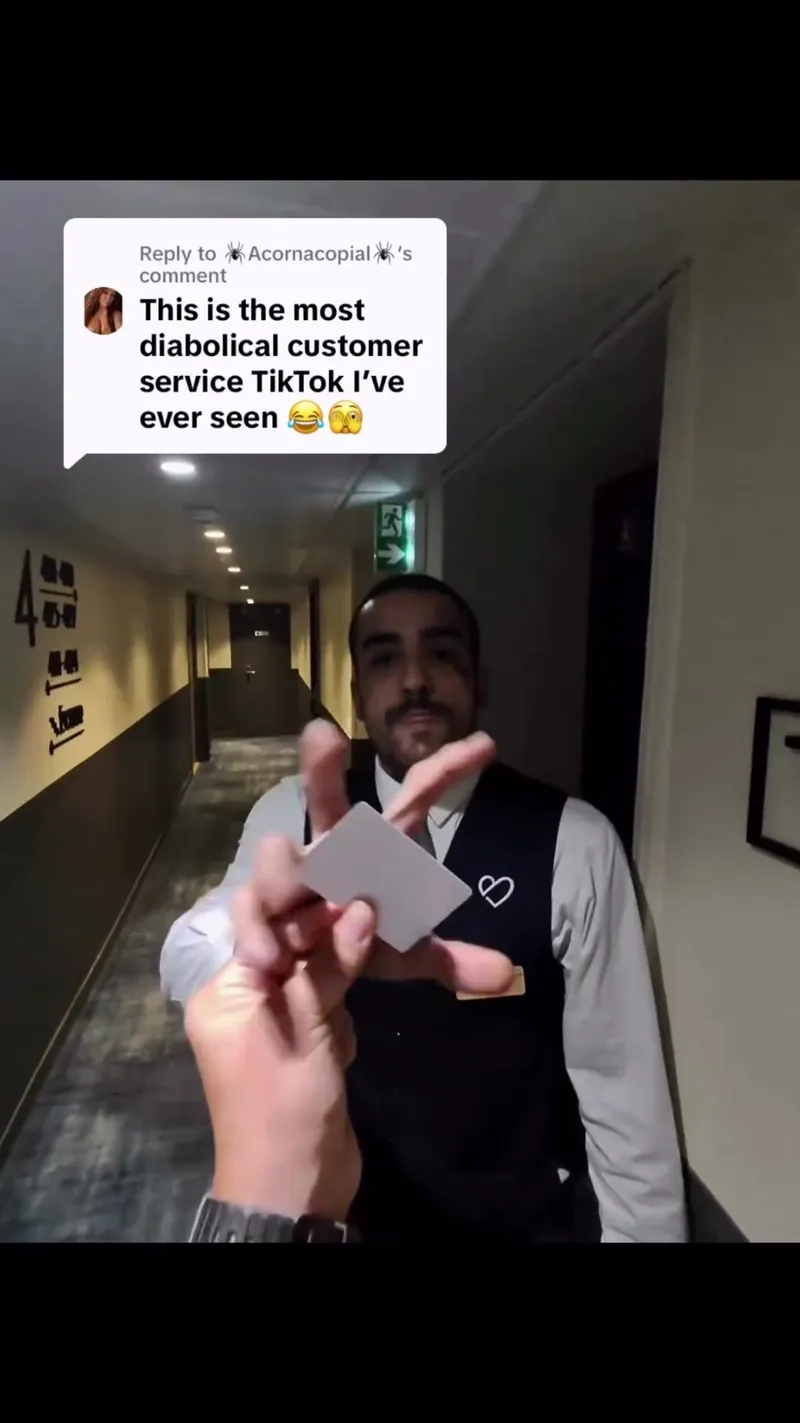
A traveler recounts a bizarre experience where a hotel employee failed to provide a working room key and then became emotionally volatile. The video includes raw clips of the employee yelling, running away, and eventually setting strange conditions for the guest to enter their room.
My Hotel Nightmare: The Key That Wouldn't Work
A hotel guest recounts repeated room-key failures and a tense dispute with an employee while trying to get back into his room. He explains why he asked whether the key worked and describes the employee’s response.
- Likes
- 239.4K
- Comments
- 8K
- Hotel room key failureHotel customer service dispute
Analysis
A hotel guest recounts repeated room-key failures and a tense dispute with an employee while trying to get back into his room. He explains why he asked whether the key worked and describes the employee’s response.
- Talking headVoiceoverStory arcCommentaryComment response
- Spoken
- Original
“His response, does the key work?”
- On-screen text
- Original
“This is the most diabolical customer service TikTok I’ve ever seen 😂😱”
- Visual
- Text-led composition with an interactionA person in a hotel corridor faces the camera as a hand presents a key card toward him; the comment headline sits prominently above the scene.
- The hallway samples show the guest holding a key toward the employee and the employee walking away, matching the narrated dispute. Later samples show the guest outdoors as he continues recounting events.
“His response, does the key work? Hey, don't fucking swallow it. After he finished crying in the bathroom, he eventually made me a third key. I went to go use it, and it didn't work. And this is what happened when I came to tell him that the third key did not work. 4:24. Stop yelling at me, please. Sir, I have not yelled at you once. You scared me. Please go back in your room. Wait till the next clip. But the irony in this one is that he's telling me to just go back to my room, as if that's not what I'm trying to do. So after this key also didn't work, he finally gets annoyed enough to come upstairs and show me what I'm doing wrong. Wait until you see what happens when we get to the door. It does not work. Monsieur, does the key work? I see him tap my room key twice, and it not work. And then finally, he opens it with, like, the master key, which. Which proves I was doing nothing wrong, which then prompts me to ask him, does the key work? Now, in all fairness, I am asking this question for two reasons. Partly because I don't want to get locked out of the room again, but also partly to be a dick, because he just spent the last 20 minutes literally calling me an idiot and telling me that I did not know how to work the lock. And his response, does the key work? Hey, don't fucking swallow it. Now if you're paying attention, he did in fact, open the door for me, but he did not hold it open or leave it open long enough for me to get in the room because he opened it 10ft away. And then when I asked him, does the key work? Because the door is now closed again, he then shouts at me and then runs away. So he opened the door, but then actually give me a chance to get into the room, and he runs away down the hallway, and I have to chase him down the stairs. Open my hotel room door. Please let me in my room. I'm not fighting with you. You said that you threw a key at me and spit at me. Sir, let me into my room. Come on. Is there any other employee here? Does anyone else work here? Now, in all fairness, I will admit that at this point, I was getting a little bit heated, especially when I was chasing him down the stairs because I was shouting at him, mostly out of the absurdity of this. He had already begrudgingly come upstairs, opened the door, did not leave it open for me to go through it, throws the key at me, and then runs away, and we still haven't solved the problem that I'm not in my room. Anyways, after this video ends and I sit in the lobby for 10 minutes pleading with him to let me into my room, he says, I shall let you into the room on one condition. That you go into the room and you do not leave until my shift is over and you do not interact with me again today. Do you understand? As if he sets conditions for what I do or do not do as a guest at the hotel. Like I want to interact with you. The entire purpose of all of my interactions was to get into the room. Me asking you to get me another room key or to come help me is somehow an imposition to the extent of which you have to throw a fit and cry in the bathroom.”
- 01Introduce the repeated question and first failures
Sets up the recurring question and a concrete problem; the failed test leads into the next attempt and its consequences.
Open with a question about whether an item or process works, then recount prior attempts, a failed test, and the reaction when the failure is reported.
“His response, does the key work? Hey, don't fucking swallow it. After he finished crying in the bathroom, he eventually made me a third key. I went to go use it, and it didn't work. And this is what happened when I came to tell him that the third key did not work. 4:24. Stop yelling at me, please. Sir, I have not yelled at you once. You scared me. Please go back in your room.”
- 02Explain the irony and set up a decisive demonstration
The narrator expects the other person to show what is being done wrong; the promise of a demonstration creates anticipation for another test.
Point out the mismatch between the instruction and what the narrator is trying to do, then describe another failure and promise a demonstration at the relevant location.
“Wait till the next clip. But the irony in this one is that he's telling me to just go back to my room, as if that's not what I'm trying to do. So after this key also didn't work, he finally gets annoyed enough to come upstairs and show me what I'm doing wrong. Wait until you see what happens when we get to the door.”
- 03Demonstration fails, then a workaround works
The initial failure complicates the claim that the narrator was at fault; the eventual workaround resolves the immediate test while prompting the recurring question again.
Show the other person also failing at first, then succeeding with a different tool or method; explain what that success proves and repeat the original question.
“It does not work. Monsieur, does the key work? I see him tap my room key twice, and it not work. And then finally, he opens it with, like, the master key, which. Which proves I was doing nothing wrong, which then prompts me to ask him, does the key work?”
- 04Explain the two motives and reprise the response
Explains why the narrator keeps asking and turns the repeated response into a pointed comic contrast with the preceding criticism.
Clarify a practical reason for repeating the question and a petty or comic reason tied to prior criticism, then repeat the question and quote the same response.
“Now, in all fairness, I am asking this question for two reasons. Partly because I don't want to get locked out of the room again, but also partly to be a dick, because he just spent the last 20 minutes literally calling me an idiot and telling me that I did not know how to work the lock. And his response, does the key work? Hey, don't fucking swallow it.”
- 05Clarify the technicality and escalate the failed access
Distinguishes a partial action from a useful resolution; the narrator still lacks access, and the other person’s departure escalates the problem.
Acknowledge the apparent success, explain why it did not solve the actual problem, and recount the renewed failure and ensuing chase.
“Now if you're paying attention, he did in fact, open the door for me, but he did not hold it open or leave it open long enough for me to get in the room because he opened it 10ft away. And then when I asked him, does the key work? Because the door is now closed again, he then shouts at me and then runs away. So he opened the door, but then actually give me a chance to get into the room, and he runs away down the hallway, and I have to chase him down the stairs. Open my hotel room door. Please let me in my room. I'm not fighting with you. You said that you threw a key at me and spit at me. Sir, let me into my room. Come on. Is there any other employee here? Does anyone else work here?”
- 06Admit the narrator's reaction and summarize the unresolved problem
Adds a self-aware qualification while reinforcing the mismatch between the effort and outcome; the main problem remains pending.
Concede becoming heated, explain the absurdity, then recap the other person's actions and state that the original problem remains unsolved.
“Now, in all fairness, I will admit that at this point, I was getting a little bit heated, especially when I was chasing him down the stairs because I was shouting at him, mostly out of the absurdity of this. He had already begrudgingly come upstairs, opened the door, did not leave it open for me to go through it, throws the key at me, and then runs away, and we still haven't solved the problem that I'm not in my room.”
- 07Deliver the later condition and ironic rebuttal
Provides a later outcome without pretending the earlier ordeal was resolved cleanly; closes on the irony that requests for help are treated as an imposition despite serving a limited practical goal.
After a later wait, report a new condition for getting help, then challenge its relevance by explaining the narrator's actual goal and why the requests were made.
“Anyways, after this video ends and I sit in the lobby for 10 minutes pleading with him to let me into my room, he says, I shall let you into the room on one condition. That you go into the room and you do not leave until my shift is over and you do not interact with me again today. Do you understand? As if he sets conditions for what I do or do not do as a guest at the hotel. Like I want to interact with you. The entire purpose of all of my interactions was to get into the room. Me asking you to get me another room key or to come help me is somehow an imposition to the extent of which you have to throw a fit and cry in the bathroom.”