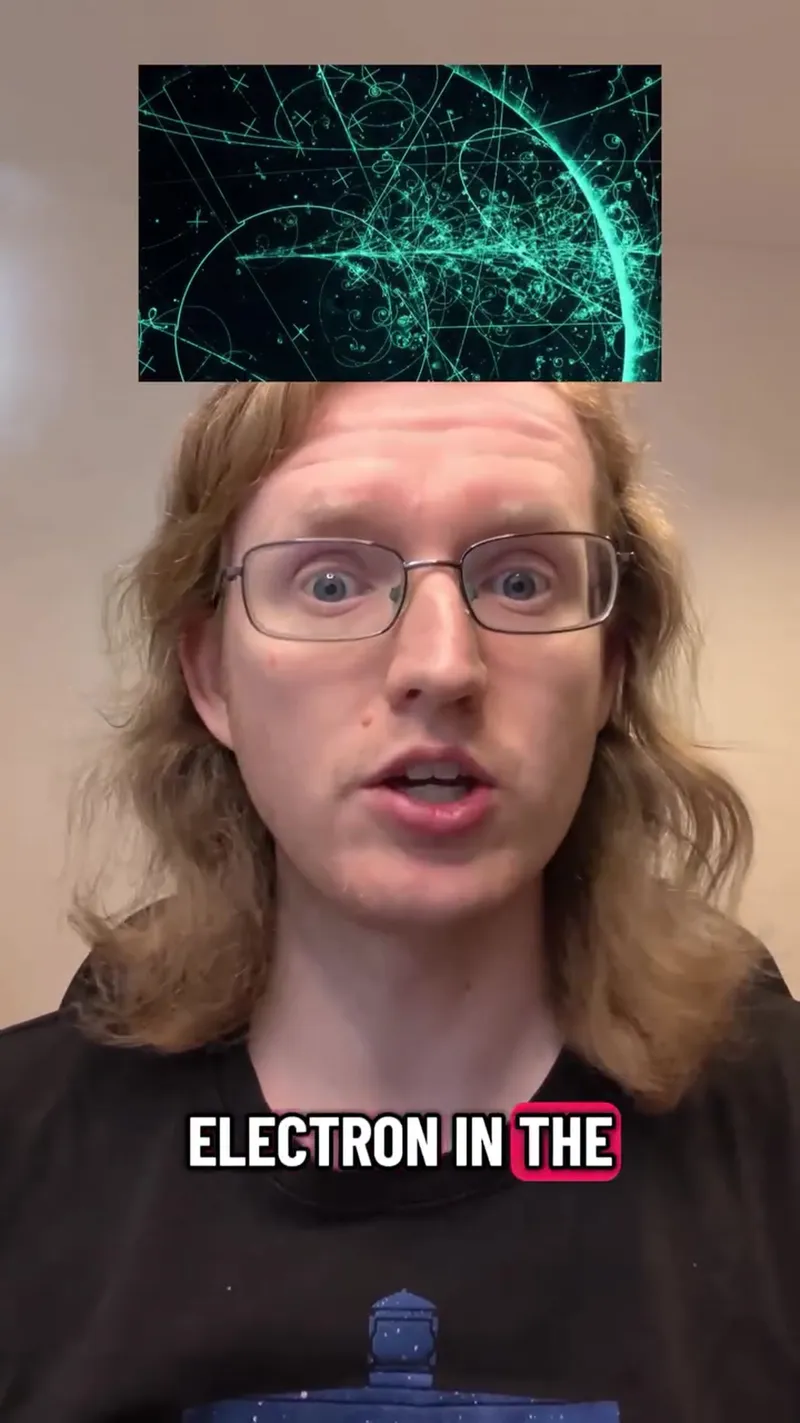
An astrophysicist explores John Wheeler's mind-bending theory that every electron in the universe is actually the same particle traveling through time. He explains why all electrons share identical properties and the reason this elegant idea ultimately doesn't align with our observations of reality.
Is Every Electron Actually the Same Particle?
An astrophysicist explains John Wheeler’s idea that all electrons could be one particle moving back and forth through time. He describes why the idea does not fit the observed electron–positron imbalance, while noting its value as a way to think about the universe.
- Views
- 364.6K
- Likes
- 19.6K
- Comments
- 574
- One-electron universe ideaElectron and positron imbalanceElectron properties in physics
Analysis
An astrophysicist explains John Wheeler’s idea that all electrons could be one particle moving back and forth through time. He describes why the idea does not fit the observed electron–positron imbalance, while noting its value as a way to think about the universe.
- Talking headVoiceoverExplainer
- Spoken
- Original
“What if every electron in the universe is actually the same electron?”
- On-screen text
- Original
“WHAT IF EVERY”
- Visual
- Text-led composition with contextual imageA centered, close-up speaker faces the camera, with a wide physics-themed image inset above their head. The prominent caption sits across the lower part of the frame.
- The speaker addresses the camera while captions track his words. Small electron and atom illustrations reinforce the physics explanation.
“What if every electron in the universe is actually the same electron? As an astrophysicist, I'm going to explain one of the strangest ideas in physics. But before we get into that, if you haven't seen me before, my name is Lawrence. I have a PhD in astrophysics and I explain cool things from space and sci fi. So make sure to give me a like and a follow, if you haven't already. One of the oddest things about electrons is, is that they're all exactly the same. They have the same mass, the same electric charge and the same quantum properties. In the 1940s, physicist John Wheeler suggested an interesting thought experiment. What if every electron was actually the same one? The idea was that this single electron could be travelling backwards and forwards in time, crossing the universe over and over again. Then every electron that we see would simply be that same particle at a different point along its journey. It's an incredibly elegant idea, but unfortunately it doesn't match what we observe. For example, there are far more electrons than positrons in the universe, which this theory would struggle to explain. So physicists don't think this is how reality actually works. But it's still a brilliant reminder that sometimes the strangest ideas seem can help us think about the universe in completely new ways. What's weirder? The idea that every electron is completely identical, or that every electron is actually the same one? Let me know what you think in the comments and I'll see you again tomorrow.”
- 01Pose the strange question and establish the explainer
Frames the central question and signals why the creator can explain it before moving into the substantive account.
Raises a surprising question, promises an explanation, introduces the creator's relevant expertise and topic, then asks for engagement.
“What if every electron in the universe is actually the same electron? As an astrophysicist, I'm going to explain one of the strangest ideas in physics. But before we get into that, if you haven't seen me before, my name is Lawrence. I have a PhD in astrophysics and I explain cool things from space and sci fi. So make sure to give me a like and a follow, if you haven't already.”
- 02Establish the premise and describe the thought experiment
Supplies the factual premise and a concrete model that answers how the startling possibility might work.
States that electrons share identical properties, introduces Wheeler's thought experiment, and explains how one particle could account for every electron.
“One of the oddest things about electrons is, is that they're all exactly the same. They have the same mass, the same electric charge and the same quantum properties. In the 1940s, physicist John Wheeler suggested an interesting thought experiment. What if every electron was actually the same one? The idea was that this single electron could be travelling backwards and forwards in time, crossing the universe over and over again. Then every electron that we see would simply be that same particle at a different point along its journey.”
- 03Test the idea against evidence and qualify its value
Resolves whether the proposal matches reality with a specific counterexample, then gives the idea a more limited intellectual payoff.
Calls the idea elegant but notes that an observed imbalance conflicts with it, then rejects it as a description of reality while preserving its value as a way to think.
“It's an incredibly elegant idea, but unfortunately it doesn't match what we observe. For example, there are far more electrons than positrons in the universe, which this theory would struggle to explain. So physicists don't think this is how reality actually works. But it's still a brilliant reminder that sometimes the strangest ideas seem can help us think about the universe in completely new ways.”
- 04Reopen the question and invite responses
Returns to the opening question after the evidence check and gives viewers a specific comparison to answer.
Recasts the central puzzle as a choice between two explanations, asks viewers what they think, and closes with a sign-off.
“What's weirder? The idea that every electron is completely identical, or that every electron is actually the same one? Let me know what you think in the comments and I'll see you again tomorrow.”