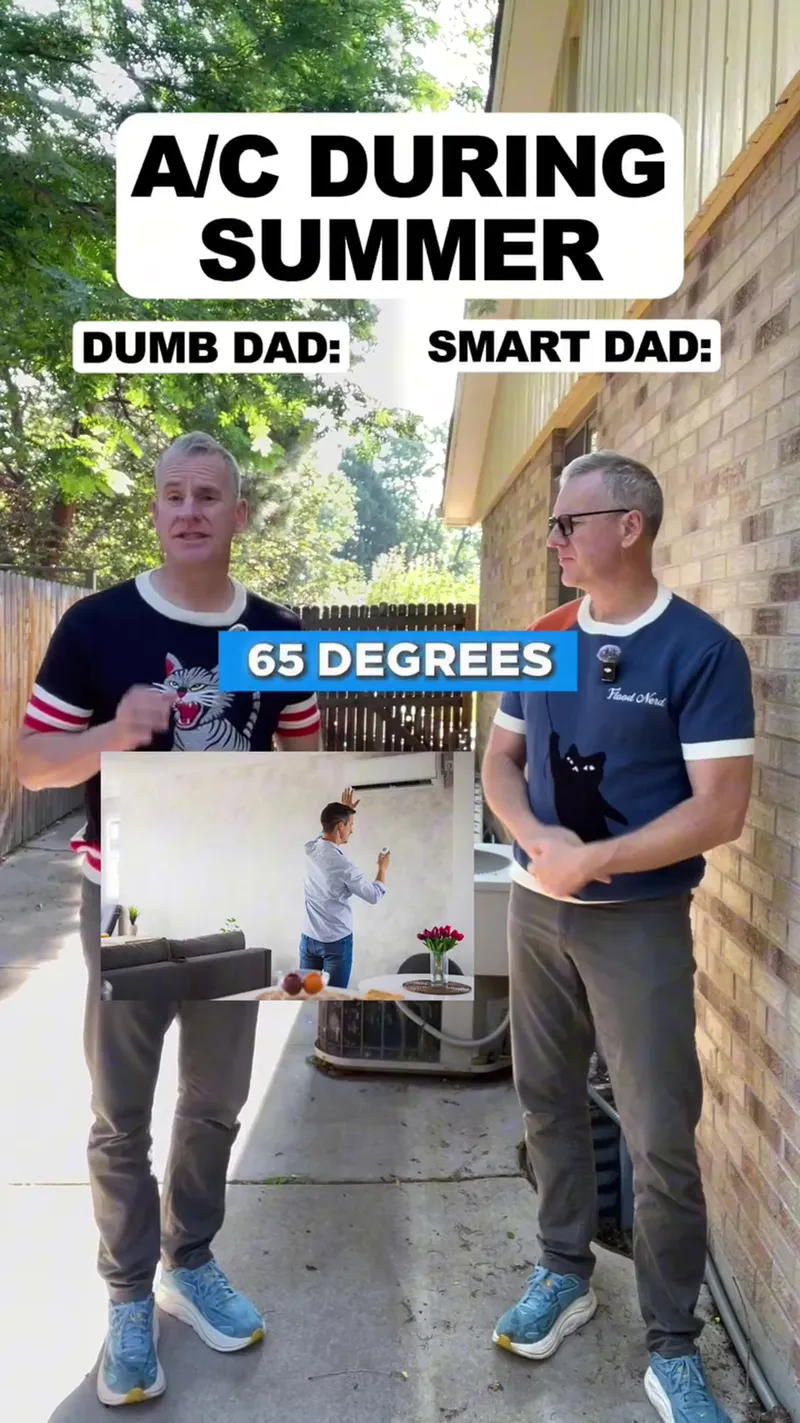
The video debunks the myth that turning your AC off while away saves money, explaining that cooling a hot house from scratch burns more energy than maintaining a steady temperature. It provides specific thermostat settings for being at home and away to help viewers lower their monthly electric bills.
Stop Turning Your AC Off! How to Lower Your Summer Electric Bill
Two men act out a comparison of costly AC habits and explain why turning the system off can use more energy when the home heats up. They recommend setting the thermostat to 78°F at home and 82°F when away.
- Likes
- 70.1K
- Comments
- 1.1K
- Summer AC settingsThermostat energy useHome cooling costs
Analysis
Two men act out a comparison of costly AC habits and explain why turning the system off can use more energy when the home heats up. They recommend setting the thermostat to 78°F at home and 82°F when away.
- SkitTutorialProblem–SolutionTalking head
- Spoken
- Original
“I crank my AC down to 65 degrees at night just so I can sleep.”
- On-screen text
- Original
“A/C DURING SUMMER DUMB DAD: SMART DAD: I CRANK MY AC”
- Visual
- Text-led comparison with illustrative insetTwo people stand side by side beneath contrasting labels; a smaller inset image of someone adjusting an indoor AC sits between them. The large headline and blue caption are the most prominent overlays.
- The captions track the spoken dialogue, while small inset images show AC and thermostat examples that support the advice.
“I crank my AC down to 65 degrees at night just so I can sleep. But my wife keeps complaining about the $400 electric bill. My house stays comfortable, and my bill runs about $186. I just change how I use the thermostat. I turn it way down when it's hot and turn it off when I leave. I figure that's the most effective way to do it. Cranking it to 65 when it's hot and turning it off when you leave are two of the most expensive things that you could actually do to your ac. Wait. Turning off when I leave makes the bill higher? I thought I was saving money. Nope. When you turn it off, the house heats up completely. Then when you come home, the AC system has to work twice as hard to bring it back down. And that's where you burn up the most energy. What should I do? Just set your thermostat to 78 when you're home and 82 when you leave. The system maintains a steady temperature and your bill drops significantly. Got it. How do you know all this? I follow Floodnerd. He shares the best dad hacks to save money.”
- 01Personal habit and apparent trade-off
Sets up the apparent conflict between comfort and cost, while hinting that the speaker's thermostat method may explain the better result.
The speaker describes a routine choice made for comfort, mentions someone else's concern about a high bill, then contrasts that with comfort and a lower bill attributed to a different thermostat approach.
“I crank my AC down to 65 degrees at night just so I can sleep. But my wife keeps complaining about the $400 electric bill. My house stays comfortable, and my bill runs about $186. I just change how I use the thermostat.”
- 02Reveal the counterproductive habits
Challenges the initial assumption and raises the question of why the apparently sensible actions increase costs.
The speaker describes turning the system down and off, says this seems effective, then reframes these habits as especially expensive.
“I turn it way down when it's hot and turn it off when I leave. I figure that's the most effective way to do it. Cranking it to 65 when it's hot and turning it off when you leave are two of the most expensive things that you could actually do to your ac.”
- 03Question and causal explanation
Resolves the central contradiction by explaining the cost of recovery after the system has been off.
A brief reconsideration asks whether switching the system off raises the bill; the answer explains that the home heats up, so the system must work harder to cool it again, using more energy.
“Wait. Turning off when I leave makes the bill higher? I thought I was saving money. Nope. When you turn it off, the house heats up completely. Then when you come home, the AC system has to work twice as hard to bring it back down. And that's where you burn up the most energy.”
- 04Actionable alternative and source
Turns the explanation into specific guidance, states its expected benefit, and closes by attributing the information.
The speaker gives two thermostat settings for different circumstances, explains that maintaining a steady temperature lowers the bill, then answers a question about the basis for the advice by naming a source.
“What should I do? Just set your thermostat to 78 when you're home and 82 when you leave. The system maintains a steady temperature and your bill drops significantly. Got it. How do you know all this? I follow Floodnerd. He shares the best dad hacks to save money.”