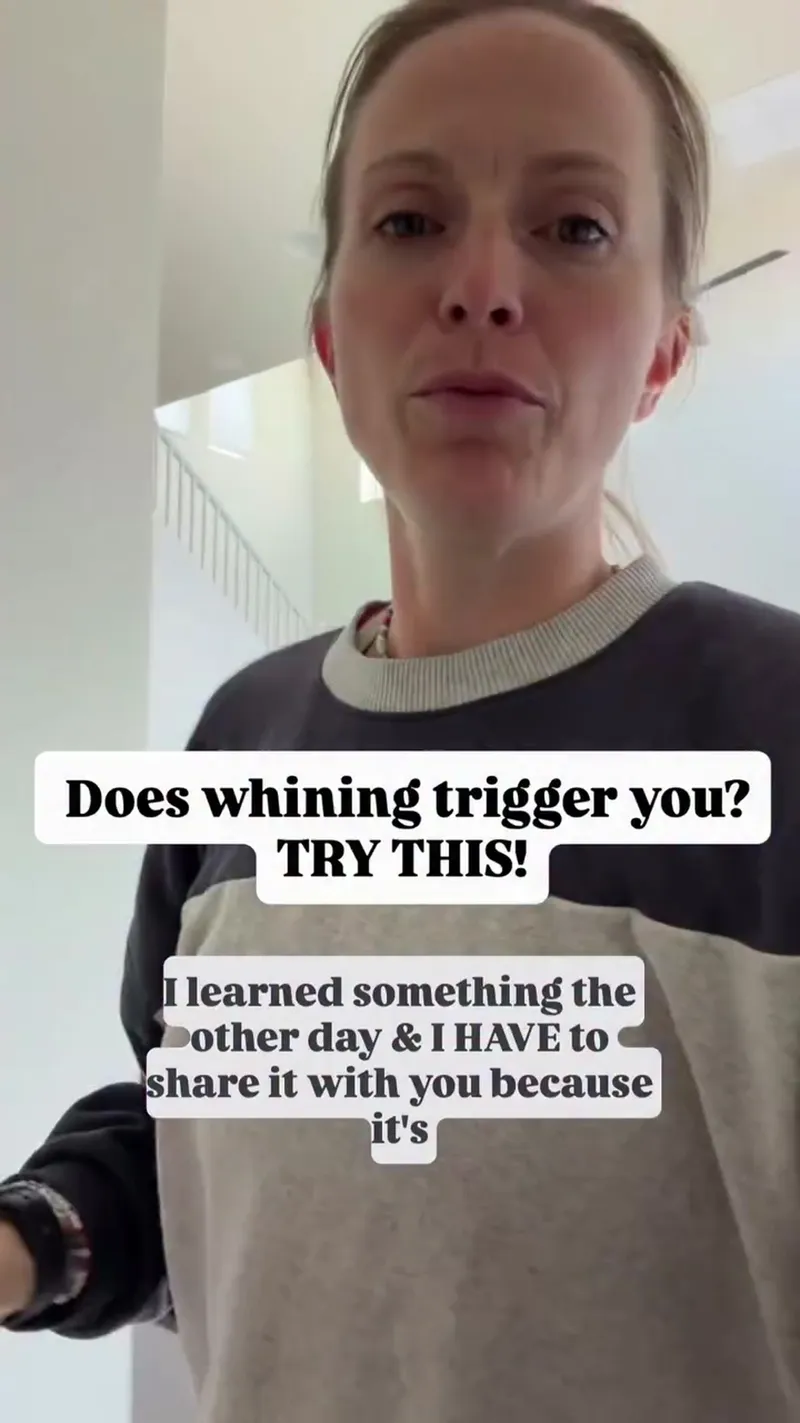
A mom shares a simple non-verbal 'nose-touch' technique to stop kids from whining and encourage them to ask politely. She explains that the hack works by forcing a pause and creating eye contact to build a quick moment of connection.
The Simple 'Nose Touch' Hack to Stop Kid Whining
A mother shares a cue she uses when her children whine: she touches her nose and waits for them to ask again more calmly. She explains why she thinks it helps and gives an example with her toddler asking for cheese.
- Views
- 766.4K
- Likes
- 42.5K
- Comments
- 444
- Responding to child whiningParenting communication strategyTeaching polite requests
Analysis
A mother shares a cue she uses when her children whine: she touches her nose and waits for them to ask again more calmly. She explains why she thinks it helps and gives an example with her toddler asking for cheese.
- Talking headTutorialExplainer
- Spoken
- Original
“Just learned something the other day and I have to share it with you because it's been kind of a game changer for us.”
- On-screen text
- Original
“Does whining trigger you? TRY THIS!”
- Visual
- Text-led compositionA close, centered view of the speaker facing the camera, with the bold two-line headline prominently overlaid across the lower-middle of the frame. The changing frames show her in a home interior; the headline remains the clearest visual hook.
- The speaker addresses the camera while captions highlight her advice and examples, including the toddler asking for cheese.
“Just learned something the other day and I have to share it with you because it's been kind of a game changer for us. You tell your kids ahead of time, anytime you come to me and you are like, whining, I'm not gonna respond. I'm just gonna touch my nose and look at you. And when I do that, that gives you the opportunity to ask again. You can explain this however you want, but that's essentially how I explained it. I don't know if this is gonna be forever, but it is for now, for sure. So whenever my kids are whining, I would just. I've literally just been looking at them and touching my nose. They immediately stop. And so they'll be like, mommy, mom, can I have a whatever? And I'm like, what is this? Magic sorcery? Here's why I think it works. Thing number one, eye pause. Have you ever been just like, doing something and your kids are whining and you're just like, guys, stop whining. Stop. Stop whining. This causes me to, like, pause, look at them, make eye contact and just touch my nose? We're connecting. One time, my daughter was losing it, and when I did this, she was like, I did this. She went and she came and gave me a hug. Also doing it with my 2 year old, who does not understand. So when he's crying, crying, crying, he's screaming, I want cheese. I just go, can we say cheese, please? And I don't know, I'm just like, trying to make the association like Pavlov, right? I'm just trying to be like, when I touch my nose, we're gonna say it nicer. It's been working. I want you to try it and I really want you to report back.”
- 01Introduce the trick and explain its use
Sets up the practical promise and gives the viewer the method before explaining why it works.
Introduces a recently learned, useful method, tells the audience what behavior to anticipate, and explains the cue and intended response.
“Just learned something the other day and I have to share it with you because it's been kind of a game changer for us. You tell your kids ahead of time, anytime you come to me and you are like, whining, I'm not gonna respond. I'm just gonna touch my nose and look at you. And when I do that, that gives you the opportunity to ask again. You can explain this however you want, but that's essentially how I explained it. I don't know if this is gonna be forever, but it is for now, for sure.”
- 02Demonstrate the effect
Provides a concrete result after the instructions, then leads into an explanation of why the method may work.
Describes using the cue in practice, the immediate response, and the speaker's surprise at its apparent effectiveness.
“So whenever my kids are whining, I would just. I've literally just been looking at them and touching my nose. They immediately stop. And so they'll be like, mommy, mom, can I have a whatever? And I'm like, what is this? Magic sorcery? Here's why I think it works.”
- 03Explain the first principle and illustrate it
Moves from observed effect to a proposed explanation, then offers a specific interpersonal example as evidence.
Names the first principle, recalls a familiar frustrating situation, and describes how the cue creates a pause and a moment of connection. Gives an example in which another person imitates the cue and responds warmly.
“Thing number one, eye pause. Have you ever been just like, doing something and your kids are whining and you're just like, guys, stop whining. Stop. Stop whining. This causes me to, like, pause, look at them, make eye contact and just touch my nose? We're connecting. One time, my daughter was losing it, and when I did this, she was like, I did this. She went and she came and gave me a hug.”
- 04Apply the cue to a contrasting case and invite participation
Shows how the method can be adapted, summarizes its logic, and closes with a direct invitation to test it.
Adds an example involving someone who may not understand the explanation, restates the method's associative principle, reports that it has worked, and asks viewers to try it and report back.
“Also doing it with my 2 year old, who does not understand. So when he's crying, crying, crying, he's screaming, I want cheese. I just go, can we say cheese, please? And I don't know, I'm just like, trying to make the association like Pavlov, right? I'm just trying to be like, when I touch my nose, we're gonna say it nicer. It's been working. I want you to try it and I really want you to report back.”