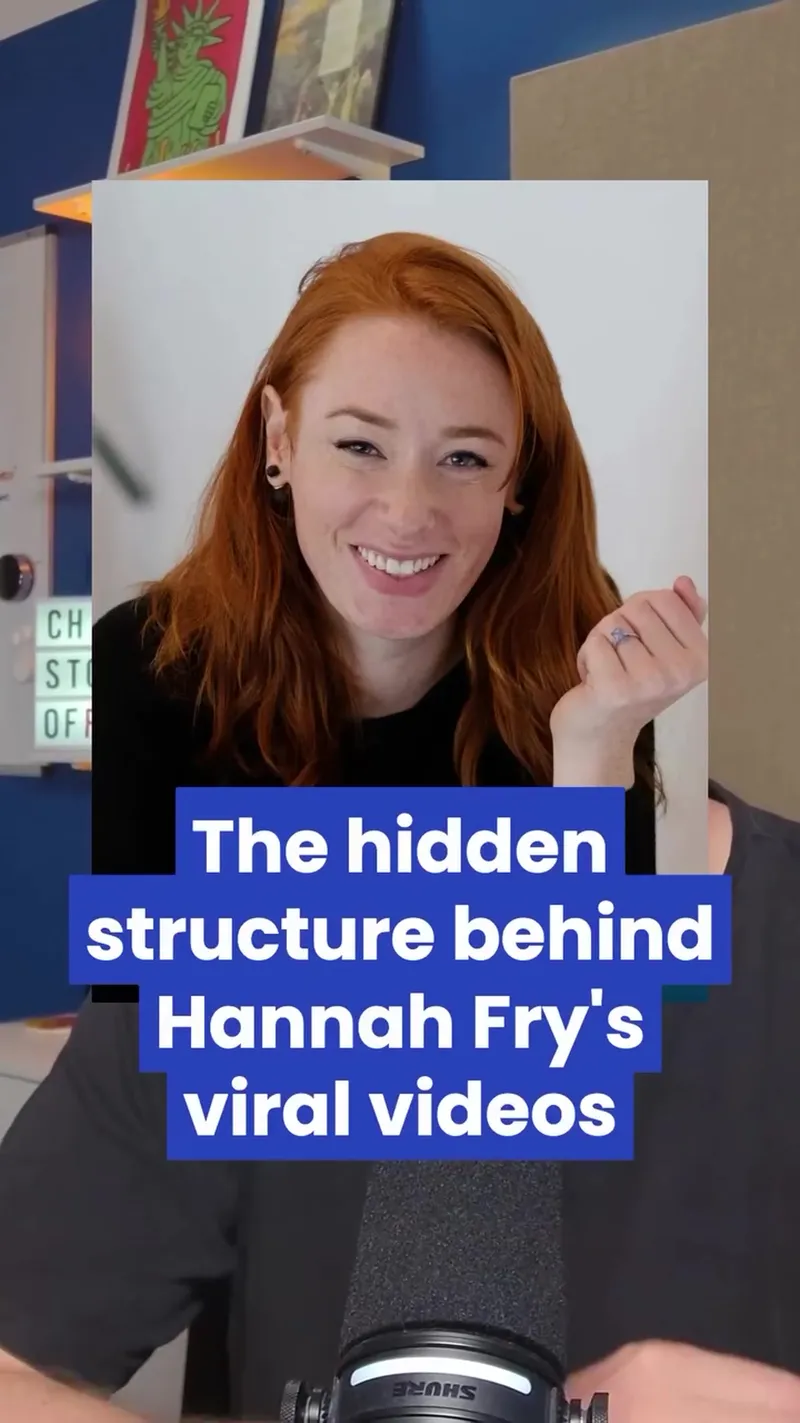
This video breaks down the specific four-part structure mathematician Hannah Fry uses to make educational content go viral. It explains how starting with relatable physical experiences and building a curiosity gap keeps audiences engaged until the end.
The Secret 4-Part Formula Behind Hannah Fry's Viral Success
The speaker explains a four-part structure he says Hannah Fry uses to make maths and science videos engaging. He describes starting with a familiar experience, explaining its mechanism, revealing an unexpected answer, and ending with a small joke or tip.
- Likes
- 33.8K
- Comments
- 504
- Hannah Fry videosExplainer video structureScience communicationAudience curiosity
Analysis
The speaker explains a four-part structure he says Hannah Fry uses to make maths and science videos engaging. He describes starting with a familiar experience, explaining its mechanism, revealing an unexpected answer, and ending with a small joke or tip.
- Talking headCommentaryExplainer
- Spoken
- Original
“Why is Hannah Fry so bloody good?”
- On-screen text
- Original
“The hidden structure behind Hannah Fry's viral videos”
- Visual
- Text-led compositionA centered presenter faces the camera in a close-up, with a large portrait inset behind a prominent blue-and-white headline. The portrait and headline carry the subject and premise; the presenter and studio framing support them.
- The presenter’s captions reinforce his explanation, while inset clips show Hannah Fry as he discusses her video structure.
“Why is Hannah Fry so bloody good? She has this amazing ability to make maths and science feel impossible to ignore. Well, I did what any normal person would do. I transcribed 30 of her highest performing videos and started looking for patterns. And what I found was fascinating because the reason the videos work actually isn't just the maths or the science. It is the structure that she uses. And almost every one follows the same four part formula. Number one, she never starts with the concept. She starts with something you've experienced. Right? You know that weird slippery feeling that you get when you accidentally get bleach on your hands? Ever notice that when you're charging your laptop, particularly if it's one with a metal case like a MacBook, and when you lightly drag your finger across the lid, it feels almost buzzy, like it's vibrating. So something physical, something you can picture, that creates a gap. There's a reason that this happens. Number two, she spends most of the video explaining the mechanism. Let me explain. So soap is one of those mad inventions. And the reason why it feels like that is, is absolutely wild. This is the part that most creators skip. She doesn't just tell you the answer, she walks you through the chain of cause and effect. So this happens, which means that this happens, and that's why you experience this, so you feel like you're discovering it. Alongside her. Number three, she creates that satisfying click. The thing that you thought was happening isn't actually happening. It's not vibrating, but you're also not making it up. That is not the bleach. That is your skin becoming soap. And number four, she ends smaller than she started. And so if your laptop ever feels aggressively buzzy, maybe just go and wash your hands. And believe me, it gets considerably less charming the longer it goes on for. She doesn't force some huge inspirational takeaway. She just lands it with, like a little joke, an observation, or a practical tip. And that's the real lesson. Great educational content isn't just about making complicated things simple. It's about making people curious enough to want the explanation. Hannah Fry is basically a curiosity machine. And the best part is that you can steal the structure even if your topic isn't maths. Start with something people recognize, explain the hidden mechanism, create the click, then get out the way. Follow for more breakdowns of the world's best communication.”
- 01Question and analysis promise
Introduces the central question and earns the forthcoming breakdown by claiming it is based on a review of multiple examples.
Ask why a person or subject is compelling, state the effect it has, then explain that the speaker analyzed examples to find recurring patterns. Reframe the apparent subject matter as a repeatable structure and promise a numbered formula.
“Why is Hannah Fry so bloody good? She has this amazing ability to make maths and science feel impossible to ignore. Well, I did what any normal person would do. I transcribed 30 of her highest performing videos and started looking for patterns. And what I found was fascinating because the reason the videos work actually isn't just the maths or the science. It is the structure that she uses. And almost every one follows the same four part formula.”
- 02Start from a recognizable experience
Makes the promised structure tangible and opens a specific question about why an ordinary experience happens, which leads into the mechanism.
Present the first principle: begin with an experience the audience can picture rather than an abstract concept. Illustrate it with familiar examples, then explain that a concrete sensation or scene creates an explanatory gap.
“Number one, she never starts with the concept. She starts with something you've experienced. Right? You know that weird slippery feeling that you get when you accidentally get bleach on your hands? Ever notice that when you're charging your laptop, particularly if it's one with a metal case like a MacBook, and when you lightly drag your finger across the lid, it feels almost buzzy, like it's vibrating. So something physical, something you can picture, that creates a gap. There's a reason that this happens.”
- 03Explain the causal mechanism
Fulfills the question raised in the first principle by showing how a hidden mechanism can be made understandable step by step.
Introduce the second principle, then model it with an explanation that traces cause and effect rather than merely stating an answer. Emphasize that the chain of explanation is the part many creators omit, and frame the audience as discovering the answer alongside the explainer.
“Number two, she spends most of the video explaining the mechanism. Let me explain. So soap is one of those mad inventions. And the reason why it feels like that is, is absolutely wild. This is the part that most creators skip. She doesn't just tell you the answer, she walks you through the chain of cause and effect. So this happens, which means that this happens, and that's why you experience this, so you feel like you're discovering it. Alongside her.”
- 04Deliver the explanatory click
Resolves the uncertainty created by the opening experience: the viewer’s perception was understandable, but its cause was different from what they assumed.
Name the third principle as a satisfying realization, then overturn the audience’s apparent interpretation while affirming that the original experience was real. State the actual explanation plainly.
“Number three, she creates that satisfying click. The thing that you thought was happening isn't actually happening. It's not vibrating, but you're also not making it up. That is not the bleach. That is your skin becoming soap.”
- 05Close small, then summarize
Completes the four-part promise with a light, concrete payoff, then distills the method into a reusable summary and a clear channel call to action.
Introduce the fourth principle: end with a modest, topic-specific joke, observation, or practical tip rather than an oversized takeaway. Follow with the broader lesson about making people curious, restate the sequence in concise instructions, and close with a follow invitation.
“And number four, she ends smaller than she started. And so if your laptop ever feels aggressively buzzy, maybe just go and wash your hands. And believe me, it gets considerably less charming the longer it goes on for. She doesn't force some huge inspirational takeaway. She just lands it with, like a little joke, an observation, or a practical tip. And that's the real lesson. Great educational content isn't just about making complicated things simple. It's about making people curious enough to want the explanation. Hannah Fry is basically a curiosity machine. And the best part is that you can steal the structure even if your topic isn't maths. Start with something people recognize, explain the hidden mechanism, create the click, then get out the way. Follow for more breakdowns of the world's best communication.”