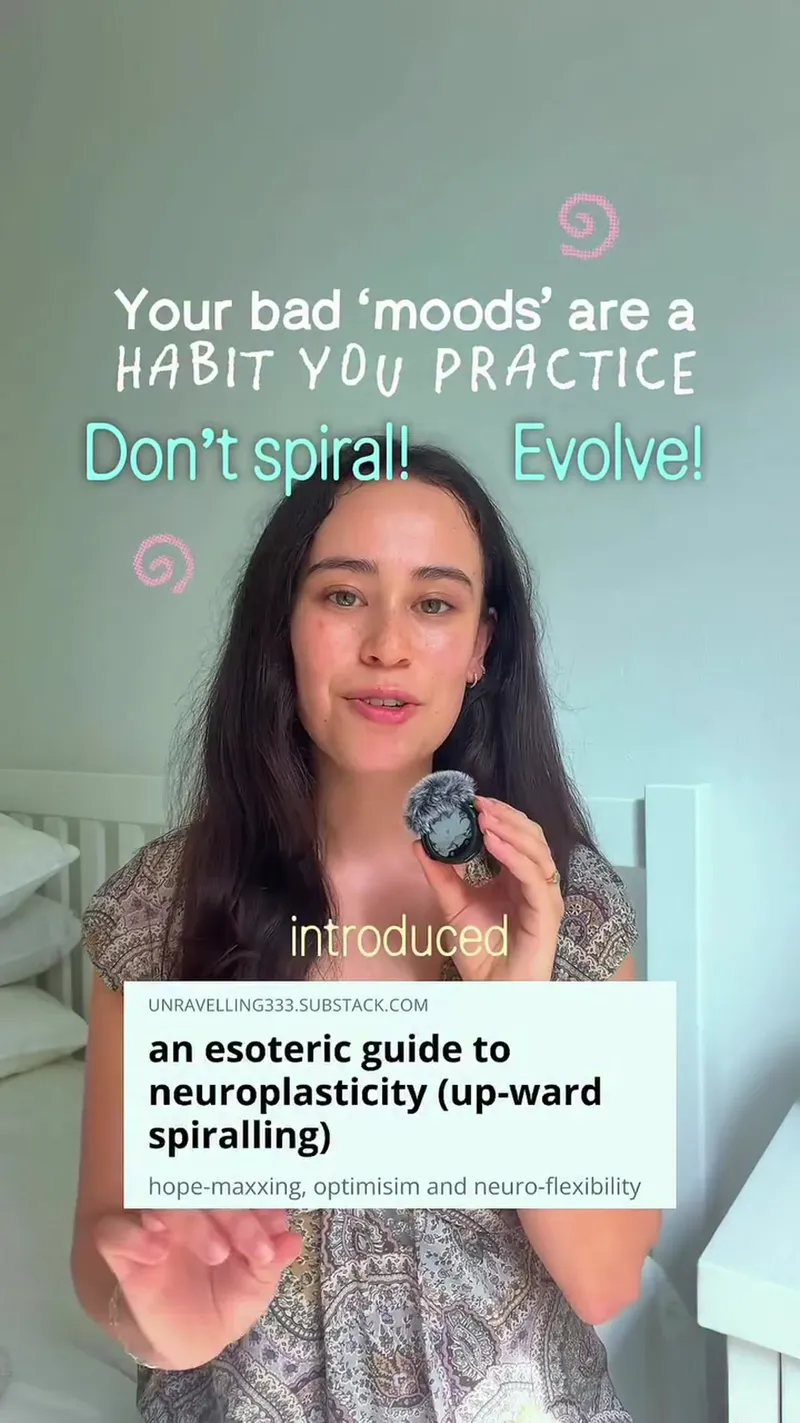
The video introduces the psychological concept of upward spiraling, where positive emotions build on each other to expand a person's mental resilience and creativity. It explains how neuroplasticity allows us to break the habit of negative downward spirals by consciously strengthening new, positive neural pathways.
Beyond the Downward Spiral: The Science of Upward Spiraling
A creator explains upward spiraling: positive emotions can build on one another and broaden thinking, while repeated worry can strengthen downward patterns. She reflects on overthinking and argues that the brain can learn new patterns through neuroplasticity.
- Views
- 343.8K
- Likes
- 19.3K
- Comments
- 50
- Upward spiralingPositive emotionsNeuroplasticityOverthinking and worry
Analysis
A creator explains upward spiraling: positive emotions can build on one another and broaden thinking, while repeated worry can strengthen downward patterns. She reflects on overthinking and argues that the brain can learn new patterns through neuroplasticity.
- Talking headExplainerCommentary
- Spoken
- Original
“I recently read the Substack article and it introduced me to the concept of upward spiraling.”
- On-screen text
- Original
“Your bad ‘moods’ are a HABIT YOU PRACTICE Don’t spiral! Evolve!”
- Visual
- Text-led composition with a direct-to-camera speaker and contextual article cardA centered speaker faces the camera in a medium shot, holding a small microphone. A large two-part headline sits above and partly overlaps the speaker; an article preview card appears lower in the sampled frames.
- The presenter speaks directly to camera while captions emphasize key ideas from her speech. Spiral graphics and the opening headline visually reinforce the contrast between downward spiraling and personal growth.
“I recently read the Substack article and it introduced me to the concept of upward spiraling. We all know what a downward spiral feels like, but the author pointed out something really interesting. You can spiral upwards in the exact same way. Psychologists Friedrichsen and Joyner coined the term upward spiral in 2002 when they found that positive emotions build on each other just like negative ones do, only in the opposite direction. Through their broaden and build theory, they discovered that positive emotions don't just feel good, they expand what you notice, how you think and what you're capable of in relationships, resilience and ideas. But if both spirals are available to to us, why do we choose the one that doesn't benefit us? Because the neural pathways you use most are the strongest. So if you spent years worrying, full of self doubt and overthinking, those lines in your brains are electric, you'll revert to them automatically because the upward spiral feels so foreign in comparison. I don't think the answer is always just choose happiness. But I do think we have mistaken vigilance for depth. We treat overthinking like rigor, like if we worry hard enough, we'll arrive somewhere safer. But what I've noticed is spiraling down actually never leaves me any the wiser. It makes me feel more stressed, like a perpetual cycle of anxiety. And if you're thinking I'm just not that optimistic, well, if your brain can train itself to spiral down, it can train itself to spiral up. And that's not optimism, that's neuroplasticity.”
- 01Introduce and explain the concept
Establishes the topic and supports the central claim with attributed research and a concrete account of what the process can affect.
Cites a recently encountered source, introduces its concept, contrasts it with a familiar counterpart, then explains the concept's origins and effects.
“I recently read the Substack article and it introduced me to the concept of upward spiraling. We all know what a downward spiral feels like, but the author pointed out something really interesting. You can spiral upwards in the exact same way. Psychologists Friedrichsen and Joyner coined the term upward spiral in 2002 when they found that positive emotions build on each other just like negative ones do, only in the opposite direction. Through their broaden and build theory, they discovered that positive emotions don't just feel good, they expand what you notice, how you think and what you're capable of in relationships, resilience and ideas.”
- 02Explain why the unhelpful pattern persists
Answers the question raised by the comparison, showing how repeated thought patterns can become automatic and why changing direction may be difficult.
Asks why someone would choose the less beneficial of two possible patterns, then explains habitual thinking and why the alternative may feel unfamiliar.
“But if both spirals are available to to us, why do we choose the one that doesn't benefit us? Because the neural pathways you use most are the strongest. So if you spent years worrying, full of self doubt and overthinking, those lines in your brains are electric, you'll revert to them automatically because the upward spiral feels so foreign in comparison.”
- 03Qualify the advice and offer a hopeful resolution
Avoids reducing the idea to forced positivity, makes the critique personal and specific, and closes by resolving the concern that change depends on being naturally optimistic.
Rejects an overly simple solution, reframes a familiar behavior as potentially misleading, shares its personal cost, then answers anticipated skepticism with a capacity-for-change claim.
“I don't think the answer is always just choose happiness. But I do think we have mistaken vigilance for depth. We treat overthinking like rigor, like if we worry hard enough, we'll arrive somewhere safer. But what I've noticed is spiraling down actually never leaves me any the wiser. It makes me feel more stressed, like a perpetual cycle of anxiety. And if you're thinking I'm just not that optimistic, well, if your brain can train itself to spiral down, it can train itself to spiral up. And that's not optimism, that's neuroplasticity.”