Katie shares a fascinating story about scientists who extracted 5,300-year-old yeast from the stomach of Ötzi the Iceman to bake sourdough bread. She explores the mummy's discovery in the Swiss Alps and explains how this ancient yeast might help break down toxic chemicals in the environment today.
Baking Sourdough with 5,300-Year-Old Mummy Yeast
The creator recounts the discovery and study of Ötzi, a 5,300-year-old frozen mummy. She describes attempts to make sourdough with yeast sampled from his body and the yeast’s reported ability to break down phenol.
- Views
- 366.6K
- Likes
- 26.1K
- Comments
- 318
- Ötzi the IcemanAncient yeastSourdough starterPhenol breakdown
Analysis
The creator recounts the discovery and study of Ötzi, a 5,300-year-old frozen mummy. She describes attempts to make sourdough with yeast sampled from his body and the yeast’s reported ability to break down phenol.
- Talking headGreen screenExplainerMonologue
- Spoken
- Original
“Recently, scientists took yeast out of this mummy's stomach and they made sourdough bread.”
- On-screen text
- Original
“UNROT UR BRAIN”
- Visual
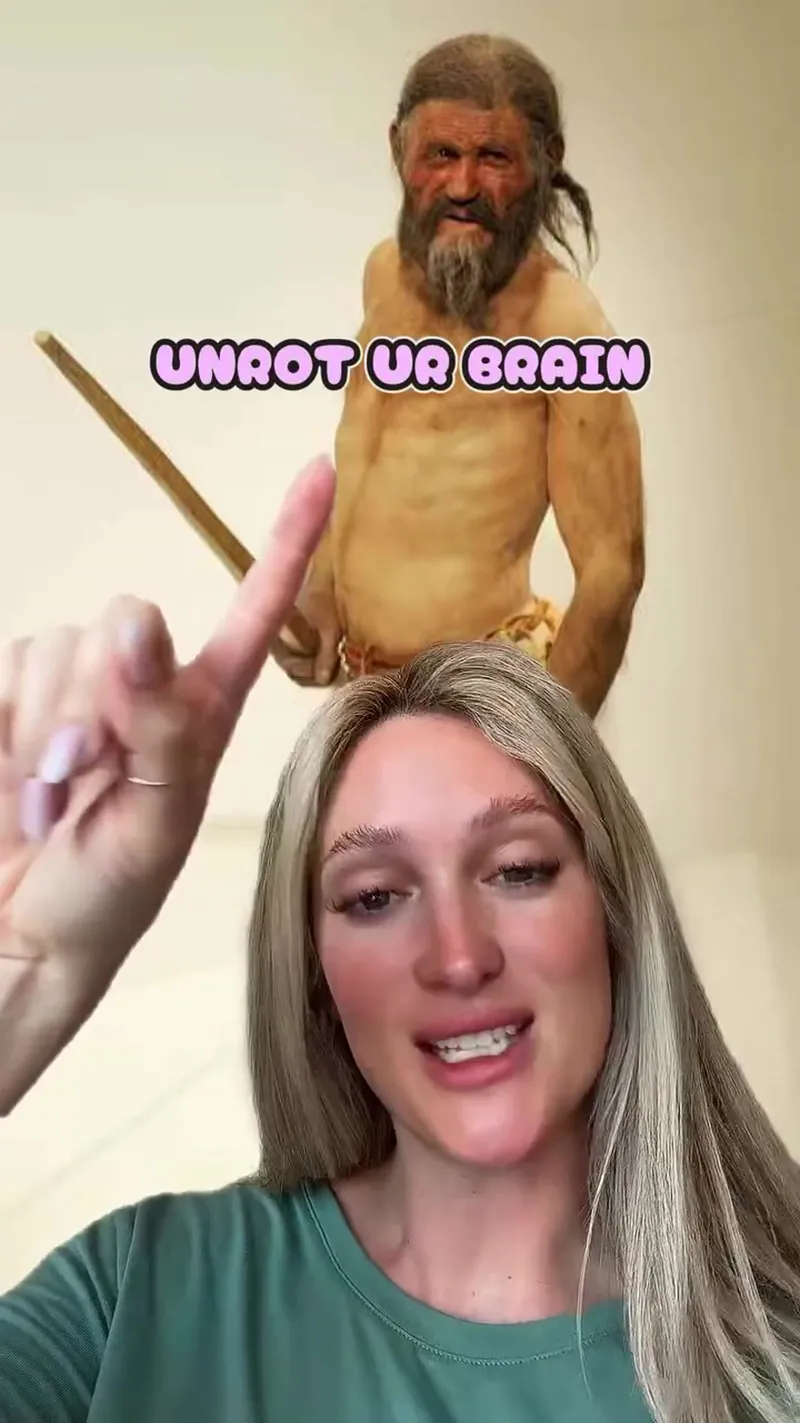
- Presenter with background reference imageA centered presenter appears in the foreground with a large image of a preserved man directly behind her; she gestures toward the image in the later supplied frames. The visual supports the mummy premise rather than showing the yeast or bread process.
- The presenter appears over images of Ötzi and his discovery in the Alps, giving visual context to her account. The opening pink text names her series, while the speech introduces the mummy and yeast story.
“Recently, scientists took yeast out of this mummy's stomach and they made sourdough bread. This is utsi, I believe that's how you pronounce it. And he is a soft or a wet mummy. So I'm going to explain how we took yeast out of his stomach and we made sourdough bread. But if you don't know who I am, my name is Katie. I do a series called on rot your brain where I deep dive a subject that I know nothing about every single week and I bring it to you and I give you some, like, podcasts or things to read if you're interested in it at all. Okay, let's get into it. So in 1991, these two hikers are hiking the Swiss Alps and they discover a body frozen in ice. They're like, hey, let's call the authorities. Somebody's probably looking for this guy. And they call, they call the cops and the cops come and they're like, I think this is maybe like outside of our purview. Of course, not before they like royally fucked up the preservation site. But that's neither here nor there. So they get this guy out of the ice and they bring him to a facility where they can study him more essentially. And while they're bringing him there, and while he's there, he starts to melt. So as the scientists are like studying him, they're like, oh my God, like, this guy's so old. He didn't just like die a couple hundred years ago. He died 5300 years ago. They named him Utsi Otzi. I don't really know how to say it. Point is, let me tell you a little bit about this guy. Your best guess is he's around 45 years old. When he died, he was 5 foot 2 in his stomach microbiome, he had grains and goat meat. He died because an arrow was shot into his shoulder and it hit an artery. He had 61 tattoos, some of the oldest known examples of tattoos that we have. And they're essentially like lines and crosses. And the best guess is that they would use charcoal and soot. A lot of scientists believe that these tattoos were actually like therapeutic, placed near pain points and joints, kind of like early acupuncture. Okay. So they bring this guy in and now he's in like a temperature controlled place, obviously. But the melting that had happened, they took four types of yeast and like they sampled obviously everything or like testing everything. They took four types of yeast out of his body. This is not normal yeast, right? This is yeast that survive a freezing for 5,300 years. And we can tell that it's old yeast and not new yeast because it, like, started to deteriorate. I guess you can, like, test the strains of it or, like, what the. What it's like, comprised of, and you could tell that it's old yeast. So they were like, let's go make some sourdough starter. I don't know why, to be honest with you. They're also going to try beer, but they tried to make sourdough starter with flour, and it would not react to the flour in the way that normal yeast does. After months of tweaking, they finally made the sourdough. Whatever. That's weird. But the interesting part is, as they were making this sourdough, they actually discovered that the yeast would eat the phenol. Phenol is a very harsh chemical that we use to, like, preserve stuff. So we were using it to preserve his body and the yeast was breaking it down. Obviously not ideal in this situation, but we have a very hard time breaking down phenol, and it's a very toxic chemical to the earth. So now we're like, oh, my God, can we use this yeast to help clean up the earth a little bit?”
- 01Lead with the surprising result and promise the explanation
The striking result establishes the subject and creates a clear question about how it happened; the series introduction gives context before the story begins.
Opens with the unusual result, identifies the subject with a pronunciation caveat, then promises to explain the process and briefly introduces the creator’s series and related resources.
“Recently, scientists took yeast out of this mummy's stomach and they made sourdough bread. This is utsi, I believe that's how you pronounce it. And he is a soft or a wet mummy. So I'm going to explain how we took yeast out of his stomach and we made sourdough bread. But if you don't know who I am, my name is Katie. I do a series called on rot your brain where I deep dive a subject that I know nothing about every single week and I bring it to you and I give you some, like, podcasts or things to read if you're interested in it at all. Okay, let's get into it.”
- 02Discovery and initial recovery
Provides the origin story and moves the subject from discovery toward investigation; the preservation mishap adds a complication to the recovery.
Recounts the discovery, the discoverers’ response, authorities’ arrival and an offhand critical aside before the body is taken for study.
“So in 1991, these two hikers are hiking the Swiss Alps and they discover a body frozen in ice. They're like, hey, let's call the authorities. Somebody's probably looking for this guy. And they call, they call the cops and the cops come and they're like, I think this is maybe like outside of our purview. Of course, not before they like royally fucked up the preservation site. But that's neither here nor there. So they get this guy out of the ice and they bring him to a facility where they can study him more essentially.”
- 03Age revelation and profile
The age revelation reframes the find as exceptionally old; the following details deepen the profile and support the transition to the scientific investigation.
Explains that the subject begins melting, reveals its great age, then gives identifying facts about age, body, diet, cause of death, tattoos and a tentative explanation for them.
“And while they're bringing him there, and while he's there, he starts to melt. So as the scientists are like studying him, they're like, oh my God, like, this guy's so old. He didn't just like die a couple hundred years ago. He died 5300 years ago. They named him Utsi Otzi. I don't really know how to say it. Point is, let me tell you a little bit about this guy. Your best guess is he's around 45 years old. When he died, he was 5 foot 2 in his stomach microbiome, he had grains and goat meat. He died because an arrow was shot into his shoulder and it hit an artery. He had 61 tattoos, some of the oldest known examples of tattoos that we have. And they're essentially like lines and crosses. And the best guess is that they would use charcoal and soot. A lot of scientists believe that these tattoos were actually like therapeutic, placed near pain points and joints, kind of like early acupuncture.”
- 04Testing the unusual material
Develops the opening promise by connecting the subject’s condition to the recovered material and the experiment, while the uncertain explanation remains conversational rather than definitive.
Returns to the controlled study setting, explains the sampling and identifies why the material is unusual; the speaker tentatively describes how its age was assessed before researchers try a practical application.
“Okay. So they bring this guy in and now he's in like a temperature controlled place, obviously. But the melting that had happened, they took four types of yeast and like they sampled obviously everything or like testing everything. They took four types of yeast out of his body. This is not normal yeast, right? This is yeast that survive a freezing for 5,300 years. And we can tell that it's old yeast and not new yeast because it, like, started to deteriorate. I guess you can, like, test the strains of it or, like, what the. What it's like, comprised of, and you could tell that it's old yeast. So they were like, let's go make some sourdough starter. I don't know why, to be honest with you. They're also going to try beer, but they tried to make sourdough starter with flour, and it would not react to the flour in the way that normal yeast does. After months of tweaking, they finally made the sourdough. Whatever. That's weird.”
- 05Unexpected finding and open-ended implication
Pays off the experimental setup with a surprising and consequential finding, then opens a new question about a possible application that remains unanswered in the supplied text.
Introduces a more interesting discovery from the experiment: the material consumes a chemical used to preserve the subject. The explanation turns this into a potential environmental benefit, but the transcript ends as that possibility is posed.
“But the interesting part is, as they were making this sourdough, they actually discovered that the yeast would eat the phenol. Phenol is a very harsh chemical that we use to, like, preserve stuff. So we were using it to preserve his body and the yeast was breaking it down. Obviously not ideal in this situation, but we have a very hard time breaking down phenol, and it's a very toxic chemical to the earth. So now we're like, oh, my God, can we use this yeast to help clean up the earth a little bit?”