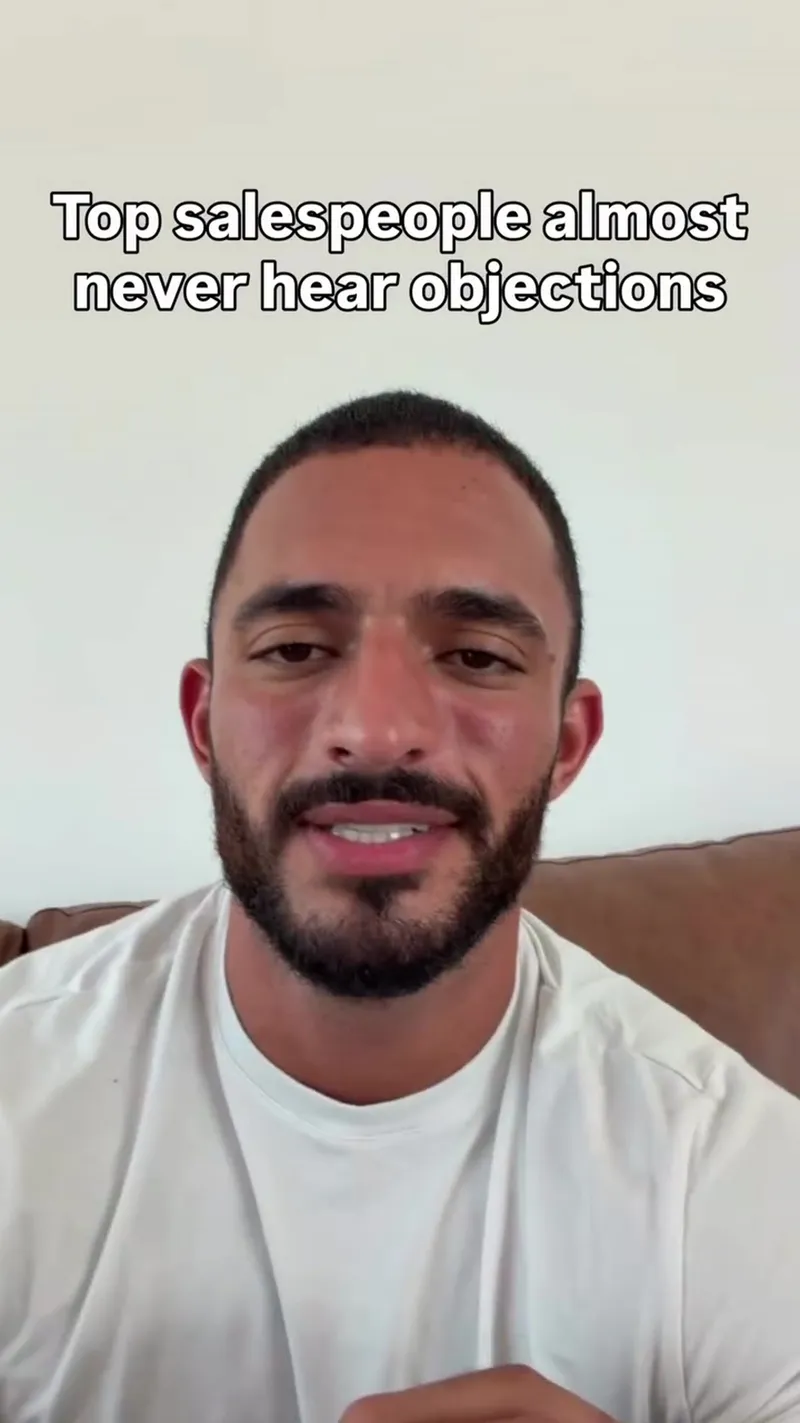
This video explains how to stop reacting to sales objections and start preventing them by addressing concerns before they are ever spoken. The creator provides specific examples for handling price, trust, and decision pressure throughout a presentation. He concludes by demonstrating these exact techniques on the viewer to prove how effective they are.
Stop Handling Objections and Start Preventing Them
A sales coach argues that strong salespeople prevent objections by addressing concerns early in a presentation. He gives examples and then points out how the video itself anticipates viewers’ doubts.
- Likes
- 9K
- Comments
- 117
- Sales objection preventionSales presentation strategySales psychology
Analysis
A sales coach argues that strong salespeople prevent objections by addressing concerns early in a presentation. He gives examples and then points out how the video itself anticipates viewers’ doubts.
- Talking headTutorialHot take
- Spoken
- Original
“Give me two minutes and I'll change the way you look at sales forever.”
- On-screen text
- Original
“Top salespeople almost never hear objections”
- Visual
- Text-led compositionA close, centered view of the speaker facing the camera, with a large two-line headline placed above him.
- The speaker addresses the camera throughout the sampled frames. Opening text states the same claim as the speech; later samples show him continuing without visible text.
“Give me two minutes and I'll change the way you look at sales forever. The best salespeople almost never hear any objections. And that's exactly why they're the best. After spending years in commission based sales and leading teams of hundreds and hundreds of reps, one lesson completely changed the way I sold forever. The best objection handler is the one who never has to handle objections in the first place. If you're handling objections, you're probably already too late. Think about it. If you know someone is going to say this is too expensive, why would you wait till the end? Instead, address it before they ever have a chance. Example. I know we're not the cheapest option and honestly, that's intentional. Let me show you why the people who chose us are happy paying more. Now you frame the objection before price ever became one. Another one. If you know they're going to wonder, how do I know this actually works? Don't wait. Say, look. Before we go any further, I want to show you a couple people who are in the exact same position you're in today. Now, trust isn't an objection. It's already been established. If you know they're worried about, let's say, making the wrong decision, don't wait for the I need to think about it because it's coming. Instead, say by the end of today, you'll know whether this is the right fit or not. And if I don't think it is, I'll be the first person to tell you you just removed all the pressure before they ever felt it. This principle never changes because objection prevention isn't memorizing scripts. It's about understanding human psychology. Average salespeople will react. Elite salespeople anticipate. And here's the biggest mistake I see. Most reps think objections happen at the close and that's furthest from the truth. Objections are created throughout the presentation. A weak presentation will create objections. A strong presentation will prevent them. Remember this, the sale isn't won when they say yes. It's won when there's nothing left to say no to. So the next time you're giving a presentation, ask what objections can I eliminate before they're ever spoken. Master that. And closing becomes the easiest part of the conversation. I'll give you a little bit more. Here's the interesting part. Some of you have probably already decided you're gonna save this video. Not because I asked you to, but because I gave you a reason why it would benefit you. Some of you have probably already decided you're gonna follow me. Not because I told you to, but because I explained that I break down sales psychology like this every single week, and some others who were skeptical, most likely when this video started, probably aren't anymore. Not because I argued with you. Because I established credibility before you ever had the chance to question it. Do you see what just happened? I wasn't just teaching objection prevention, I was demonstrating it. I removed all of the reasons you would have said no before you had the chance to thank them. That's the difference between average salespeople and elite ones. Now, I want you to do one thing. Go back and watch the last minute of this video again. I promise you'll catch at least three objections I handled before you even realized you had them. Then come back here and comment the first one you noticed. Once you start seeing objection prevention, you'll never sell the same way again.”
- 01Counterintuitive thesis and credibility
Sets up the central paradox and establishes why the advice is worth hearing: the best response is to prevent the problem from arising.
Promises a lasting change in perspective, states that top practitioners rarely face the problem, then supports the claim with experience and a concise reframing.
“Give me two minutes and I'll change the way you look at sales forever. The best salespeople almost never hear any objections. And that's exactly why they're the best. After spending years in commission based sales and leading teams of hundreds and hundreds of reps, one lesson completely changed the way I sold forever. The best objection handler is the one who never has to handle objections in the first place.”
- 02Explain the principle with a concrete example
Turns the thesis into an actionable technique and previews that more examples will follow.
Argues that reacting to a predictable concern comes too late, demonstrates anticipating a price objection, and summarizes the move as reframing it before it becomes an objection.
“If you're handling objections, you're probably already too late. Think about it. If you know someone is going to say this is too expensive, why would you wait till the end? Instead, address it before they ever have a chance. Example. I know we're not the cheapest option and honestly, that's intentional. Let me show you why the people who chose us are happy paying more. Now you frame the objection before price ever became one.”
- 03Anticipate another concern and resolve it
Extends the method beyond price to trust and decision anxiety, showing how reassurance can remove pressure before the concern is voiced.
Introduces a second anticipated question, recommends showing relevant proof before proceeding, then addresses fear of a bad decision with a clear timeline, permission to decline, and a pressure-reducing payoff.
“Another one. If you know they're going to wonder, how do I know this actually works? Don't wait. Say, look. Before we go any further, I want to show you a couple people who are in the exact same position you're in today. Now, trust isn't an objection. It's already been established. If you know they're worried about, let's say, making the wrong decision, don't wait for the I need to think about it because it's coming. Instead, say by the end of today, you'll know whether this is the right fit or not. And if I don't think it is, I'll be the first person to tell you you just removed all the pressure before they ever felt it.”
- 04Generalize the principle and correct a misconception
Extracts the examples into a general principle and explains why the method must apply throughout the presentation, not just at its end.
Distinguishes anticipating concerns from memorizing scripts, contrasts reacting with anticipating, identifies a common misconception about when objections form, and links objection prevention to presentation quality.
“This principle never changes because objection prevention isn't memorizing scripts. It's about understanding human psychology. Average salespeople will react. Elite salespeople anticipate. And here's the biggest mistake I see. Most reps think objections happen at the close and that's furthest from the truth. Objections are created throughout the presentation. A weak presentation will create objections. A strong presentation will prevent them.”
- 05Summarize and make the method actionable
Condenses the argument into a memorable rule and practical prompt; then opens a new payoff by offering more and signaling an interesting demonstration.
Defines when a sale is truly won, gives the audience a question to ask before a presentation, and promises that mastering the principle makes closing easier.
“Remember this, the sale isn't won when they say yes. It's won when there's nothing left to say no to. So the next time you're giving a presentation, ask what objections can I eliminate before they're ever spoken. Master that. And closing becomes the easiest part of the conversation. I'll give you a little bit more. Here's the interesting part.”
- 06Reveal the teaching as a live demonstration
Pays off the promised interesting part: the creator has applied the method within the explanation itself, turning the lesson into evidence.
Explains that viewers may have chosen to save or follow because reasons were supplied, and that initial skepticism may have been preempted by establishing credibility. It then identifies the video as a demonstration of its own lesson.
“Some of you have probably already decided you're gonna save this video. Not because I asked you to, but because I gave you a reason why it would benefit you. Some of you have probably already decided you're gonna follow me. Not because I told you to, but because I explained that I break down sales psychology like this every single week, and some others who were skeptical, most likely when this video started, probably aren't anymore. Not because I argued with you. Because I established credibility before you ever had the chance to question it. Do you see what just happened? I wasn't just teaching objection prevention, I was demonstrating it. I removed all of the reasons you would have said no before you had the chance to thank them. That's the difference between average salespeople and elite ones.”
- 07Rewatch challenge and participation prompt
Turns the demonstration into an explicit viewer exercise and comment prompt, then closes by restating the broader transformation promised at the opening.
Asks viewers to rewatch the final minute, look for at least three handled objections, and comment on the first one noticed; closes with a promise about the lasting effect of recognizing the principle.
“Now, I want you to do one thing. Go back and watch the last minute of this video again. I promise you'll catch at least three objections I handled before you even realized you had them. Then come back here and comment the first one you noticed. Once you start seeing objection prevention, you'll never sell the same way again.”