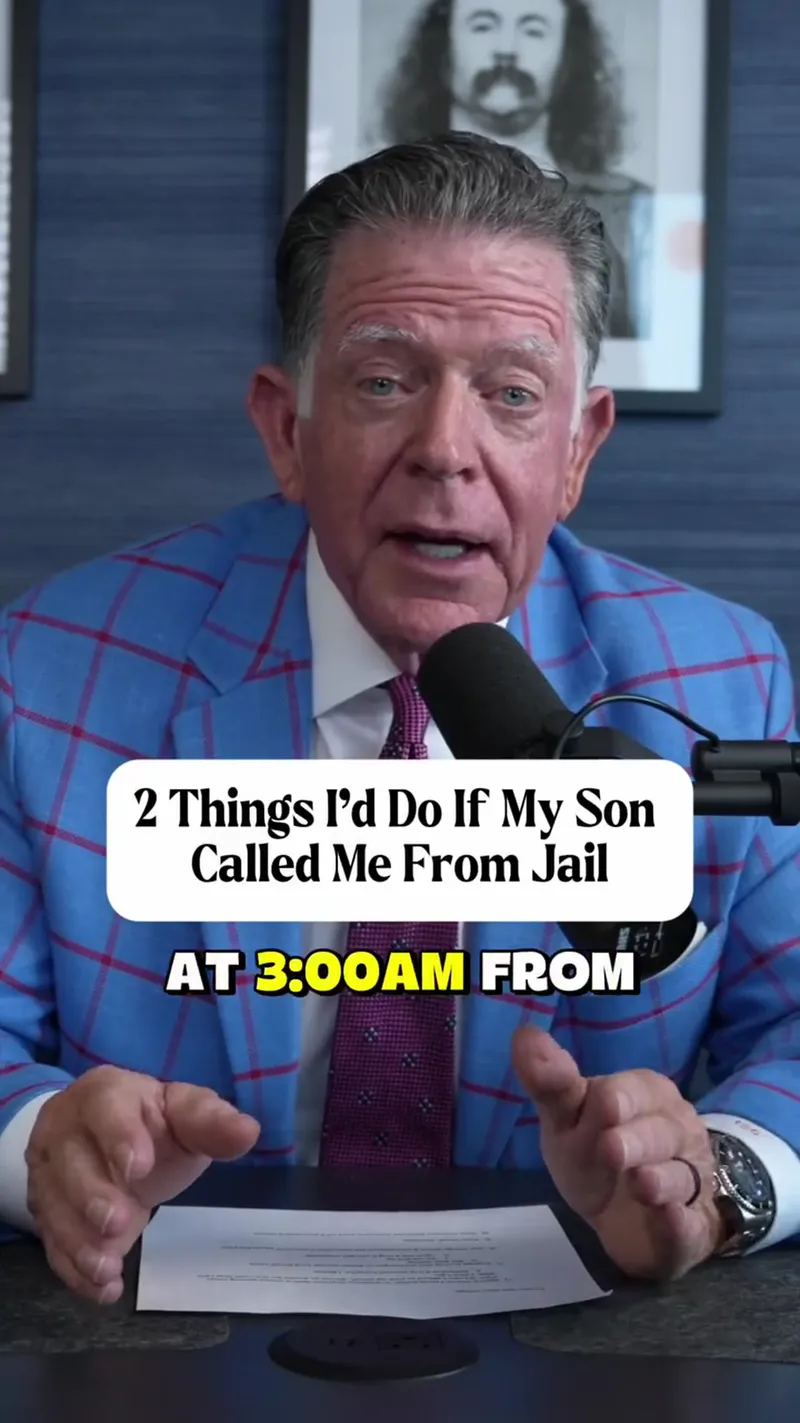
A legal professional explains why he would not immediately bail his own child out of jail, emphasizing the importance of facing consequences to learn accountability. He shares a personal anecdote about how his father once left him in jail for three days to teach him a life lesson despite his innocence.
Why I'd Leave My Son in Jail: A Lesson in Accountability
A speaker explains what he would do if his son called from jail: advise him not to speak to police or consent to a search, and wait before visiting. He shares his own arrest story to argue that parents should not always bail children out right away.
- Likes
- 8.4K
- Comments
- 276
- Parenting after arrestJail phone callsConsequences of behaviorPersonal arrest story
Analysis
A speaker explains what he would do if his son called from jail: advise him not to speak to police or consent to a search, and wait before visiting. He shares his own arrest story to argue that parents should not always bail children out right away.
- Talking headListicleMonologueHot take
- Spoken
- Original
“If my own son called me at 3am from jail, what would I do?”
- On-screen text
- Original
“2 Things I’d Do If My Son Called Me From Jail”
- Visual
- Text-led compositionA seated speaker is centered in a medium shot, facing the camera behind a desk, with a microphone in the foreground. A large headline sits across the lower-middle area, with spoken-word captions beneath it and selected words highlighted in yellow.
- The speaker addresses the camera while on-screen captions emphasize phrases from his speech, including his advice not to talk to police and a detail from his personal story.
“If my own son called me at 3am from jail, what would I do? I would do two things. Number one, I would tell him, do not talk to the police. Do not consent to the search. Number two, I'd say, I'll come see you in a day or two. And I know that sounds harsh, but the reality is I see way too many clients, way too many parents. Their little darling gets a dwi, or their little darling gets a possession of marijuana, and mommy or daddy immediately bails them out of jail. And guess what? That kid hadn't learned the consequences of his conduct at all. Which is not to say every child that gets arrested is guilty. One of the best things my father ever did for me is I was falsely arrested for public intoxication when I was in college. I actually was not intoxicated and got arrested for public intoxication in beautiful Brazos county, the home of the fighting Texas Aggies. And I called my dad from jail, and my dad at, I think about 7 o' clock at night, said, son, you're smart enough to get into the jail, you're smart enough to get out. And he hung the fucking phone up on me. And I stayed in jail for not one, not two, but three days. And even though I was not guilty of that crime, my dad indirectly or directly gave me a great life lesson. And that is, there are consequences to your actions. And I suffered those consequences because even though I wasn't guilty, I. I was an asshole to the cop which caused me to become arrested, and he did me a great favor by letting my ass sit there. So that's a really windy way of saying the best answer is not always to immediately bond your little darling out of jail, because sometimes they need to sit there and think about what the fuck they've done to get into jail.”
- 01Hypothetical and two-part advice
Answers the opening question directly while establishing the recommendation that the following explanation will qualify.
Poses a hypothetical about a close relation calling from jail, promises two actions, then gives immediate advice and a delayed visit.
“If my own son called me at 3am from jail, what would I do? I would do two things. Number one, I would tell him, do not talk to the police. Do not consent to the search. Number two, I'd say, I'll come see you in a day or two.”
- 02Caveat and example of enabling
Explains the rationale behind the advice and provides an example, while qualifying the principle by noting that not every arrested child is guilty.
Acknowledges that the advice sounds harsh, then describes parents immediately bailing out children and argues this prevents them from learning consequences.
“And I know that sounds harsh, but the reality is I see way too many clients, way too many parents. Their little darling gets a dwi, or their little darling gets a possession of marijuana, and mommy or daddy immediately bails them out of jail. And guess what? That kid hadn't learned the consequences of his conduct at all. Which is not to say every child that gets arrested is guilty.”
- 03Personal story and lesson
Supplies a personal example supporting the earlier claim, while clarifying that the speaker was not guilty of the charge but still contributed to the situation through their behavior.
Introduces a father's formative choice, recounts a false arrest and the father's refusal to intervene, then explains the lesson about consequences and personal responsibility.
“One of the best things my father ever did for me is I was falsely arrested for public intoxication when I was in college. I actually was not intoxicated and got arrested for public intoxication in beautiful Brazos county, the home of the fighting Texas Aggies. And I called my dad from jail, and my dad at, I think about 7 o' clock at night, said, son, you're smart enough to get into the jail, you're smart enough to get out. And he hung the fucking phone up on me. And I stayed in jail for not one, not two, but three days. And even though I was not guilty of that crime, my dad indirectly or directly gave me a great life lesson. And that is, there are consequences to your actions. And I suffered those consequences because even though I wasn't guilty, I. I was an asshole to the cop which caused me to become arrested, and he did me a great favor by letting my ass sit there.”
- 04Restated recommendation
Returns to the opening recommendation and resolves the explanation with a practical takeaway.
Calls the explanation long-winded, then summarizes the advice against immediately rescuing a loved one and says they may need to reflect on what they did.
“So that's a really windy way of saying the best answer is not always to immediately bond your little darling out of jail, because sometimes they need to sit there and think about what the fuck they've done to get into jail.”