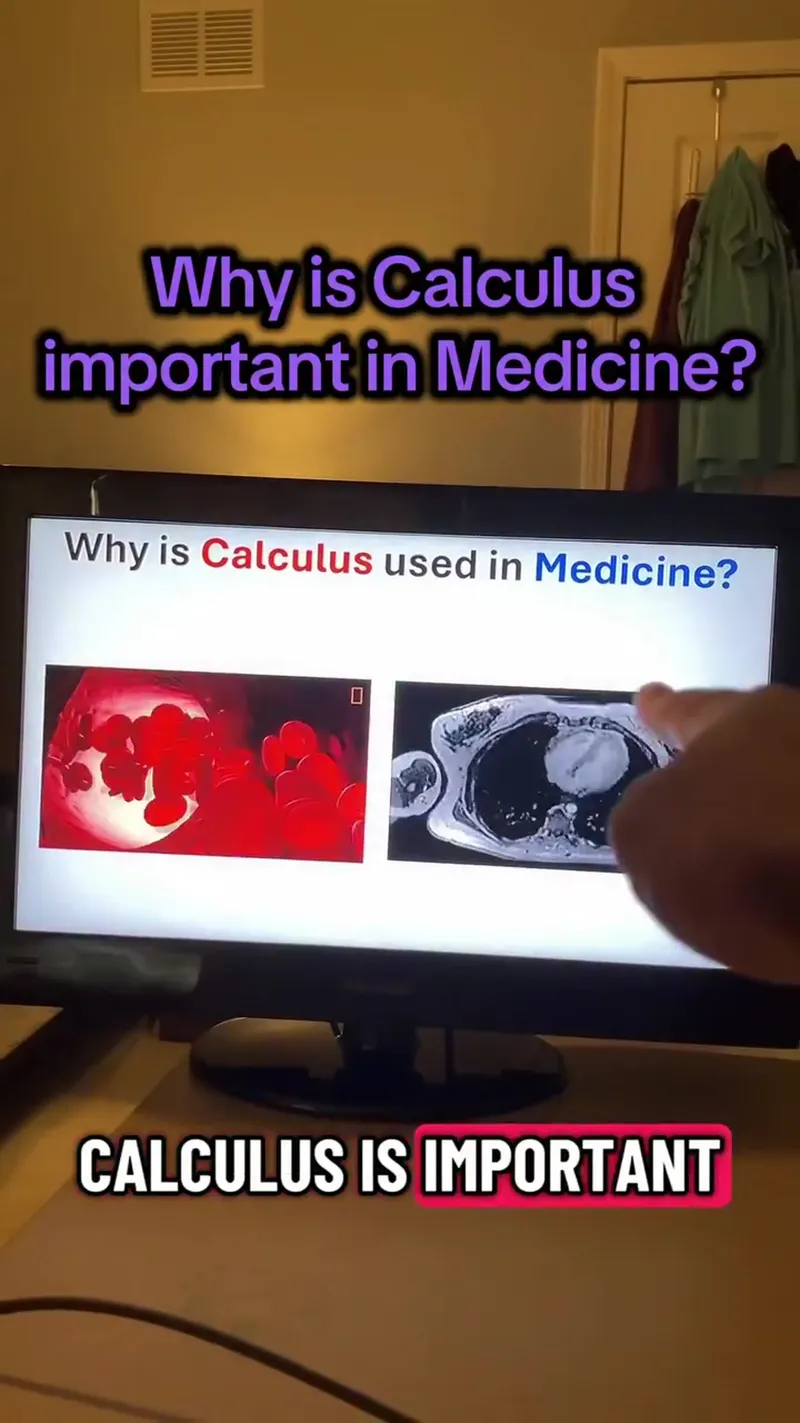
The video explains how various medical specialists, such as cardiologists and neuroscientists, use specific mathematical equations in their daily work. It emphasizes that a deep, intuitive understanding of physics is necessary to master these applications and promotes a physics study guide for students.
Why Calculus is Vital for Medical Careers
The speaker lists ways equations are used across medical fields, from radiation therapy to epidemiology, and argues that learning the science helps make the math intuitive. The video then promotes the speaker’s physics guide and a bundle with an algebra guide.
- Likes
- 31.1K
- Comments
- 151
- Calculus in medicineMedical physics equationsPhysics study guide
Analysis
The speaker lists ways equations are used across medical fields, from radiation therapy to epidemiology, and argues that learning the science helps make the math intuitive. The video then promotes the speaker’s physics guide and a bundle with an algebra guide.
- VoiceoverDemoListicleExplainer
- Spoken
- Original
“This is why calculus is important in medicine.”
- On-screen text
- Original
“Why is Calculus important in Medicine?”
- Visual
- Text-led composition with visual examplesA monitor fills the middle of the vertical frame, showing a pair of medical images; a hand points toward them in later samples. A large purple, black-outlined question headline sits above the monitor.
- The monitor slides show medical examples and equations as the speaker names their uses. Later, a guide-topic slide supports the spoken promotion.
“This is why calculus is important in medicine. Radiation therapists use this equation to measure the intensity of radiation. Cardiologists use the Navier Stokes equations to measure blood flow. Neuroscientists use Ohm's law to measure neuron action potentials. Anesthesiologists use this equation to measure mug elimination within the body. Pharmacologists use the Michaelis Menten equation to measure how enzymes metabolize mugs. Epidemiologists use this equation to measure how disease spreads. Surgeons use the heat equation to measure how temperature changes due to laser removal surgery and general physicians use the diffusion equation to measure how oxygen diffuses so why isn't any of this in biology class? Because you have to learn the science before you can use the math. And if you understand physics intuitively as a science, you will never have to memorize a practice problem again. Which is why I created version two of my guide teaching you physics. We have all the topics from version one along with Newton's second law, torque and conservation of energy so you don't fall behind next semester like you did this semester. Link in Bio or you can save 12% but getting the bundle which comes with the Algebra guide for STEM alongside it. Also link in bio.”
- 01Concrete applications
Establishes the subject’s real-world relevance through varied examples, setting up the contrast with its absence from a related class.
Opens by naming a subject’s importance and gives a sequence of professional roles paired with equations and what they measure or explain.
“This is why calculus is important in medicine. Radiation therapists use this equation to measure the intensity of radiation. Cardiologists use the Navier Stokes equations to measure blood flow. Neuroscientists use Ohm's law to measure neuron action potentials. Anesthesiologists use this equation to measure mug elimination within the body. Pharmacologists use the Michaelis Menten equation to measure how enzymes metabolize mugs. Epidemiologists use this equation to measure how disease spreads. Surgeons use the heat equation to measure how temperature changes due to laser removal surgery and general physicians use the diffusion equation to measure how oxygen diffuses so”
- 02Question and explanation
Resolves the contrast raised by the examples with a learning principle, then links that principle to the upcoming teaching resource.
Asks why the applications are not covered in a related class, answers that the underlying science must come first, and argues that intuitive understanding avoids memorizing practice problems.
“why isn't any of this in biology class? Because you have to learn the science before you can use the math. And if you understand physics intuitively as a science, you will never have to memorize a practice problem again.”
- 03Resource introduction and contents
Turns the preceding learning principle into a specific resource offer, showing its contents and a relevant student benefit.
Presents a second version of a guide, identifies its teaching focus, and lists included topics while promising help keeping up.
“Which is why I created version two of my guide teaching you physics. We have all the topics from version one along with Newton's second law, torque and conservation of energy so you don't fall behind next semester like you did this semester.”
- 04Offer and call to action
Closes with purchase details and a clear next step; the repeated prompt reinforces the call to action.
Directs viewers to the link in the bio, gives a discount and bundle option, and repeats the link prompt.
“Link in Bio or you can save 12% but getting the bundle which comes with the Algebra guide for STEM alongside it. Also link in bio.”