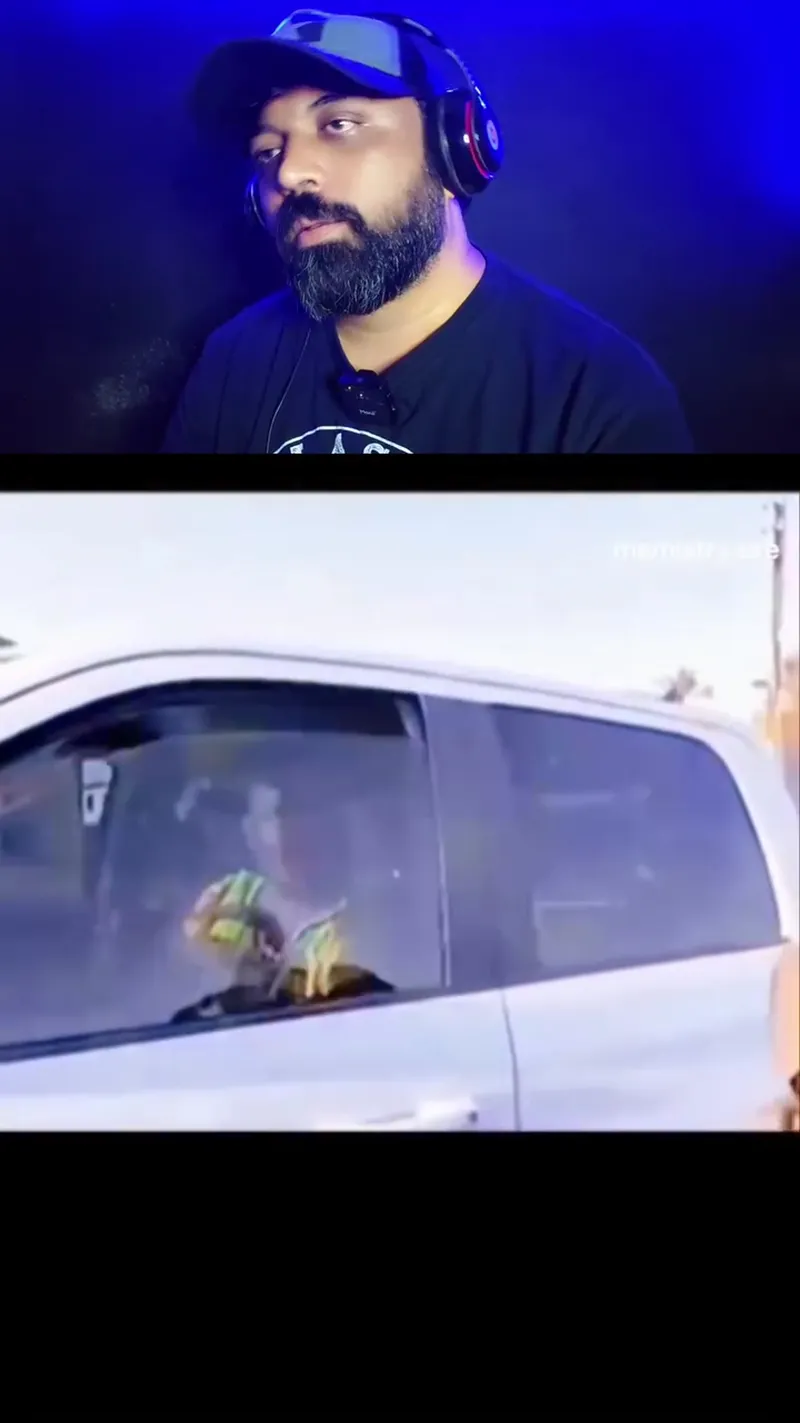
A driver is pulled over for speeding and creates a confusing situation by interpreting the word 'armed' literally rather than as a reference to weapons. The video uses a comedy skit to highlight a funny linguistic difference between American and African English during a tense police encounter.
Lost in Translation: The Literal Meaning of Being Armed
A staged traffic stop turns into a wordplay misunderstanding when a driver says he is “armed,” meaning he has arms, while the officer means guns. A creator watches the scene in a split-screen reaction format.
- Likes
- 16.2K
- Comments
- 135
- Police traffic stopEnglish word confusionArms versus firearms
Analysis
A staged traffic stop turns into a wordplay misunderstanding when a driver says he is “armed,” meaning he has arms, while the officer means guns. A creator watches the scene in a split-screen reaction format.
- Split screenReactionSkit
- Spoken
- Original
“Sir. Do you know why I'm pulling you over? No.”
- Visual
- Split-screen reactionA vertical split-screen places a seated, close-up reaction presenter against a blue-lit background above a lower-resolution roadside scene showing an officer beside a white car. The lower scene shifts across the supplied frames; no readable editorial headline is visible.
- The lower panel shows the traffic-stop exchange described in the transcript, while the upper panel shows a creator reacting; subtitles highlight parts of the dialogue.
“Sir. Do you know why I'm pulling you over? No. Sir, you're going 60 in the 20 mile per hour zone. 60 in the 20. I need you to come out of the car now. Get out of the car. 60 in 80, right? Get out of the car. Hurry up. Get out of the car. Sir, are you armed? Am I armed? Are you armed? Yes, I am. How many? Two. Need you to put your arms down. My arms down. Pull your arms down immediately. Slowly. Slowly. Slowly. What are you doing? I'm putting my arms down, sir. I asked you if you're armed. Yes, I am armed. How many Cool. Can you see that My arms are here? I'm putting them down, sir. I'm putting my arms down. Sir. Do you have any guns on you? No. Then why did you say you were armed? I am armed. You can see my arms. I am not disabled. These are my arms. Hands. Arms. In America, when we say arm, we mean gun. Oh no. In Africa, when you say arm, we mean hands. Nonsense.”
- 01Set up the initial misunderstanding
Establishes the language confusion and the authority figure’s immediate response, setting up further miscommunication.
One person asks why they are being stopped; the other gives a speed-limit reason, which is misunderstood as a different speed and followed by an order to exit the car.
“Sir. Do you know why I'm pulling you over? No. Sir, you're going 60 in the 20 mile per hour zone. 60 in the 20. I need you to come out of the car now.”
- 02Escalate the mistaken interpretation
Extends the same misunderstanding with an increasingly confused response before the conversation pivots to another ambiguity.
The driver offers a revised speed interpretation, while the officer repeats the command to exit and adds urgency.
“Get out of the car. 60 in 80, right? Get out of the car. Hurry up. Get out of the car.”
- 03Confuse a safety question with a body-part instruction
Introduces the central wordplay and prolongs it through the mismatch between a safety question and a physical instruction.
The officer asks whether the driver is armed; the driver interprets that as having raised arms. Repeated commands to lower them prompt the driver to explain what they are doing, and the officer clarifies the intended meaning.
“Sir, are you armed? Am I armed? Are you armed? Yes, I am. How many? Two. Need you to put your arms down. My arms down. Pull your arms down immediately. Slowly. Slowly. Slowly. What are you doing? I'm putting my arms down, sir. I asked you if you're armed. Yes, I am armed. How many Cool. Can you see that My arms are here? I'm putting them down, sir. I'm putting my arms down.”
- 04Explain the competing meanings and tag the joke
Resolves the source of the confusion with an explicit explanation of both meanings, then closes on a brief comic disagreement.
The officer asks about guns; the driver insists they meant their arms, then contrasts regional meanings of the word. The officer dismisses the explanation.
“Sir. Do you have any guns on you? No. Then why did you say you were armed? I am armed. You can see my arms. I am not disabled. These are my arms. Hands. Arms. In America, when we say arm, we mean gun. Oh no. In Africa, when you say arm, we mean hands. Nonsense.”