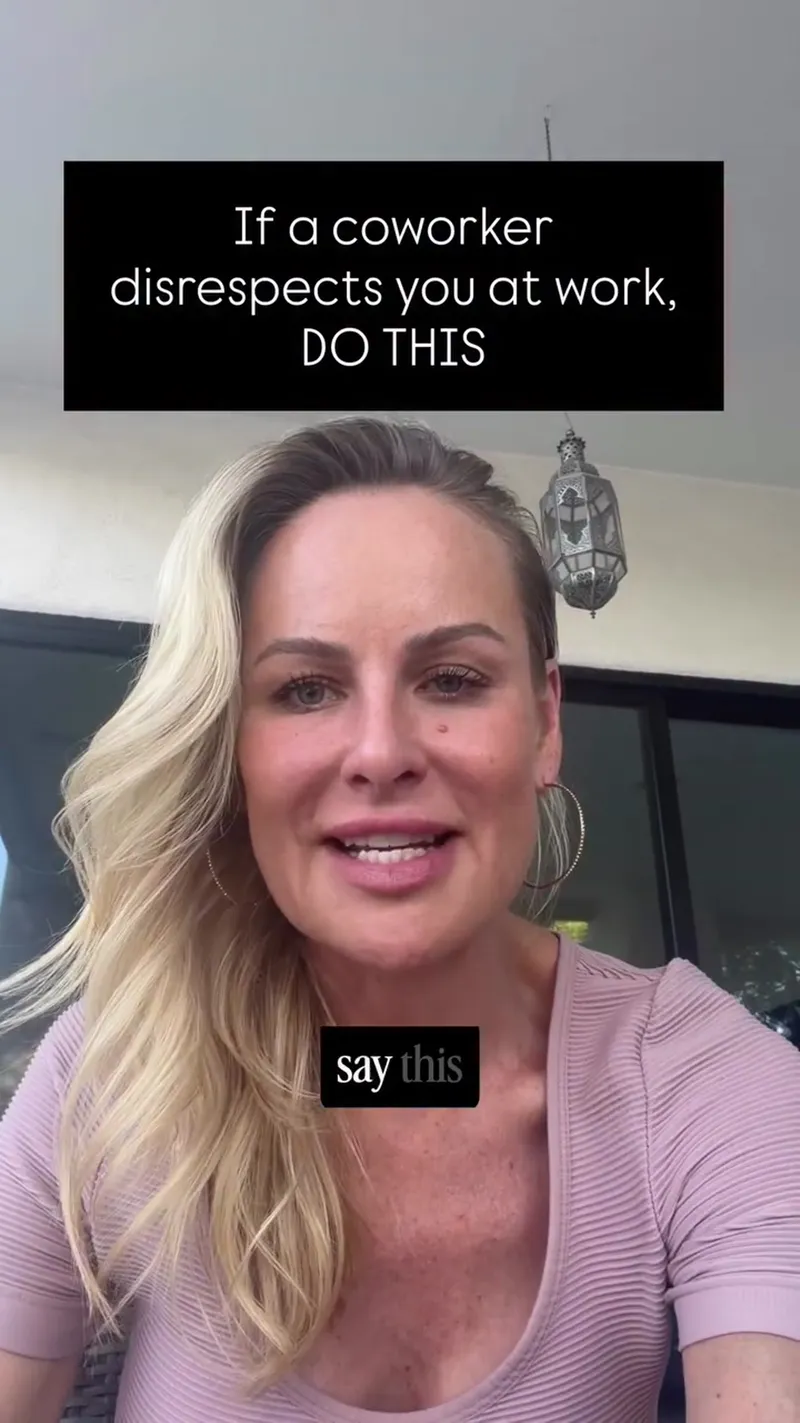
This video outlines three specific psychological tactics to handle workplace disrespect with calm precision. It provides word-for-word scripts for exposing bad behavior, dismissing aggression, and setting firm professional boundaries.
3 Tactics to Stop Workplace Disrespect Instantly
A woman shares three calm responses to workplace disrespect: expose the behavior, redirect a meeting, or set a firm boundary. She then promotes the ProMotion Sprint as a way to get promoted and paid faster.
- Likes
- 66.9K
- Comments
- 714
- Workplace disrespectProfessional boundariesCareer advancement
Analysis
A woman shares three calm responses to workplace disrespect: expose the behavior, redirect a meeting, or set a firm boundary. She then promotes the ProMotion Sprint as a way to get promoted and paid faster.
- Talking headListicleTutorialProblem–Solution
- Spoken
- Original
“If someone disrespects you at work, you say this. They will never try it again.”
- On-screen text
- Original
“If a coworker disrespects you at work, DO THIS”
- Visual
- Text-led compositionA prominent black headline panel sits across the upper part of the frame above a centered speaker shown in a close, direct-to-camera view.
- The woman speaks directly to camera while captions highlight her words; the opening headline frames the workplace advice.
“If someone disrespects you at work, you say this. They will never try it again. You're at your job. Someone talks down to you or disrespects you in front of your coworkers and your blood boils. But you can't snap back because you need this paycheck and you need this job. Most people either stay silent or look weak or blow up and completely destroy their reputation. But if you understand psychology, you know you can't do either. You respond with calm, surgical precision. 3 Responses that shut down disrespect instantly without getting you fired. Tactic one, the exposure. Someone disrespects you to look funny or to look tough. You don't react. You look at them straight in the eye and you say this. Are you trying to impress someone or is this really the best you've got? You just exposed their act. They were trying to gain status by putting you down. Once you call it out, the show's over. All eyes shift to them. Their confidence cracks. Tactic two, the demotion. Someone raises their voice at you in a meeting. Stay completely calm, look at them, and you say this. Noted. Let's get back to the previous conversation, then redirect your attention to someone else. You didn't insult them, you demoted them. Dismissal cuts deeper than any argument. Tactic three, the red line. Someone speaks to you with a disrespectful tone. Pause, look at them straight in the eye and say this. No one speaks me like that. If you have something professional to say, please say it. I invite it. Otherwise, we're done here. Then silence. You just set a boundary they can't argue with without looking Worse, you draw the line. They never cross it again. These tactics work. They come from a place of power, not emotion. But handling disrespect is just one small piece if you want to get promoted and earn what you're worth. Not just survive at work, but dominate. I built a promotion sprint for exactly that comment. Sprint below to join the promotion sprint so you can stop being overlooked and start getting paid faster.”
- 01Problem, stakes, and promise
Establishes why the problem matters and contrasts ineffective extremes with the promised practical sequence.
Introduces a difficult situation, explains the competing risks and common reactions, then promises three composed alternatives.
“If someone disrespects you at work, you say this. They will never try it again. You're at your job. Someone talks down to you or disrespects you in front of your coworkers and your blood boils. But you can't snap back because you need this paycheck and you need this job. Most people either stay silent or look weak or blow up and completely destroy their reputation. But if you understand psychology, you know you can't do either. You respond with calm, surgical precision. 3 Responses that shut down disrespect instantly without getting you fired.”
- 02Response one: expose the motive
Fulfills the first promised response with a concrete line and explains its intended social effect, while teeing up the next tactic.
Presents a tactic for handling a public slight, supplies a pointed question, and explains how it redirects attention to the other person's conduct.
“Tactic one, the exposure. Someone disrespects you to look funny or to look tough. You don't react. You look at them straight in the eye and you say this. Are you trying to impress someone or is this really the best you've got? You just exposed their act. They were trying to gain status by putting you down. Once you call it out, the show's over. All eyes shift to them. Their confidence cracks.”
- 03Response two: redirect and dismiss
Provides a contrasting, lower-conflict tactic and its rationale; the third promised response remains to come.
Shows how to answer a raised voice briefly, return to the prior discussion, and explain the effect of withholding further engagement.
“Tactic two, the demotion. Someone raises their voice at you in a meeting. Stay completely calm, look at them, and you say this. Noted. Let's get back to the previous conversation, then redirect your attention to someone else. You didn't insult them, you demoted them. Dismissal cuts deeper than any argument.”
- 04Response three: set a boundary
Completes the promised list with the clearest limit-setting response and states its intended consequence.
Offers a firm but professional boundary statement, then explains why it draws a clear line and concludes the three-item sequence.
“Tactic three, the red line. Someone speaks to you with a disrespectful tone. Pause, look at them straight in the eye and say this. No one speaks me like that. If you have something professional to say, please say it. I invite it. Otherwise, we're done here. Then silence. You just set a boundary they can't argue with without looking Worse, you draw the line. They never cross it again.”
- 05Synthesis and promotion call to action
Summarizes the advice, connects it to the larger stated goal of career advancement, and converts that connection into an explicit next step.
Asserts that the tactics share a principle, places the advice within a broader career goal, and promotes a program with a direct sign-up prompt.
“These tactics work. They come from a place of power, not emotion. But handling disrespect is just one small piece if you want to get promoted and earn what you're worth. Not just survive at work, but dominate. I built a promotion sprint for exactly that comment. Sprint below to join the promotion sprint so you can stop being overlooked and start getting paid faster.”