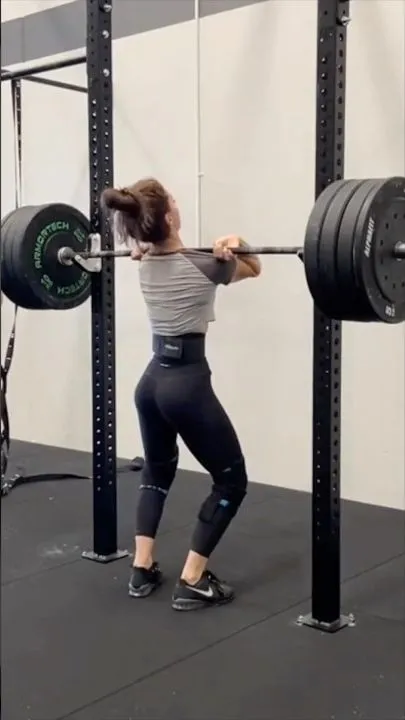
Her Front Squat Was PERFECT!❤️
Her Front Squat Was PERFECT!❤️
A patient struggles to keep his elbows high and hands outside his shoulders in a front squat, despite having enough range of motion. The video explains a banded external rotation drill to build control and reports that his front rack felt easier afterward.
- Views
- 291.5K
- Likes
- 5.6K
- Comments
- 121
- Front squat techniqueShoulder external rotationBanded rotation drill
Analysis
A patient struggles to keep his elbows high and hands outside his shoulders in a front squat, despite having enough range of motion. The video explains a banded external rotation drill to build control and reports that his front rack felt easier afterward.
- DemoTutorialProblem–Solution
- Spoken
- Original
“A great looking front squat has a high elbow position, hands on the outside of the shoulders. But if you can't do this without your elbows dropping, here's a tip.”
“A great looking front squat has a high elbow position, hands on the outside of the shoulders. But if you can't do this without your elbows dropping, here's a tip. This patient of mine had that exact issue. In fact, just holding the bar created shoulder and wrist pain. Now, he could easily raise his arms overhead during my testing, showing his lats were flexible enough to achieve a high elbow position. But remember, the hands also need to be on the outside of the shoulder. This requires external rotation. This position, can you get your hands on the outside? They just don't want to move to the outside. Yeah. Now, come right here. Okay. So, from here, I can get your arm out this far. You just can't control it. Because what I want you to do now is hold right here. Okay? Don't let me push your hand back in. See how easy that that forces back down? Yep. So, you have the available range of motion to get out here, which is where you need to be for a front squat. I just can't. I don't own it. You just can't own it. So, what we're going to do is build stability in that externally rotated position. One drill I gave him was a banded external rotation, using his free hand to help him into as much rotation as possible. Pause for a moment to build ownership of that position, and then slowly return back to the start. When retesting after, he noticed his front rack was significantly easier to get into, showing he was now on the right track.”
- 01Introduce the standard and the problem
Establishes the target, a relatable obstacle, and a reason for the assessment and advice that follow.
Describe what a successful movement looks like, then offer help to someone who cannot achieve it. Introduce a case with the same difficulty and its consequence.
“A great looking front squat has a high elbow position, hands on the outside of the shoulders. But if you can't do this without your elbows dropping, here's a tip. This patient of mine had that exact issue. In fact, just holding the bar created shoulder and wrist pain.”
- 02Test the suspected capability
Distinguishes the initially tested capacity from the remaining limitation, setting up a more specific, hands-on assessment.
Show a test result that appears to support the target position, then clarify that another requirement is also necessary. Ask whether the person can achieve that position and state that they cannot.
“Now, he could easily raise his arms overhead during my testing, showing his lats were flexible enough to achieve a high elbow position. But remember, the hands also need to be on the outside of the shoulder. This requires external rotation. This position, can you get your hands on the outside? They just don't want to move to the outside.”
- 03Demonstrate the control limitation
Resolves whether range is available by demonstrating the difference between reaching a position and controlling it, which motivates the intervention.
Guide the person into a partial position, identify their lack of control, and use gentle resistance to reveal how the position changes. Conclude that the available range exists but is not controlled or owned.
“Yeah. Now, come right here. Okay. So, from here, I can get your arm out this far. You just can't control it. Because what I want you to do now is hold right here. Okay? Don't let me push your hand back in. See how easy that that forces back down? Yep. So, you have the available range of motion to get out here, which is where you need to be for a front squat.”
- 04Name the limitation and prescribe a drill
Turns the assessment into a concrete exercise designed to build control in the needed position.
The person says they cannot maintain the position. The instructor frames the task as building stability, then describes an assisted drill with a pause and a controlled return.
“I just can't. I don't own it. You just can't own it. So, what we're going to do is build stability in that externally rotated position. One drill I gave him was a banded external rotation, using his free hand to help him into as much rotation as possible. Pause for a moment to build ownership of that position, and then slowly return back to the start.”
- 05Retest and report progress
Pays off the intervention with a specific observed improvement while stopping short of claiming a complete resolution.
On retesting, the person notices that entering the target position is significantly easier, presented as evidence of being on the right track.
“When retesting after, he noticed his front rack was significantly easier to get into, showing he was now on the right track.”