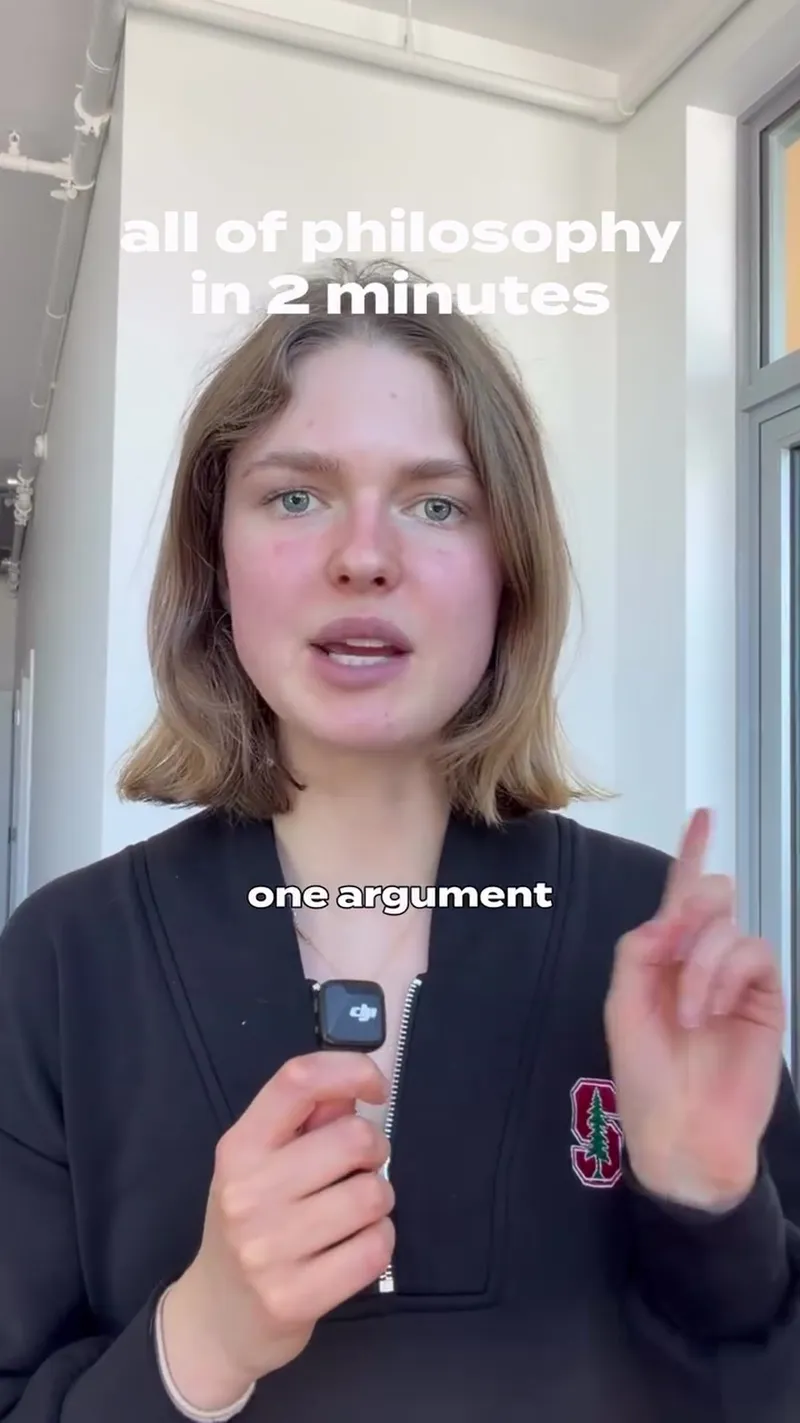
This video provides a high-speed overview of the last 2,600 years of Western philosophy, framing it as a single ongoing argument. It traces the progression of ideas from Ancient Greek thinkers to 20th-century existentialism, highlighting how each era built upon or rejected the previous one.
2,600 Years of Philosophy Explained in 2 Minutes
A fast overview traces major Western philosophers and debates from ancient Greece through the 20th century. It ends by noting that philosophy has not settled its central questions and encourages viewers to read and develop their own ideas.
- Views
- 1.3M
- Likes
- 59.1K
- Comments
- 1.1K
- Western philosophy historyAncient Greek philosophyRationalism and empiricismModern philosophical movements
Analysis
A fast overview traces major Western philosophers and debates from ancient Greece through the 20th century. It ends by noting that philosophy has not settled its central questions and encourages viewers to read and develop their own ideas.
- Talking headExplainer
- Spoken
- Original
“2,600 years of philosophy is basically one argument being passed back and forth.”
- On-screen text
- Original
“all of philosophy in 2 minutes”
- Visual
- Text-led compositionA centered presenter faces the camera in a medium close-up, with a large headline above and subtitle-style text across the lower torso. The visual framing supports the compressed-overview premise rather than demonstrating a process.
- The presenter delivers the history summary to camera, while captions highlight words from the speech and a temple image supports the ancient Greek section.
“2,600 years of philosophy is basically one argument being passed back and forth. So this is philosophy in two minutes. It starts in 600 BC, when the Greeks stop defaulting to the gods, did it. And start asking what the world is made of. Thales said water. He was wrong, but the move was everything. He tried to explain nature with nature. Then Socrates turned the question inwards. He asked not what is the world, but how should you live? And he got executed for asking that question too. Well, then his student Plato said that the real world is invisible, perfect forms, and this shadow world that we occupy is a copy. Plato's student Aristotle disagrees with his own. No, study this world, not this perfect form. Dissect this world and categorize it. Those two, Plato pointing up and Aristotle pointing down, set up a fight that runs for 2000 years. Fast forward. Rome falls. And for a millennium, philosophy mainly serves the Church. Augustine, then Aquinas, bolting Aristotle into Christianity. Essentially reason they thought exists to confirm faith. Then the 1600s blow that argument apart. Descartes doubts absolutely everything. Maybe the world is an illusion. Maybe a demon fakes your senses until he hits one thing that he cannot. I think, therefore I am. Philosophy restarts from the self. This splits Europe. The rationalists say that knowledge comes from reason. The empiricists like Locke and Hume say, no, it comes only from experience. And Hume drops the absolute bomb. You've never actually seen cause and effect. You just see one thing follow another and assume that there must have been a cause. Kant wakes up in his words from that and brokers the peace. The mind is not a blank state or a pure reasoner. It actively builds reality through structures like time and space. You basically never see the world raw. You see it through a lens that you cannot take off. A lens of your own perception. After Kant, philosophy fractures again. Nietzsche declares that God is dead and asks what values will survive this fall. Marx says, stop interpreting the world. Stop sitting around and thinking. Actively change the world. The 20th century essentially splits into two rivers that barely speak. Analytic philosophy, obsessed with logic and language and existentialism. Think Sartre and de Beauvoir, obsessed with freedom and meaning in a universe that offers almost none. 26 centuries and notice we never actually answered the question.”
- 01Frame the debate and begin its history
Promises a compressed overview and gives it a narrative engine: the field develops through successive positions. The initial answer establishes that pattern, while its failure leaves room for the next thinker’s more consequential move.
Set a long time span against a very short summary, state the field’s central pattern as an argument passed between people, then start at an early turning point and introduce the first explanatory question and answer.
“2,600 years of philosophy is basically one argument being passed back and forth. So this is philosophy in two minutes. It starts in 600 BC, when the Greeks stop defaulting to the gods, did it. And start asking what the world is made of. Thales said water. He was wrong, but the move was everything. He tried to explain nature with nature.”
- 02Shift the question and establish the long-running opposition
Develops the opening’s handoff-of-arguments pattern into a clear, memorable disagreement. The opposed approaches set up the next major historical shifts.
Introduce a new thinker who turns the inquiry inward, note the personal cost, then contrast a student's idealized account with a later student's empirical approach. Summarize their opposition as a conflict that lasts for centuries.
“Then Socrates turned the question inwards. He asked not what is the world, but how should you live? And he got executed for asking that question too. Well, then his student Plato said that the real world is invisible, perfect forms, and this shadow world that we occupy is a copy. Plato's student Aristotle disagrees with his own. No, study this world, not this perfect form. Dissect this world and categorize it. Those two, Plato pointing up and Aristotle pointing down, set up a fight that runs for 2000 years.”
- 03Compress a period of institutional influence, then overturn its premise
Shows that the debate can be absorbed by powerful institutions, then reopened. The pivot to doubt creates the next major problem: what can still be known?
Jump forward to describe a long era in which the field serves an institution, name figures who adapt an earlier approach to its doctrines, and pivot to a later thinker who dismantles that argument through radical doubt.
“Fast forward. Rome falls. And for a millennium, philosophy mainly serves the Church. Augustine, then Aquinas, bolting Aristotle into Christianity. Essentially reason they thought exists to confirm faith. Then the 1600s blow that argument apart. Descartes doubts absolutely everything. Maybe the world is an illusion. Maybe a demon fakes your senses until he hits one thing that he cannot. I think, therefore I am. Philosophy restarts from the self.”
- 04Present rival accounts of knowledge and a proposed reconciliation
Resolves the immediate conflict with a synthesis, while the explanation that perception is mediated gives the next section a conceptual bridge into later fractures.
Set out two schools’ competing accounts of knowledge, illustrate the empiricist challenge with an everyday inference, then introduce a thinker who reconciles the dispute by arguing that the mind structures experience.
“This splits Europe. The rationalists say that knowledge comes from reason. The empiricists like Locke and Hume say, no, it comes only from experience. And Hume drops the absolute bomb. You've never actually seen cause and effect. You just see one thing follow another and assume that there must have been a cause. Kant wakes up in his words from that and brokers the peace. The mind is not a blank state or a pure reasoner. It actively builds reality through structures like time and space. You basically never see the world raw. You see it through a lens that you cannot take off. A lens of your own perception.”
- 05Survey later fractures and leave the central question open
Completes the historical progression with distinct later responses, then delivers a concise unresolved-question payoff rather than implying the survey has settled the debate.
Move beyond the synthesis to later thinkers who challenge inherited beliefs and urge action, then describe a modern split between two schools with different concerns. Close by returning to the centuries-long overview and pointing out that its central question remains unanswered.
“After Kant, philosophy fractures again. Nietzsche declares that God is dead and asks what values will survive this fall. Marx says, stop interpreting the world. Stop sitting around and thinking. Actively change the world. The 20th century essentially splits into two rivers that barely speak. Analytic philosophy, obsessed with logic and language and existentialism. Think Sartre and de Beauvoir, obsessed with freedom and meaning in a universe that offers almost none. 26 centuries and notice we never actually answered the question.”