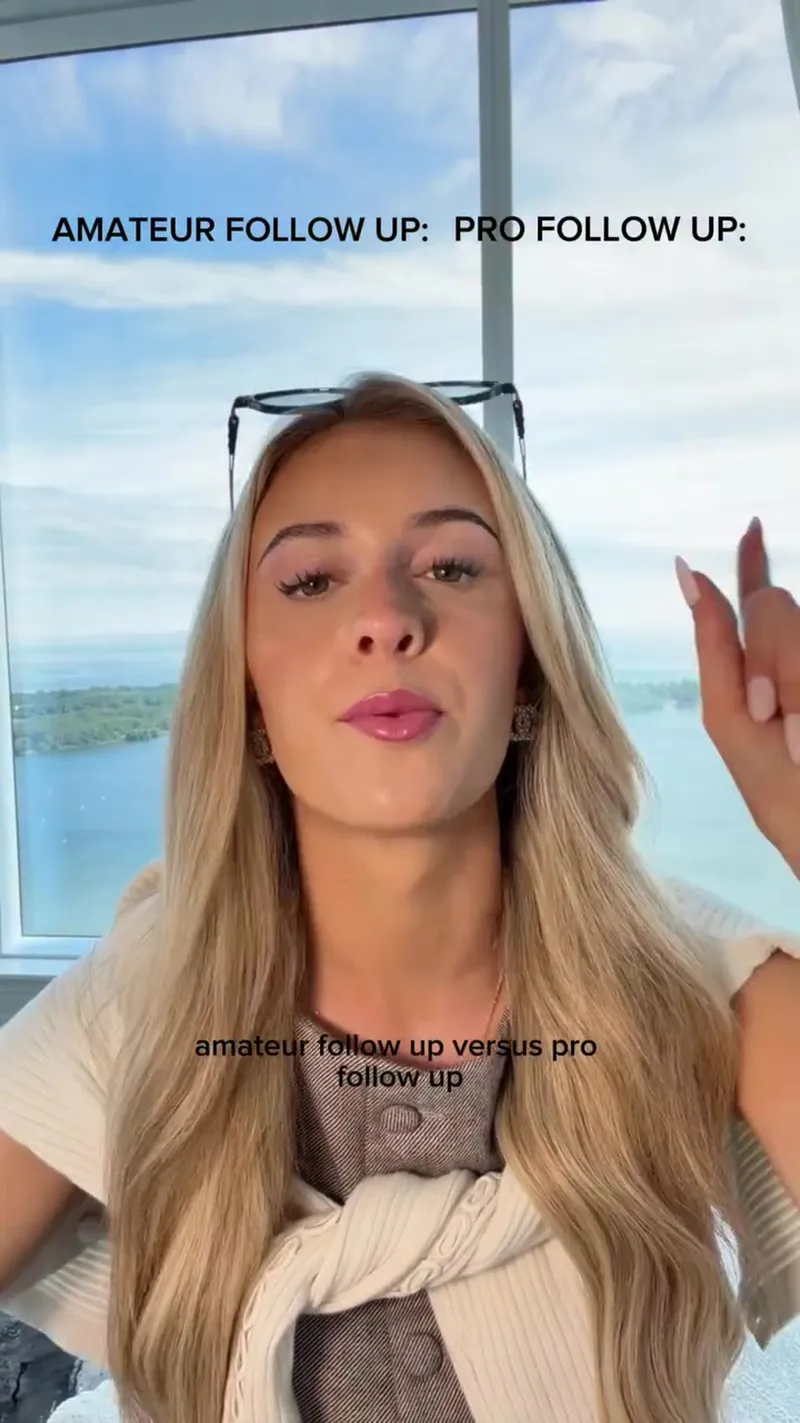
This video contrasts weak 'amateur' follow-up phrases with professional alternatives designed to uncover objections and drive decisions. The creator explains that effective sales follow-up should initiate meaningful conversations rather than just remind prospects that you exist.
Amateur vs. Pro: How to Master the Sales Follow-Up
A sales coach contrasts weak follow-up lines with questions designed to uncover why prospects have not decided. She shares several example scripts and explains that effective follow-up opens a conversation instead of pressuring someone.
- Likes
- 5.7K
- Comments
- 80
- Sales follow-up scriptsHigh-ticket sales closingProspect decision barriers
Analysis
A sales coach contrasts weak follow-up lines with questions designed to uncover why prospects have not decided. She shares several example scripts and explains that effective follow-up opens a conversation instead of pressuring someone.
- Talking headListicleComparisonTutorial
- Spoken
- Original
“Amateur follow up versus Pro follow up.”
- On-screen text
- Original
“AMATEUR FOLLOW UP: PRO FOLLOW UP:”
- Visual
- Text-led compositionA centered presenter faces the camera in a medium close-up, gesturing upward toward a prominent comparison headline across the top of the frame.
- The presenter speaks directly to camera while on-screen headings and captions echo the amateur-versus-pro comparison and highlight sample follow-up lines.
“Amateur follow up versus Pro follow up. Amateur follow up says, just checking in. Pro follow up says, hey John, when we last spoke, you seemed pretty confident that this was the direction you wanted to go. Can I ask what has changed since then, if anything? Amateur follow up says, have you made a decision yet? Pro follow up says, of course. Can I ask, what specifically have you been wanting to think through? Amateur follow up says, just bumping this to the top of your inbox. Pro follow up says. Says, hey John, typically when someone goes quiet is because three things. Either timing has changed, priorities have shifted, or you're just unsure about something now. Which do you feel best describes where you're currently at? Amateur follow up says, are you still interested? Pro follow up says, last time we spoke, you mentioned that not solving this was costing you xyz. Now, can I ask, has anything changed around that, or is that challenge still there for you? Amateur follow up says, let me know if you have any questions. Pro follow up says, can I ask what do you feel needs to happen before moving forward that would make this make sense for you now? After closing $2.6 million in only one year? Here's what I've learned. Amateur follow up tries to convince people. Pro follow up creates conversations. Because the goal of follow up is not to remind someone you exist. It's to open that loop back up and uncover what's actually preventing them from making a decision. That's how you stop chasing people and you start closing them and having them sell themselves to you. Make sure you save this for your next follow up.”
- 01Frame the comparison and first example
Establishes the central distinction through a concrete weak-versus-better example, setting up further comparisons.
Introduce amateur versus professional follow-up, contrast a generic check-in with a question that recalls the prospect’s earlier confidence and asks what changed.
“Amateur follow up versus Pro follow up. Amateur follow up says, just checking in. Pro follow up says, hey John, when we last spoke, you seemed pretty confident that this was the direction you wanted to go. Can I ask what has changed since then, if anything?”
- 02Ask what remains unresolved
Adds another example of replacing pressure for a decision with an open question about the obstacle.
Contrast asking whether a decision has been made with asking what the person still wants to think through.
“Amateur follow up says, have you made a decision yet? Pro follow up says, of course. Can I ask, what specifically have you been wanting to think through?”
- 03Diagnose silence
Broadens the examples from a single question to a diagnostic framework, giving the audience a useful way to surface hesitation.
Contrast bumping a message to the top of an inbox with naming three possible reasons someone has gone quiet and asking which fits.
“Amateur follow up says, just bumping this to the top of your inbox. Pro follow up says. Says, hey John, typically when someone goes quiet is because three things. Either timing has changed, priorities have shifted, or you're just unsure about something now. Which do you feel best describes where you're currently at?”
- 04Reconnect to the stated problem
Shows how prior context can make a follow-up specific and relevant rather than asking for a bare yes-or-no response.
Contrast asking whether the prospect is still interested with recalling the cost of an unresolved problem and asking whether it remains.
“Amateur follow up says, are you still interested? Pro follow up says, last time we spoke, you mentioned that not solving this was costing you xyz. Now, can I ask, has anything changed around that, or is that challenge still there for you?”
- 05Clarify conditions for moving forward
Completes the series of paired examples by turning a vague invitation into a question about the prospect’s decision criteria.
Contrast a passive offer to answer questions with asking what would need to happen for moving forward to make sense.
“Amateur follow up says, let me know if you have any questions. Pro follow up says, can I ask what do you feel needs to happen before moving forward that would make this make sense for you now?”
- 06State the lesson and payoff
Resolves the examples with the underlying principle and a claimed outcome, then closes with a practical call to action.
Cite a sales result as context, summarize the contrast as convincing versus creating conversations, explain that follow-up should uncover what prevents a decision, and end with a save-for-later prompt.
“After closing $2.6 million in only one year? Here's what I've learned. Amateur follow up tries to convince people. Pro follow up creates conversations. Because the goal of follow up is not to remind someone you exist. It's to open that loop back up and uncover what's actually preventing them from making a decision. That's how you stop chasing people and you start closing them and having them sell themselves to you. Make sure you save this for your next follow up.”