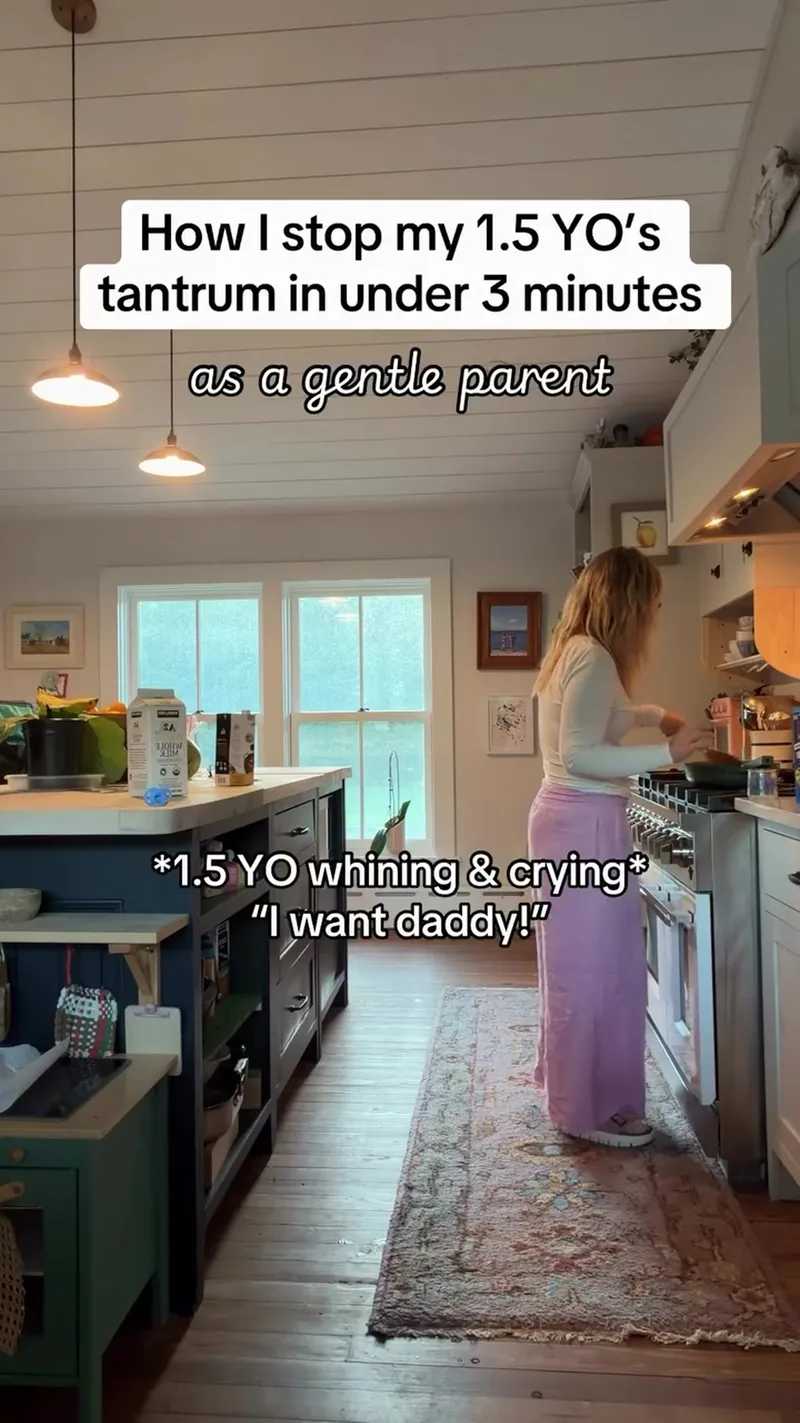
A mother provides a real-life demonstration of managing a toddler's tantrum using gentle parenting. She sets firm boundaries regarding throwing objects and redirects the child's energy into safe outlets like throwing pillows and running.
How to Stop a Toddler Tantrum in Under 3 Minutes
A parent sets a boundary after her toddler throws a cup, then helps redirect the child’s energy toward stomping, running, and throwing soft pillows. The caption explains this gentle-parenting approach of naming feelings, holding limits, and offering safer alternatives.
- Views
- 784.9K
- Likes
- 79.8K
- Comments
- 588
- Gentle toddler parentingTantrum redirectionThrowing behavior boundaries
Analysis
A parent sets a boundary after her toddler throws a cup, then helps redirect the child’s energy toward stomping, running, and throwing soft pillows. The caption explains this gentle-parenting approach of naming feelings, holding limits, and offering safer alternatives.
- DemoTutorialVoiceover
- On-screen text
- Original
“How I stop my 1.5 YO’s tantrum in under 3 minutes as a gentle parent”
- Visual
- Text-led composition with contextual settingA wide, full-body view of a parent in a home kitchen, with a prominent headline across the upper portion and a two-line situation caption near the bottom. The scene establishes the parenting context; no clear demonstration of the promised method is visible in these stills.
- The kitchen footage shows the parent responding to the toddler, while on-screen captions identify moments such as the cup being dropped and the toddler grunting. The opening headline frames the scene as an example of stopping a tantrum through gentle parenting.
“Dad, Daddy's just doing some work. Did you just throw that cup? You don't get to throw cups. No cup is. Cup is done. Now. All done. All done. No more cup. No. No more milky. Threw the cup. That's not allowed. No more milky. I know you threw the cup. Now the cup is all done. We threw the cup. The cup is all done. You're not getting a new cup out of the dishwasher. No, we're going to keep that closed. Puppy, do I need to put you in another room? Cuz you're not listening. We're not getting out a new cuff. We're not getting a new cup. Okay. You upset? That's fine. You can lay down if you'd like. You're not getting a new cup. You threw the cup. Now the cup is finished. We're not throwing other things either. No. Everything you throw, Mommy takes away. No throwing. No. No. Can you just have a moment on the floor? Yeah. You feeling better? Mad. You can stomp or you can clap. Do you want to clap together? Whoa. Good running. Running's good. You can run. Why don't you run in that room and run back with the grass? Ready? Go. Go. Go. Run. Woo. Good running. What are you doing? Are you having fun with the cushions? Are you throwing pillows? Are you throwing my pillows? Monkey, now you're having so much fun, can you throw on more pillows? I like when you throw pillows. We can throw pillows now. Throw cups. Throw pillows? Yes. Pillows are soft. Yeah. Come throw a pillow at me. Let's throw pillows. Ready? Whoa. Okay, ready? Pillow. Throw. You get it? Okay. Ready? Pillow. Hello. Look, is the pillow soft? Is it soft? Yeah. We can throw soft. Oh, you want? And you're jumping off of it. That's a good idea. Looks soft. We can throw it. Ready? Ready. It. It doesn't hurt. Soft. Soft. Soft. Soft. Can I throw it? One, two.”
- 01State the immediate boundary
Establishes the limit and its concrete consequence before responding to the child’s upset.
The speaker explains the immediate context, identifies the prohibited behavior, and states the consequence for the item involved.
“Dad, Daddy's just doing some work. Did you just throw that cup? You don't get to throw cups. No cup is. Cup is done. Now. All done. All done. No more cup. No. No more milky. Threw the cup. That's not allowed. No more milky. I know you threw the cup. Now the cup is all done. We threw the cup. The cup is all done. You're not getting a new cup out of the dishwasher. No, we're going to keep that closed.”
- 02Hold the limit and acknowledge feelings
Maintains the consequence while recognizing the child’s feelings and setting expectations for related behavior.
The speaker repeats the limit, checks whether the child is upset, allows space to calm down, and explains the broader boundary against throwing things.
“Puppy, do I need to put you in another room? Cuz you're not listening. We're not getting out a new cuff. We're not getting a new cup. Okay. You upset? That's fine. You can lay down if you'd like. You're not getting a new cup. You threw the cup. Now the cup is finished. We're not throwing other things either. No. Everything you throw, Mommy takes away. No throwing. No. No. Can you just have a moment on the floor?”
- 03Offer acceptable ways to release energy
Moves from the boundary to constructive alternatives, demonstrating how to redirect rather than merely prohibit.
After checking whether the child feels better and naming the feeling, the speaker suggests safe actions and guides a short running activity.
“Yeah. You feeling better? Mad. You can stomp or you can clap. Do you want to clap together? Whoa. Good running. Running's good. You can run. Why don't you run in that room and run back with the grass? Ready? Go. Go. Go. Run. Woo. Good running.”
- 04Redirect throwing toward soft objects
Shows the safer substitute in practice and reinforces the contrast between a prohibited object and a permitted, soft one.
The speaker notices the child playing with cushions, approves throwing pillows, distinguishes them from cups, and joins in a guided pillow-throwing activity.
“What are you doing? Are you having fun with the cushions? Are you throwing pillows? Are you throwing my pillows? Monkey, now you're having so much fun, can you throw on more pillows? I like when you throw pillows. We can throw pillows now. Throw cups. Throw pillows? Yes. Pillows are soft. Yeah. Come throw a pillow at me. Let's throw pillows. Ready? Whoa. Okay, ready? Pillow. Throw. You get it? Okay. Ready? Pillow. Hello. Look, is the pillow soft? Is it soft? Yeah. We can throw soft. Oh, you want? And you're jumping off of it. That's a good idea. Looks soft. We can throw it. Ready? Ready. It. It doesn't hurt. Soft. Soft. Soft. Soft. Can I throw it? One, two.”