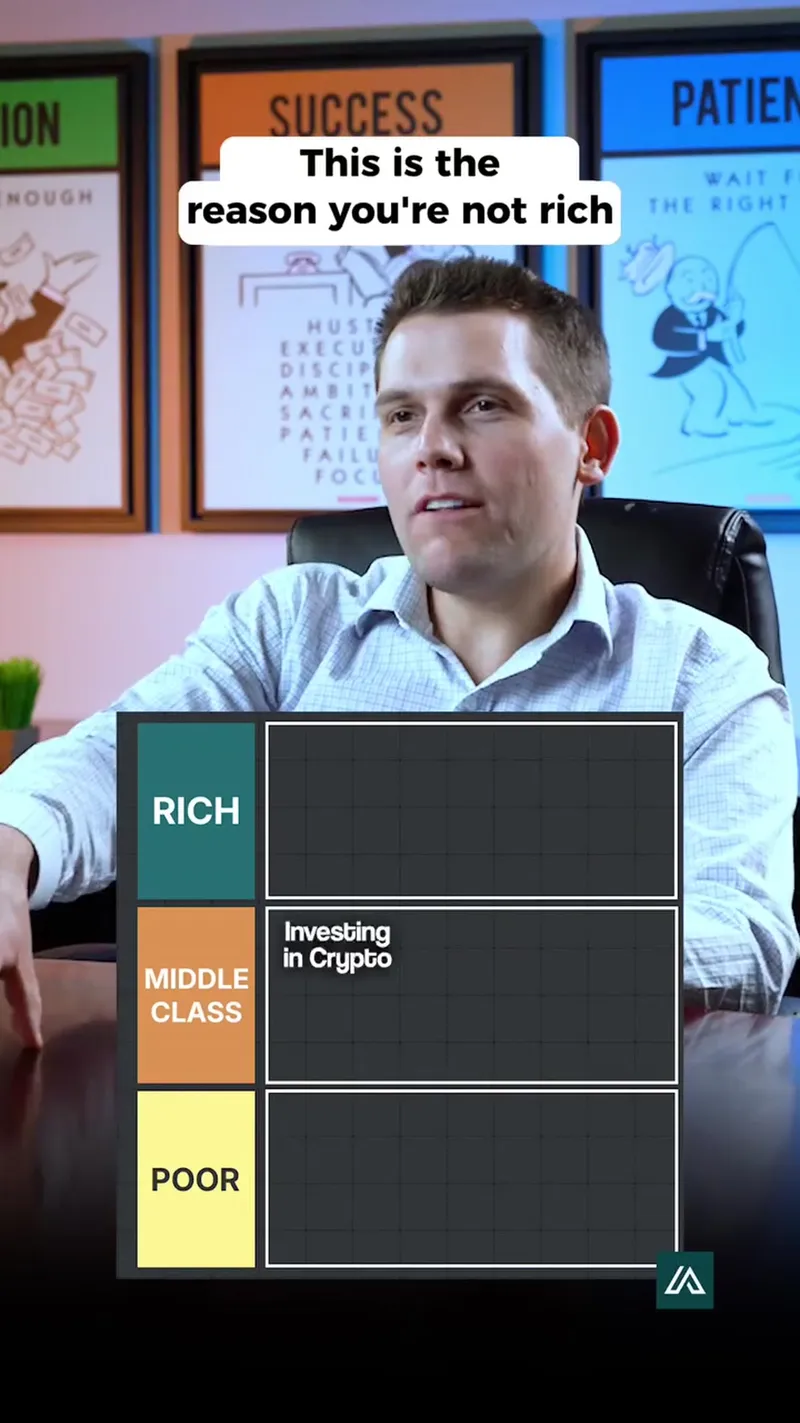
The speaker uses a tier list to categorize common financial habits and assets into poor, middle class, or rich categories. He argues that traditional middle-class staples like 401ks and home ownership are not the primary ways the wealthy actually build or maintain their fortunes.
Why You’re Not Rich: The Investment Tier List
A speaker sorts financial choices into rich, middle-class, and poor categories, including crypto, 401(k)s, home ownership, rentals, savings, gold, and lotteries. He argues that common middle-class approaches do not build wealth like some strategies used by the rich.
- Likes
- 1.8K
- Comments
- 65
- Wealth-building habitsMiddle-class financesReal estate investingRetirement savingsLottery and gambling
Analysis
A speaker sorts financial choices into rich, middle-class, and poor categories, including crypto, 401(k)s, home ownership, rentals, savings, gold, and lotteries. He argues that common middle-class approaches do not build wealth like some strategies used by the rich.
- Talking headListicleHot take
- Spoken
- Original
“Investing in crypto. That's how the middle class becomes poor.”
- On-screen text
- Original
“This is the reason you're not rich”
- Visual
- Text-led composition with a supporting chartA centered seated speaker appears above a large, color-coded three-tier chart labeled RICH, MIDDLE CLASS, and POOR. The tiers have empty spaces beside their labels; the headline sits prominently above the speaker.
- The chart labels and fills in the rich, middle-class, and poor tiers as the speaker discusses each financial choice, visually organizing his comparisons.
“Investing in crypto. That's how the middle class becomes poor. Maxing out your 401k middle class 401ks are great for growing wealth for retirement, but the rich aren't thinking about their 401k a whole lot. Buying a house Middle class Especially if your house is your biggest asset and you see it as a wealth vehicle. The rich do not see their house as a wealth vehicle. They may own a house, but it's not their largest asset. And they own a house for convenience, not as an investment. Renting forever Poor and rich Poor people rent forever because unfortunately they don't have any other choice. And the funny thing about rich people is sometimes you get to a certain level of wealth where you do not want to deal with owning all these properties anymore, so you just rent what you want when you want. Owning residential rental properties Middle class Nobody's building serious wealth through Airbnbs or a few residential rental homes. Buying commercial real estate Rich but here's the thing. You're not going to get rich with commercial real estate unless you raise other people's money to buy commercial real estate. But if you're already rich, commercial real estate is a great place to to put your money. Keeping money in your savings account Middle class if you're poor, you probably don't have a savings account. And if you're rich, you're not building up savings. You have how much cash you want to keep on hand and you invest everything else buying gold. I would attribute that to paranoid not rich. Poor Middle class Playing the lottery Poor It's a known fact lotteries and legalized gambling is just a tax on the poor. The rich use for a tax advantage.”
- 01Opening contrast
Establishes the recurring comparison between groups and signals that the following examples will challenge assumptions about wealth-building.
Opens with a provocative claim that a familiar financial choice leads to a negative outcome for one group, then contrasts it with a retirement-saving option that is useful but not the focus for the wealthy.
“Investing in crypto. That's how the middle class becomes poor. Maxing out your 401k middle class 401ks are great for growing wealth for retirement, but the rich aren't thinking about their 401k a whole lot.”
- 02Homeownership
Develops the opening comparison with a familiar asset and resolves the distinction between owning a home and treating it as an investment.
Contrasts treating a home as a major wealth-building asset with owning a home mainly for convenience, then clarifies that it may not be the wealthy group's largest asset.
“Buying a house Middle class Especially if your house is your biggest asset and you see it as a wealth vehicle. The rich do not see their house as a wealth vehicle. They may own a house, but it's not their largest asset. And they own a house for convenience, not as an investment.”
- 03Renting
Adds a contrasting example and explains why similar behavior can reflect different circumstances; the qualification provides the section's payoff.
Distinguishes renting due to limited options from renting by choice for flexibility or convenience, including a qualification about wealth and property ownership.
“Renting forever Poor and rich Poor people rent forever because unfortunately they don't have any other choice. And the funny thing about rich people is sometimes you get to a certain level of wealth where you do not want to deal with owning all these properties anymore, so you just rent what you want when you want.”
- 04Property investment
Complicates the earlier property comparison: the asset class alone is not enough; access to other people's money changes the claim.
Rejects small-scale residential rentals as a route to substantial wealth, then distinguishes commercial property as a vehicle for wealthy investors while qualifying how newcomers might acquire it.
“Owning residential rental properties Middle class Nobody's building serious wealth through Airbnbs or a few residential rental homes. Buying commercial real estate Rich but here's the thing. You're not going to get rich with commercial real estate unless you raise other people's money to buy commercial real estate. But if you're already rich, commercial real estate is a great place to to put your money.”
- 05Savings and cash
Continues the wealth-group comparison through liquidity and investment, with the closing quip providing a brief comic judgment rather than opening a new question.
Contrasts having little or no savings with holding only a chosen amount of cash and investing the rest, then ends with a skeptical punchline about gold.
“Keeping money in your savings account Middle class if you're poor, you probably don't have a savings account. And if you're rich, you're not building up savings. You have how much cash you want to keep on hand and you invest everything else buying gold. I would attribute that to paranoid not rich.”
- 06Lottery and gambling
Supplies a final example of the broader comparison and ends on a concise, pointed reversal.
Closes with a compact contrast: gambling is characterized as a burden on poorer people and a tax advantage for the wealthy.
“Poor Middle class Playing the lottery Poor It's a known fact lotteries and legalized gambling is just a tax on the poor. The rich use for a tax advantage.”