A memory expert explains how chess grandmasters use a technique called chunking to remember complex patterns rather than individual pieces. She breaks down how anyone can use this method to improve their own memory through real-world examples, self-quizzing, and naming patterns.
How to Remember Like a Chess Grandmaster
A memory expert uses a chessboard challenge to explain how grandmasters remember patterns instead of individual pieces. She shares practical ways to use chunking, including studying examples, self-quizzing, naming patterns, and spacing study sessions.
- Likes
- 11.3K
- Comments
- 284
- Chunking for memoryChess grandmaster patternsMemory practice techniques
Analysis
A memory expert uses a chessboard challenge to explain how grandmasters remember patterns instead of individual pieces. She shares practical ways to use chunking, including studying examples, self-quizzing, naming patterns, and spacing study sessions.
- Talking headDemoTutorialListicle
- Spoken
- Original
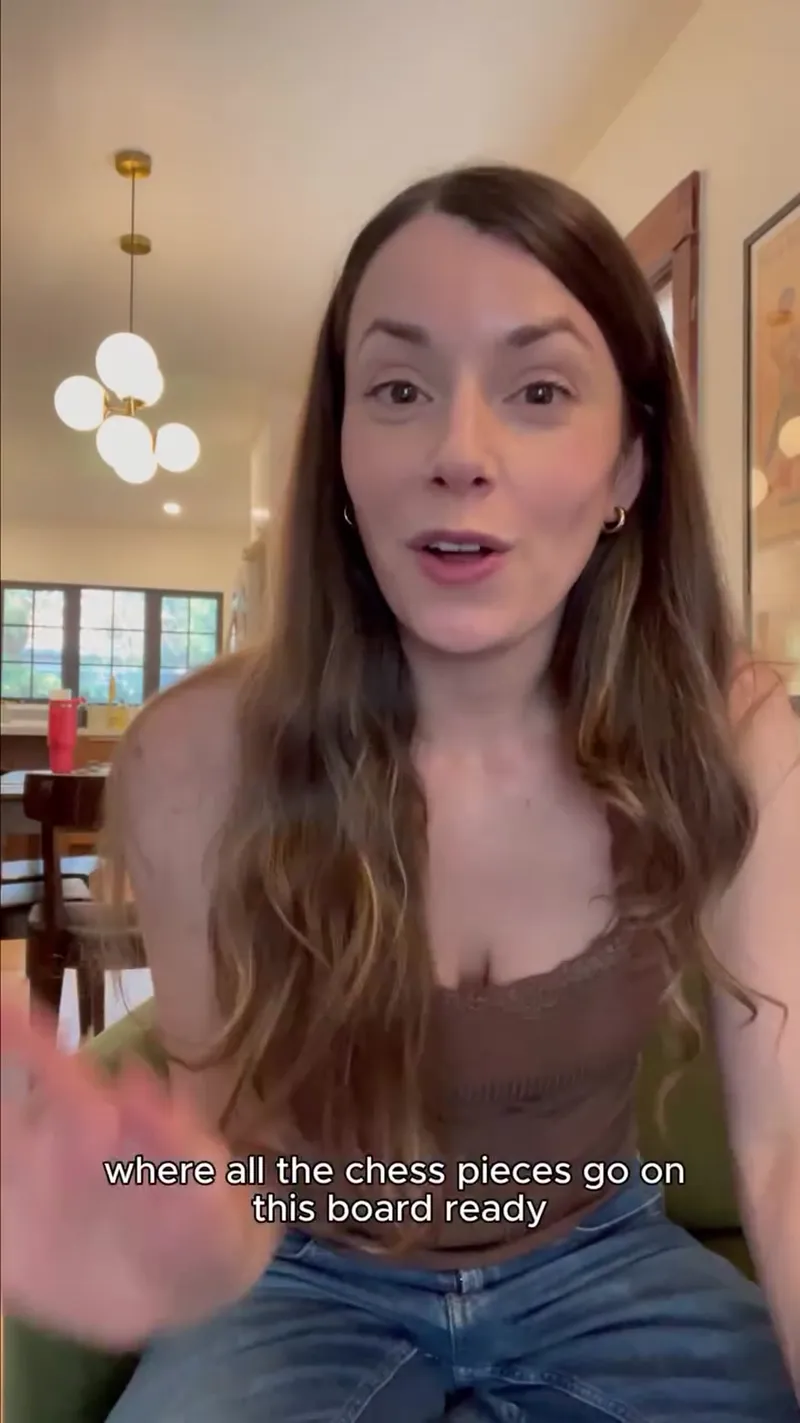
“Let's play a game. I want you to remember where all the chess pieces go on this board. Ready?”
- On-screen text
- Original
“let's play a game I want you to remember”
- Visual
- Talking headA seated presenter faces the camera in a medium close-up, with the room visible behind her; ordinary captions sit across the lower part of the frame.
- The presenter speaks directly to camera; a chessboard graphic illustrates the opening memory challenge, and a graphic showing scattered letters grouped into “READING” supports her explanation of chunking.
“Let's play a game. I want you to remember where all the chess pieces go on this board. Ready? Time's up. I know that felt fast, but the crazy thing is that chess grandmasters would be able to remember every piece. And it's not because they have exceptional memories. It's because they're using a tactic. I have my PhD in memory. Let me explain how you can use this tactic to remember anything you want. Grandmasters aren't remembering individual pieces, they're remembering patterns. They see the whole board the same way you or I see a word instead of individual letters. It's called chunking, and it's a super powerful memory tool. Let me explain how to use it. First, study real examples. If you're trying to remember a concept, look for examples of where that concept applies in real life. 2. Quiz yourself. Cover up the information and try to recall it by yourself as well as you can. Three, try to name different patterns. Your brain grabs something that's named better than something that's not. Or space out your memory and mix up when you're doing your studying. Tell me what you're trying to remember in the comments and I'll tell you how to break it into patterns.”
- 01Quick recall challenge
Creates a concrete memory test that sets up the later explanation of how experts remember more effectively.
Invite the viewer into a brief game to remember where a set of items belongs, then end the attempt and acknowledge that the time felt short.
“Let's play a game. I want you to remember where all the chess pieces go on this board. Ready? Time's up. I know that felt fast, but the crazy thing is that chess grandmasters would be able to remember every piece.”
- 02Reveal the principle
Resolves the challenge's implied question with a learnable method, then frames it as useful beyond the original example.
Reject exceptional memory as the explanation, attribute experts' performance to a tactic, establish relevant expertise, promise to explain its broader use, and name chunking through an analogy.
“And it's not because they have exceptional memories. It's because they're using a tactic. I have my PhD in memory. Let me explain how you can use this tactic to remember anything you want. Grandmasters aren't remembering individual pieces, they're remembering patterns. They see the whole board the same way you or I see a word instead of individual letters. It's called chunking, and it's a super powerful memory tool. Let me explain how to use it.”
- 03Practical steps and invitation
Fulfills the promise with actionable steps and closes by turning the general method into a specific opportunity for viewer participation.
Give three ways to apply the principle: study real examples, quiz yourself, and name or space out patterns. Explain why naming helps, then invite viewers to share what they want to remember for tailored guidance.
“First, study real examples. If you're trying to remember a concept, look for examples of where that concept applies in real life. 2. Quiz yourself. Cover up the information and try to recall it by yourself as well as you can. Three, try to name different patterns. Your brain grabs something that's named better than something that's not. Or space out your memory and mix up when you're doing your studying. Tell me what you're trying to remember in the comments and I'll tell you how to break it into patterns.”