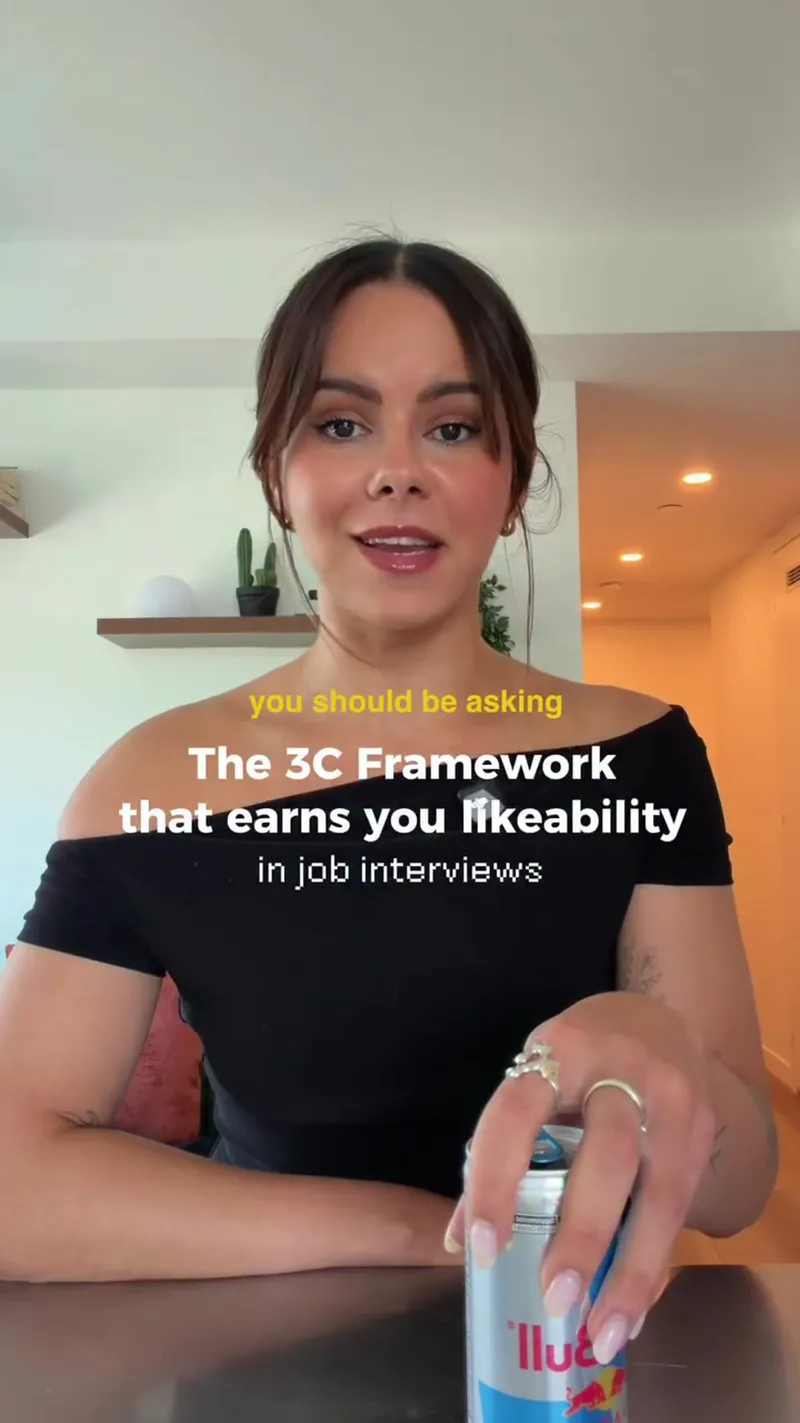
This video breaks down the 3C Framework—Clarify, Connect, and Collaborate—to help job seekers ask high-impact questions during interviews. It explains how using these specific question types can psychologically boost your likability and make it easier for hiring managers to envision you in the role.
The 3C Framework: How to Ask Better Interview Questions
A presenter explains a 3C framework for asking three to five questions in a job interview: clarify during the interview, connect with the interviewer, and collaborate with an example- or problem-based question. She says thoughtful questions can improve likability and help interviewers picture you in the role.
- Views
- 1.2M
- Likes
- 31.1K
- Comments
- 59
- Job interview questionsInterview likability3C question framework
Analysis
A presenter explains a 3C framework for asking three to five questions in a job interview: clarify during the interview, connect with the interviewer, and collaborate with an example- or problem-based question. She says thoughtful questions can improve likability and help interviewers picture you in the role.
- Talking headTutorialExplainer
- Spoken
- Original
“There are only three to five questions you should be asking in an interview to get an offer.”
- On-screen text
- Original
“The 3C Framework that earns you likeability in job interviews”
- Visual
- Text-led compositionA centered presenter faces the camera in a medium shot. A large, high-contrast headline overlays the torso, with smaller yellow text above it; the room is visible behind her.
- The presenter speaks directly to camera as captions highlight her points; a research excerpt appears while she discusses the link between asking questions and likability.
“There are only three to five questions you should be asking in an interview to get an offer. Because psychologically there's a direct link between asking the right questions and your likability just as much as your answers do. This is the art of the interview. And these are the only questions you need to ask to earn those likeability points and get that bag. And to help you to remember those questions, we're using my 3C framework. 80% of candidates treat it like an afterthought and just rehearse their answers. But you're going to be the 20% that treats it like an encore at a concert. So you're going to ask one to two questions that clarifies, one to two that connects and one that collaborates. Clarifying questions are ones you ask during the interview, not at the end. When in interviewer asks you a general question, it's important to not take it at face value and ask clarifying questions for details and context. It proves you're listening and engaged. At the end of the interview, you're going to ask one to two connect questions. And that's when you get the interviewer to talk about themselves. When people self disclose, it makes them feel good psychologically. They attach that good feeling to you. What is that? Like 15 likability points. And the closer is asking one collaborate question. This is either example based or problem based. Asking for an example or about a problem creates the concreteness effect. It helps the interviewer picture you in the role. Three to five questions, that's it.”
- 01Promise and framework
Sets a concrete outcome and scope, then gives viewers a simple structure for the promised guidance.
Recommend a small number of actions for a desired outcome, explain why they matter, frame the topic as a skill, and introduce a mnemonic to organize the advice.
“There are only three to five questions you should be asking in an interview to get an offer. Because psychologically there's a direct link between asking the right questions and your likability just as much as your answers do. This is the art of the interview. And these are the only questions you need to ask to earn those likeability points and get that bag. And to help you to remember those questions, we're using my 3C framework.”
- 02Contrast and first framework stage
Develops the framework with a practical first step and explains why it improves the interaction.
Contrast the common mistake with a more deliberate approach, use an analogy to make the alternative memorable, then explain the first category, when to use it, and what it signals.
“80% of candidates treat it like an afterthought and just rehearse their answers. But you're going to be the 20% that treats it like an encore at a concert. So you're going to ask one to two questions that clarifies, one to two that connects and one that collaborates. Clarifying questions are ones you ask during the interview, not at the end. When in interviewer asks you a general question, it's important to not take it at face value and ask clarifying questions for details and context. It proves you're listening and engaged.”
- 03Second stage and its benefit
Continues the framework and supplies a distinct rationale for the second type of action.
Place the second category at the end of the interaction, explain how it invites personal sharing, and connect that sharing to a positive feeling and the speaker's benefit.
“At the end of the interview, you're going to ask one to two connect questions. And that's when you get the interviewer to talk about themselves. When people self disclose, it makes them feel good psychologically. They attach that good feeling to you. What is that? Like 15 likability points.”
- 04Final stage and concise close
Completes the three-part framework with a concrete benefit and resolves the opening promise with a concise summary.
Introduce the final category, explain its forms and practical effect, then close by restating the recommended total.
“And the closer is asking one collaborate question. This is either example based or problem based. Asking for an example or about a problem creates the concreteness effect. It helps the interviewer picture you in the role. Three to five questions, that's it.”