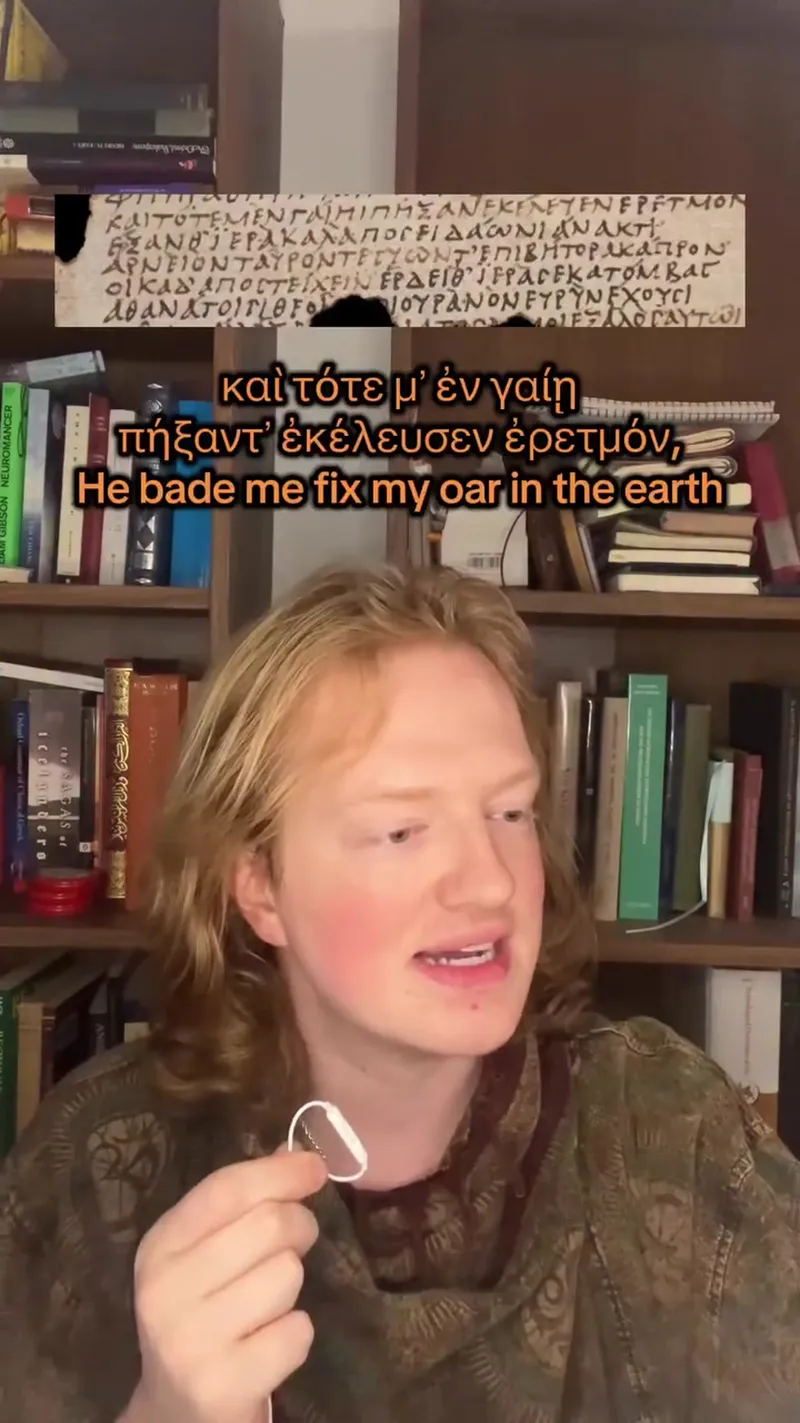
This video explores the Manchester Odyssey, the oldest known book-form copy of Homer's epic poem. The creator explains how ancient texts lacked spaces between words and shows real examples of mistakes corrected by ancient scribes.
Inside the Oldest Book Copy of the Odyssey
A presenter explains the Manchester Odyssey, a third-century CE copy of The Odyssey in book form. They point out its unspaced Greek text, a corrected scribal mistake, and accent marks used to show word stress.
- Likes
- 582.9K
- Comments
- 3.4K
- Manchester Odyssey manuscriptAncient Greek writingEarly book historyGreek accent marks
Analysis
A presenter explains the Manchester Odyssey, a third-century CE copy of The Odyssey in book form. They point out its unspaced Greek text, a corrected scribal mistake, and accent marks used to show word stress.
- Talking headExplainerDemo
- Spoken
- Original
“The oldest copy of the Odyssey.”
- On-screen text
- Original
“Oldest Odyssey copy”
- Visual
- Text-led compositionA prominent manuscript image with a large caption occupies the upper portion of the frame; a centered presenter appears below it in front of bookshelves.
- The presenter speaks to camera while manuscript images and Greek text excerpts illustrate the explanation; overlays show a spelling correction and accent marks.
“The oldest copy of the Odyssey. The Manchester Odyssey is the oldest copy of the poem in book form, representing a transition from the rolled up scrolls of antiquity to bound books. It dates to the third century CE and we're towards a portion of book 23. And if you notice, the text doesn't have any spaces. You just have to know when one word ends and when another begins. We also have mistakes that were then corrected by a later scribe. For instance, the original authors spelled they sacrificed as egsant, but it should be erksant as the correction shows. This later hand also added in the accent marks that signify where you put the stress on a certain word. So for instance, we know that this word is pronounced as tauros, with the stress on the first syllable instead of tauros, which would be marked like this.”
- 01Identify and situate the artifact
Establishes what the object is and why it matters, then narrows the discussion to a particular part for the following close reading.
Names the subject, identifies it as the oldest example of its kind in a specified format, and places it in a historical transition. Gives its date and points to the portion being examined.
“The oldest copy of the Odyssey. The Manchester Odyssey is the oldest copy of the poem in book form, representing a transition from the rolled up scrolls of antiquity to bound books. It dates to the third century CE and we're towards a portion of book 23.”
- 02Explain a feature of the text
Turns a visible textual feature into an accessible explanation, developing the close-reading setup without opening a separate question.
Points out the lack of spaces and explains how readers determine where one word ends and another begins.
“And if you notice, the text doesn't have any spaces. You just have to know when one word ends and when another begins.”
- 03Show a correction and interpret a mark
Builds from the general fact of correction to concrete evidence and its interpretive value: the marks help establish both the intended spelling and pronunciation.
Introduces mistakes corrected by a later copyist, gives a spelling example contrasting the original with its correction, then explains added accent marks and uses one to demonstrate how stress indicates pronunciation.
“We also have mistakes that were then corrected by a later scribe. For instance, the original authors spelled they sacrificed as egsant, but it should be erksant as the correction shows. This later hand also added in the accent marks that signify where you put the stress on a certain word. So for instance, we know that this word is pronounced as tauros, with the stress on the first syllable instead of tauros, which would be marked like this.”