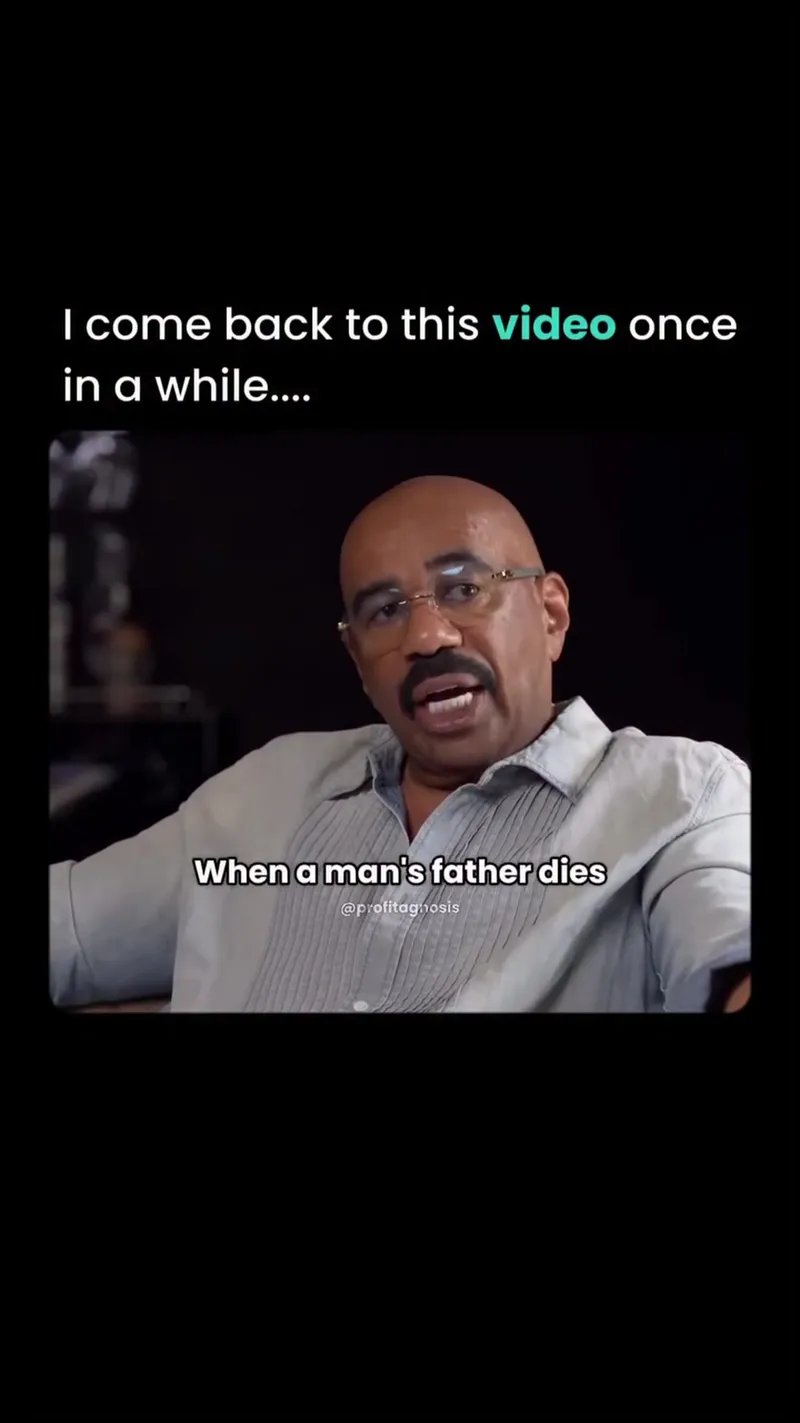
Steve Harvey shares a deeply personal reflection on how a father is often the only person who genuinely wants his child to be more successful than himself. He describes the profound void left behind when that source of unconditional pride and encouragement is gone.
Steve Harvey on the Unique Bond Between Fathers and Sons
Steve Harvey reflects on how a father's wish for his child to surpass him makes that loss feel especially profound. He recalls missing his father's words of pride after his death.
- Likes
- 587.8K
- Comments
- 5.7K
- Father's death and griefFather-son encouragementParental pride
Analysis
Steve Harvey reflects on how a father's wish for his child to surpass him makes that loss feel especially profound. He recalls missing his father's words of pride after his death.
- Talking headVoiceover
- Spoken
- Original
“When a man's father dies, he realizes that the one man who truly wanted him to be better than him is gone.”
- On-screen text
- Original
“I come back to this video once in a while....”
- Visual
- Text-led compositionA seated interview subject appears in a medium shot within a centered video panel on a black background. A large reflection headline sits above the panel; a short bold caption overlays the lower part of the image.
- The sampled footage shows Steve Harvey speaking, with subtitles matching his remarks about a father's death and support. Later samples show him visibly emotional, reinforcing the transcript's grief.
“When a man's father dies, he realizes that the one man who truly wanted him to be better than him is gone. Your father is the only man that has ever wanted you to be better than him. There ain't another man living wants you to be better than him. I love you, man, but I don't want you to be better than me. Ryan crazy about you, but he ain't fitting to want you to be better than me. That's real. Your father wants you to be better than him. And when he dies, you realize it. And what the part that fucked me so bad was. I don't feel like crying today, man. The only thing. How about that? Listen, man, I didn't have nobody when my daddy died. I didn't have nobody to say they was proud of me. It fucked me up. Cause you know, my dad. Used to call me so proud. There's a cry. And when he died, man, nobody said that to me. Nobody.”
- 01Establish the unique support
Introduces the central claim about selfless encouragement and gives it emphasis through repetition.
Frame a loved one's death as making clear that this person uniquely wanted the listener to surpass them, then restate the point as a broad claim.
“When a man's father dies, he realizes that the one man who truly wanted him to be better than him is gone. Your father is the only man that has ever wanted you to be better than him.”
- 02Contrast other people's support
Supports the central claim with a pointed comparison and returns to the loved one's distinctive encouragement.
Contrast the loved one's wish for the listener to excel with the speaker's and another person's presumed reluctance, then reaffirm that the loved one wants the listener to do better.
“There ain't another man living wants you to be better than him. I love you, man, but I don't want you to be better than me. Ryan crazy about you, but he ain't fitting to want you to be better than me. That's real. Your father wants you to be better than him.”
- 03Turn to personal loss
Moves from the general claim to a personal emotional response, setting up the account of what was missing.
Say that the realization comes after the loved one's death, then introduce how strongly that realization affected the speaker.
“And when he dies, you realize it. And what the part that fucked me so bad was. I don't feel like crying today, man. The only thing.”
- 04Recall the missing affirmation
Resolves the personal account with a specific example of the lost affirmation, reinforcing the passage's claim about the father's irreplaceable support.
Explain that after the speaker's father's death, nobody was there to say they were proud, recall that his father used to say it, and end by repeating that nobody said it afterward.
“How about that? Listen, man, I didn't have nobody when my daddy died. I didn't have nobody to say they was proud of me. It fucked me up. Cause you know, my dad. Used to call me so proud. There's a cry. And when he died, man, nobody said that to me. Nobody.”