AI is killing GitHub #github #coding #programming
AI is killing GitHub
The speaker argues that AI coding agents are increasing the number of commits and repository writes beyond what GitHub was designed to handle. He explains how large monorepositories and replicated Git hosting make scaling harder, and predicts changes to developer tools.

- Views
- 479.1K
- Likes
- 17.2K
- Comments
- 137
- GitHub scaling challengesAI coding agentsGit repository replicationMonorepositories and write load
Analysis
The speaker argues that AI coding agents are increasing the number of commits and repository writes beyond what GitHub was designed to handle. He explains how large monorepositories and replicated Git hosting make scaling harder, and predicts changes to developer tools.
- Talking headVoiceoverExplainerCommentary
- Spoken
- Original
“AI is killing GitHub, but it's not because their developers are shipping slop.”
- On-screen text
- Original
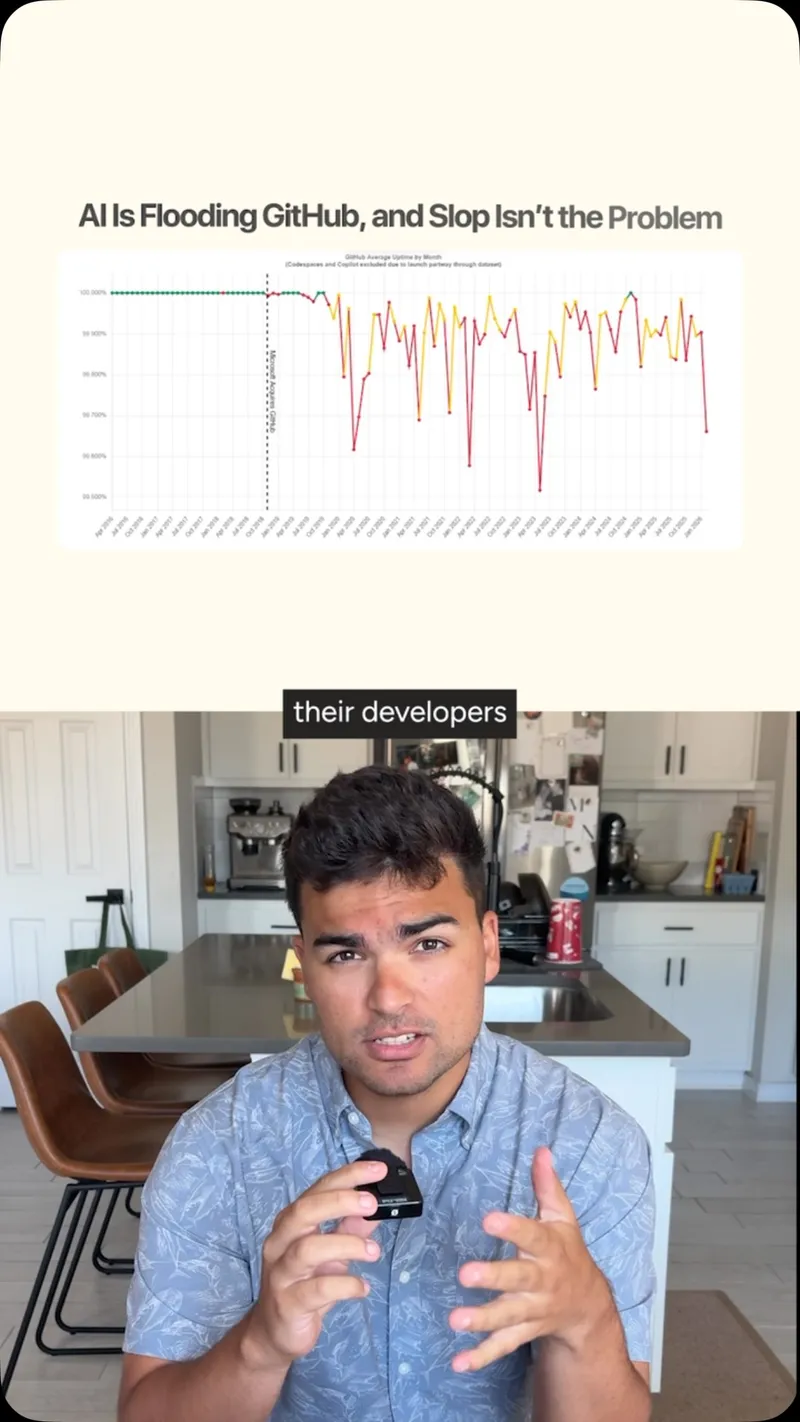
“AI Is Flooding GitHub, and Slop Isn’t the Problem”
- Visual
- Text-led composition with supporting diagram and chartA vertically split layout places the speaker in a kitchen below a cream-colored graphic. The upper graphic shows a central GitHub logo connected by dashed lines to service icons; later, a chart appears above the speaker. The diagram and chart support the headline rather than showing a real-world demonstration.
- The presenter speaks to camera while simple graphics and a chart illustrate GitHub and developer activity. Captions highlight phrases from the explanation.
“AI is killing GitHub, but it's not because their developers are shipping slop. It's because GitHub was built for an entirely different age of writing software. Think about how GitHub used to get used. When I was a software engineer at Amazon, the standard was one commit per day. You'd spend hours writing code, reading it, testing it, getting it reviewed, and this was actually a pretty good pace. And yes, there was millions of developers on GitHub constantly reviewing and pushing code, but there was a limit to how much code they could produce at now give that same developer a coding agent. It's not unusual for me to push 20 or 30 commits per day. And I'm just one developer. And you can see the same story play out in GitHub's numbers. Massive year over year increase in commits, repositories and PRs. This is a fundamentally different workload than what GitHub was designed around. Okay, so why can't GitHub just add more servers like any other application and solve this? Hosting Git is actually an extremely hard distributed systems problem. There are many reasons for this, and I suggest you read this article from an engineer a cursor, which is an excellent breakdown, but I'll give you one Git hosting systems typically keep multiple versions of a repository across servers to make sure that you have high availability and can keep things in sync. This is great because you can spread reads across all those machines and if one goes down, you still have a backup available. But every time somebody pushes code, that code change has to go out to all the replicas immediately to make sure they all agree on the code. You wouldn't want to pull code from a repository that doesn't have the latest up to date code. And at the same time, companies are increasingly putting more and more code into huge mono repos. These are typically easier to reason about and easier for coding agents to interact with. So now you have massive repositories which need to be replicated for high availability, more commits than ever coming from both humans and agents, and the need for high availability across this, where each replica makes writing harder at the same time that we're getting a lot more demand for writes. That's a really nasty scaling problem. So now we have bigger repositories due to people creating monorepos. We have more rights than ever due to agents writing way more code than humans do. And we have an increasing need for high availability, so we need to create replicas. This creates a very difficult scaling problem. I expect we're going to see massive changes to developer tooling around git in the coming years as these problems get worse and worse. What do you guys think?”
- 01Qualified opening claim
Sets up the central argument and promises an explanation beyond the obvious criticism.
States a provocative claim, rejects an obvious explanation, and offers a deeper cause: the system was designed for a different era.
“AI is killing GitHub, but it's not because their developers are shipping slop. It's because GitHub was built for an entirely different age of writing software.”
- 02Then-and-now workload contrast
Makes the workload shift concrete through personal experience, then broadens the evidence from one person to system-wide activity.
Recalls an earlier work pace, describes the labor behind it, then contrasts that limit with a new tool-enabled pace and supporting aggregate figures.
“Think about how GitHub used to get used. When I was a software engineer at Amazon, the standard was one commit per day. You'd spend hours writing code, reading it, testing it, getting it reviewed, and this was actually a pretty good pace. And yes, there was millions of developers on GitHub constantly reviewing and pushing code, but there was a limit to how much code they could produce at now give that same developer a coding agent. It's not unusual for me to push 20 or 30 commits per day. And I'm just one developer. And you can see the same story play out in GitHub's numbers. Massive year over year increase in commits, repositories and PRs. This is a fundamentally different workload than what GitHub was designed around.”
- 03Question and core scaling constraint
Turns the workload evidence into a concrete question and begins answering it with a clear mechanism: replication improves availability but requires changes to propagate consistently.
Asks why the system cannot simply add capacity, then introduces the technical difficulty and a central replication tradeoff.
“Okay, so why can't GitHub just add more servers like any other application and solve this? Hosting Git is actually an extremely hard distributed systems problem. There are many reasons for this, and I suggest you read this article from an engineer a cursor, which is an excellent breakdown, but I'll give you one Git hosting systems typically keep multiple versions of a repository across servers to make sure that you have high availability and can keep things in sync. This is great because you can spread reads across all those machines and if one goes down, you still have a backup available. But every time somebody pushes code, that code change has to go out to all the replicas immediately to make sure they all agree on the code. You wouldn't want to pull code from a repository that doesn't have the latest up to date code.”
- 04Compounding pressures and conclusion
Completes the technical explanation by showing how several trends compound the replication constraint, then closes with a forecast and a direct invitation to respond.
Adds the shift toward larger shared systems, connects that to more frequent changes and availability demands, summarizes the resulting scaling difficulty, forecasts tooling changes, and asks for opinions.
“And at the same time, companies are increasingly putting more and more code into huge mono repos. These are typically easier to reason about and easier for coding agents to interact with. So now you have massive repositories which need to be replicated for high availability, more commits than ever coming from both humans and agents, and the need for high availability across this, where each replica makes writing harder at the same time that we're getting a lot more demand for writes. That's a really nasty scaling problem. So now we have bigger repositories due to people creating monorepos. We have more rights than ever due to agents writing way more code than humans do. And we have an increasing need for high availability, so we need to create replicas. This creates a very difficult scaling problem. I expect we're going to see massive changes to developer tooling around git in the coming years as these problems get worse and worse. What do you guys think?”